CHAPTER 4
§
Designing the Meeting Experience
LEARNER OUTCOMES
§
A. Describe the process of creating a meeting experience.
B. Explain the three response (physical, physiological, psychological) to a meeting environment.
C. Diagram a minimum of three common room sets.
D. Describe the facets of speaker management for a meeting.
E. Explain the influence of a needs assessment on meeting design decisions.
Chapter Summary
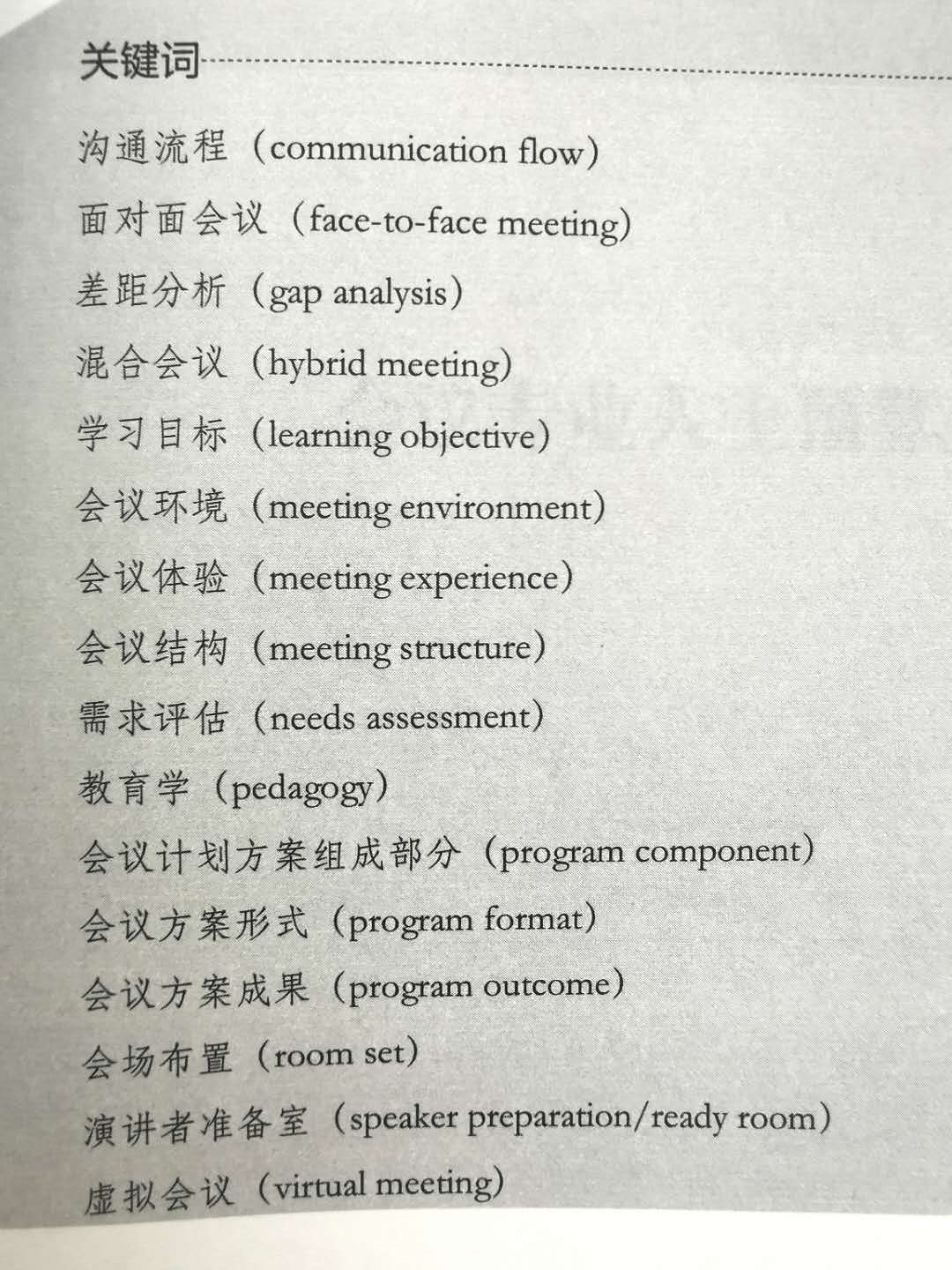
Meeting planning begins with a needs assessment, which creates the foundation upon which all decisions about a meeting are vetted and considered. It is important that this is completed before designing the meeting. This helps to determine gaps or needs of the stakeholders.
A meeting professional will define their needs formally or informally by using the who, what, when, where, and why to understand the meeting’s past and its future.
The elements of a Needs Assessment consists of four elements:
1. The Meeting History
2. The Stakeholder requirements, objectives, and outcomes
3. A Gap Analysis
4. A Target Audience Profile
Part two of the chapter puts a focus on moving from the needs assessment to action which strategically aligns with the organization. This alignment aids in meeting the organizations goals and objectives. In addition to meeting the goals and objectives, strategic thinking aims to ensure optimal communication within the meeting. This form of thinking supports the organizations reputation, brand, and mission.
The reason or purpose for holding a meeting is usually to have time to gather on official business. Learning objectives and program outcomes help to meet the specific goals of that business and to determine an outline for that meeting. A learning objective is intended attendee actions, and the program outcome should result in the attendees learning and their subsequent action.
It is necessary at this stage to build a bridge between the objectives and the outcomes of the meeting. This is done in the form of a Gap Analysis. This form of analysis will identify current levels of knowledge, skills, and/or attitudes, and determine the effectiveness of objectives as it relates to a specific level of learning.
Many meeting professionals are responsible for writing objectives for their conclave and these objectives must be directly related to a level of specific learning. There are models that exist to guide the important exercise of writing objectives. The two models used for this chapter are, “SMART-TER Objectives” and the “A-B-C-D Model”.
The SMART-TER Objective model (an acronym) that is used is done to write objectives that document clearly what will be achieved through a meeting. The acronym spelled out stands for the following:
“S” - Specific Answers who, what, and when. The objective must be specific in reference.
“M” – Measurable and MeaningfulThe objective can be counted or labeled, and the effort is pertinent to the stakeholder.
“A” – Achievable, yet challengingPersonnel can attain this objective, though it may require significant effort to do so.
“R” – RelevantKey stakeholders see value in achieving this objective.
“T” – TimelyThe time frame for achieving this objective is clearly defined.
“T” – Tied TogetherThese objectives are obviously connected to the goals and clearly lead to activities that personnel or volunteers will be expected to accomplish.
“E” – Economical and EfficientThis objective is cost effective, and the effort it requires is within the scope of what personnel or volunteers expect to do.
“R” – Reported and RecognizedThis objective is reported in terms of how it was or was not accomplished, and the information in that report has been recognized sufficiently to drive business decisions.
The A-B-C-D Model is preferred by meeting professionals when writing learning objectives. Each letter represents a step towards writing these objectives.
“A” is for audience – Who are the learners?
“B” is for behavior – What should participants be able to do?
“C” is for conditions – How will learners demonstrate mastery? Under what conditions should the acquired knowledge or behavior be demonstrated?
“D” is for degree of mastery needed – How much will be accomplished? What level of mastery should learners achieve for the objective?
When writing learner objectives it is important to use active verbs where behaviors can be observed and measured. Here is a list of those type of active verbs that encourage observable behaviors.
1. Solve
2. Develop
3. Present
4. Apply
5. Write
6. Publish
7. Analyze
8. Calculate
9. Create
10. Evaluate
11. Reconcile
12. Demonstrate
The meeting environment is the space where people gather and is essentially defining the meeting experience. The meeting participant response to the space consists of three aspects: physical, physiological, and psychological.
The physical environment is routinely altered for meetings and it should be noted that 75% of learning is about motivation, meaningful learning, and memory.
While the remaining 25% is dependent on the effects of the physical environment.
The facility equipment can be used to create and prepare the environment and meeting professionals will determine the size of the space needed for each meeting or event. A review of the facility inventory assists in preparing the room set-ups.
Examples of venue furniture inventory include:
1. Tables – Rectangular, round, cabaret, serpentine
2. Chairs – Banquet style with a seat base of 17.5 to 18.5 inches, table chairs (style of chair found in lecture halls and ergonomic chairs found in most conference centers
3. Podiums, lecterns, and/or head tables – give aid in the style of meeting room configurations based presentations and communication flow, be it seminars, workshops, board meetings, etc.
The communication flow describes the way content or information moves between the speaker and audience, and room sets are directly linked to that flow. There is one-way communication, where the speaker presents to the audience. Two-way communication occurs when the speaker and the audience communicate with each other, and finally multi-faceted communication occurs when the speaker and audience are communicating between speaker, audience, and participants. More and more meetings design two-way or multi-faceted communication into their conclaves.
An overview of room sets requires that the audience perception be taken into account. This would include their ability to see and hear the speaker. Understand the tone of the meeting, be it formal or informal. Determine the level of involvement of the audience, recognize basic group dynamics, and identify what would be the relationship of the audience to the speaker. Room sets will affect the audience perceptions and will either captivate, engage, and bring about effective communications.
The physiological environment of a meeting essentially is the mandate of a comfortable meeting room. It requires physical comfort, food, water, room temperature, etc. These need to be adequately met.
We then move into the food and beverage needs of the participant of the meeting. This is an important physiological requirement. Meeting professional design menus and plan food and beverage functions to maintain good energy levels that impact thinking and retention of information.
An attendees comfort at a meeting has a direct effect on concentration and learning. There is a temperature comfort zone for a meeting attendee in a meeting room. A clothed person in winter is the most comfortable between 68 – 75.2 degrees (F)(20-24摄氏度), and a clothed person in summer prefer the room temperature of 73.4 – 78.8 degrees (F)(23-26摄氏度). A’s perception of comfort is affected by room temperature, air movement, humidity, clothing, and other factors.
The meeting design decisions affect the meeting experience. These design decisions include logistics and other basic design decisions that set the stage for the meeting. Other critical design decisions include: meeting modality, meeting structure, program components, formats, content, sequencing and pacing, and engaging the audience.
Selection of the speakers will influence the entire meeting experience as well attendance. Finding a speaker takes time and energy. The meeting professional recognizes that a speaker provides critical content and are the conduit for gaining new knowledge, skills, and awareness.
Speakers can be found through speaker’s bureaus and speaker showcases. Viewing a potential speaker in a live presentation firsthand is an ideal way to determine the feasibility of extending an invitation to present at a meeting. Extending an invitation can be done through a call for presentations or a call for proposals.
Speaker management and speaker guidelines are done through contracts that set expectations of that speaker. Guidelines for a speaker include: Title of presentation, organization’s history and mission, the language, level of formality at the meeting, audience profile, meeting purpose, goals, and objectives, room set-up, audiovisual requirements, timing of elements from needed from the speaker, expectation for speaker arrival and departure, any other services, e.g., book signing, limitation on selling products, introduction script, and special accommodations.

