
目录

  • 1 跨文化阅读U1 Advertising
    • 1.1 Note on the Topic
    • 1.2 Before You Read
    • 1.3 Reading
    • 1.4 Intercultural Notes
  • 2 跨文化阅读U2  Schooldays
    • 2.1 Note On The Topic
    • 2.2 Before You Read
    • 2.3 Reading
  • 3 跨文化阅读U3  A Tale of the Unexpected
    • 3.1 Note On The Topic
    • 3.2 Before You Read
    • 3.3 Reading
    • 3.4 Further Information
  • 4 跨文化阅读U4  Personal Space
    • 4.1 Note On The Topic
    • 4.2 Before You Read
    • 4.3 Reading
    • 4.4 Intercultural Notes
    • 4.5 Further Information
  • 5 跨文化阅读U5  Physical Disabilities
    • 5.1 Note On The Topic
    • 5.2 Before You Read
    • 5.3 Reading
    • 5.4 Further Information
  • 6 跨文化阅读U6  Western Knowledge  of Chinese Science
    • 6.1 Note on the Topic
    • 6.2 Before You Read
    • 6.3 Reading
    • 6.4 Further Information
  • 7 跨文化阅读U7 Mastering a New Language
    • 7.1 Note On The Topic
    • 7.2 Before You Read
    • 7.3 Reading
    • 7.4 Further Information
  • 8 跨文化阅读U8  Good Teachers; Good Students
    • 8.1 Note On The Topic
    • 8.2 Before You Read
    • 8.3 Reading
    • 8.4 Intercultural Notes
    • 8.5 Further Information
  • 9 跨文化阅读U9  Eyeless Sight
    • 9.1 Note On The Topic
    • 9.2 Before You Read
    • 9.3 Reading
    • 9.4 Further Information
  • 10 跨文化阅读U10  Superstitions
    • 10.1 Note On The Topic
    • 10.2 Before You Read
    • 10.3 Reading
    • 10.4 Further Information
  • 11 跨文化阅读U11  An English New Town
    • 11.1 Note On The Topic
    • 11.2 Before You Read
    • 11.3 Reading
    • 11.4 Further Information
  • 12 跨文化阅读U12  Bridging China and the West
    • 12.1 Note On The Topic
    • 12.2 Before You Read
    • 12.3 Reading
    • 12.4 Further Information
  • 13 跨文化阅读U13  Gestures
    • 13.1 Note On The Topic
    • 13.2 Before You Read
    • 13.3 Reading
    • 13.4 Intercultural Notes
  • 14 跨文化阅读U14  Romantic Fiction
    • 14.1 Note On The Topic
    • 14.2 Before You Read
    • 14.3 Reading
    • 14.4 Further Information
  • 15 跨文化阅读U15  Re-engineering the Music Business
    • 15.1 Note On The Topic
    • 15.2 Before You Read
    • 15.3 Reading
    • 15.4 Further Information
  • 16 跨文化阅读U16  Application Letters
    • 16.1 Note On The Topic
    • 16.2 Before You Read
    • 16.3 Reading
    • 16.4 Intercultural Notes
  • 17 视听说U1 College culture
    • 17.1 Part I Before Listening
    • 17.2 Part II While Listening
    • 17.3 Part III After Listening
    • 17.4 Conversation 1-Video
    • 17.5 Conversation 1-Transcript
    • 17.6 Conversation 2-Video
    • 17.7 Conversation 2- Transcript
    • 17.8 Outside View (Video)
    • 17.9 Outside view Transcript
    • 17.10 Listening In 1- (Audio)
    • 17.11 Listening In 1-Transcript
    • 17.12 Listening In 2 -(Audio)
    • 17.13 Listening In 2 -Transcript
    • 17.14 Listening In 3- (Audio)
    • 17.15 Listening In 3 Transcript
  • 18 视听说U2 Mixed feelings
    • 18.1 Part I Before Listening
    • 18.2 Part II While Listening
    • 18.3 Part III After Listening
    • 18.4 Conversation1-Video
    • 18.5 Conversation 1 Transcript
    • 18.6 Conversation 2-Video
    • 18.7 Conversation 2 Transcript
    • 18.8 Outside View (Video)
    • 18.9 Outside View (Script)
    • 18.10 Listening In 1 -(Audio)
    • 18.11 Listening In 1-transcript
    • 18.12 Listening In 2 -(Audio)
    • 18.13 Listening In 2 -transcript
    • 18.14 Listening In 3 -(Audio)
    • 18.15 Listening In 3 -transcript
  • 19 视听说U3 Sporting life
    • 19.1 Part I  Before Listening
    • 19.2 Part II While Listening
    • 19.3 Part III After Listening
    • 19.4 Conversation1-Video
    • 19.5 Conversation 1 - Transcript
    • 19.6 Conversation 2 -Video
    • 19.7 Conversation 2- Transcript
    • 19.8 Outside view (Video)
    • 19.9 Outside view (Script)
    • 19.10 Listening In 1- (Audio)
    • 19.11 Listening In 1-transcript
    • 19.12 Listening In 2 -(Audio)
    • 19.13 Listening In 2- transcript
    • 19.14 Listening In 3 -(Audio)
    • 19.15 Listening In 3- transcript
  • 20 视听说U4 Crime watch
    • 20.1 Part I  Before Listening
    • 20.2 Part II While Listening
    • 20.3 Part III After Listening
    • 20.4 Conversation1-Video
    • 20.5 Conversation 1-  Transcript
    • 20.6 Conversation 2- Video
    • 20.7 Conversation 2 -Transcript
    • 20.8 Outside View (Video)
    • 20.9 Outside View (Script)
    • 20.10 Listening In 1- (Audio)
    • 20.11 Listening In 1-transcript
    • 20.12 Listening In 2- (Audio)
    • 20.13 Listening In 2- transcript
    • 20.14 Listening In 3- (Audio)
    • 20.15 Listening In 3 -transcript
  • 21 视听说U5 Time off
    • 21.1 Part I  Before Listening
    • 21.2 Part II While Listening
    • 21.3 Part III After Listening
    • 21.4 Inside View 1- (Video)
    • 21.5 Inside View (Script)
    • 21.6 Inside View 2- (Video)
    • 21.7 Inside View  2-(Script)
    • 21.8 Outside View (Video)
    • 21.9 Outside View (Script)
    • 21.10 Listening In 1-(Audio)
    • 21.11 Listening In (Script)
    • 21.12 Listening In 2-(Audio)
    • 21.13 Listening In 2- (Script)
    • 21.14 Listening In 3-(Audio)
    • 21.15 Listening In 3- (Script)
  • 22 视听说U6 The secret life of science
    • 22.1 Part I  Before Listening
    • 22.2 Part II While Listening
    • 22.3 Part III After Listening
    • 22.4 Inside View 1-(Video)
    • 22.5 Inside View (Script)
    • 22.6 Inside View 2-(Video)
    • 22.7 Inside View  2-(Script)
    • 22.8 Outside View (Video)
    • 22.9 Outside View (Script)
    • 22.10 Listening In 1- (Audio)
    • 22.11 Listening In (Script)
    • 22.12 Listening In 2- (Audio)
    • 22.13 Listening In 2- (Script)
    • 22.14 Listening In 3- (Audio)
    • 22.15 Listening In 3- (Script)
  • 23 视听说U7 The world at war
    • 23.1 Part I  Before Listening
    • 23.2 Part II While Listening
    • 23.3 Part III After Listening
    • 23.4 Inside View 1-(Video)
    • 23.5 Inside View 1-(Script)
    • 23.6 Inside View 2-(Video)
    • 23.7 Inside View 2-(Script)
    • 23.8 Outside View (Video)
    • 23.9 Outside View (Script)
    • 23.10 Listening In 1- (Audio)
    • 23.11 Listening In 1-(Script)
    • 23.12 Listening In 2- (Audio)
    • 23.13 Listening In 2-(Script)
    • 23.14 Listening In 3- (Audio)
    • 23.15 Listening In 3-(Script)
  • 24 视听说U8 Have you got what it takes?
    • 24.1 Part I  Before Listening
    • 24.2 Part II While Listening
    • 24.3 Part III After Listening
    • 24.4 Inside View 1-(Video)
    • 24.5 Inside View 1-(Script)
    • 24.6 Inside View 2-(Video)
    • 24.7 Inside View2- (Script)
    • 24.8 Outside View (Video)
    • 24.9 Outside View (Script)
    • 24.10 Listening In 1- (Audio)
    • 24.11 Listening In 1- (Script)
    • 24.12 Listening In 2- (Audio)
    • 24.13 Listening In 2- (Script)
    • 24.14 Listening In 3- (Audio)
    • 24.15 Listening In (Script)
Listening In (Script)

Listening In

Passage 2

Harry: So how was your first day of teaching, Lucy?

Lucy: It was all right – wasn’t as terrifying as I thought it would be.

Harry: Well done!

Lucy: Yes, I was frightened I’d go completely blank but it was OK. I think the students were happy. It’s the grammar I find difficult, there’s so much to cover.

Jessica: It’s extraordinary, isn’t it? We speak English, we think we know the grammar and then we do a teaching English course and discover we don’t know anything.

Lucy: How long have you been teaching, Jessica?

Jessica: Just over two years. I did the training course and then got a job teaching in Japan – Tokyo. It was an eye-opener[使人大开眼界的事物] really – the whole thing about keeping face [维护面子, 泰然处之]. You have to be so polite all the time.

Patrick: So you’re teaching English because you want to travel?

Jessica: Yes, that’s part of it, but also because I enjoy it, I enjoy the interaction with students, and also it’s a good career.

Patrick: I feel the same. So what do you want to do next?

Jessica: Marketing, I think. I’m going to do a year here, then – I hope – get a job at a language school in London, do my MA[Master's Degree,文科硕士学位], then apply for a marketing job. Anyway, that’s the plan.

Patrick: Sounds good.

Harry: What about you, Patrick? Where have you worked?

Patrick: I did three years in Italy – Director of Studies in Rome. I want to spend a couple of years here, then work in London, hopefully become a teacher trainer. Your turn, Harry.

Harry: Well, I’m not like you and Jessica. I’m just happy to be here, in a beautiful city doing a job I enjoy.

Jessica: You don’t see teaching English as a career?

Harry: Well, my thing is travel, for the moment anyway.

Lucy: Which countries have you been to, Harry?

Harry: I did a year’s teaching in Brazil – Rio de Janeiro[里约热内卢(巴西城市)] – such a stunning city and stunning beaches, Copacabana[科帕卡巴纳海滩], and all overlooked by Sugar Loaf mountain[休格洛夫山].

Patrick: Cool. And then?

Harry: Two years in Mexico City ...

Jessica: You should be a travel writer.

Harry: I’m too busy travelling! In fact I just arrived from Spain three days ago, from Barcelona[巴塞罗纳(西班牙城市)], I was teaching primary school kids.

Lucy: Great!

Harry: Well, we’re all giving our reasons for teaching English, so what’s yours, Lucy?

Lucy: Um – I think I’m going to really enjoy it, simple as that. And obviously it’s great to be in Italy. I mean Venice[威尼斯(意大利城市)], what more can you ask?


Answers: 

Passage 2

5. Example Answers:

1   In the major economies where there is a demand for English, for example, China, Japan, Saudi Arabia, European countries and so on.
2   It allows them to travel and make contact with local people.
3   Classroom teaching, producing learning materials, teacher training etc.

6. Answers:
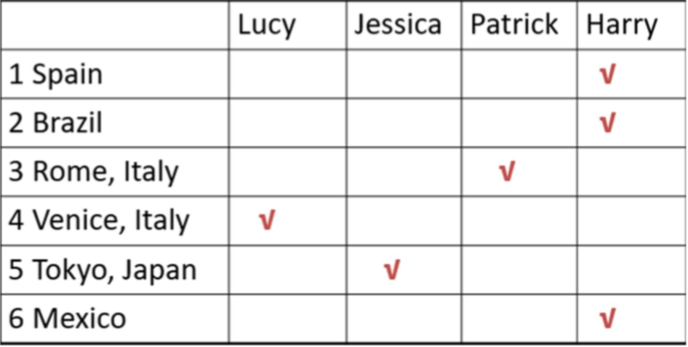
7. Answers:

1   Lucy: enjoys teaching

2   Jessica: enjoys travelling, enjoys teaching and wants a career 

3   Patrick: enjoys travelling, enjoys teaching and wants a career 

4   Harry: enjoys travelling

8. Answers:

1(a)     2(d)     3(c)     4(a)

9. Example Answers:

1 • Yes, they all sound enthusiastic and talk about beautiful places they have lived in (but, of course, not every school or city is desirable).
   • On the surface they make it sound attractive, but actually they are only doing the job on a temporary basis so that they can make money while they travel. They do not really see teaching English as a career, and they plan to work in other fields later. So it can’t really be that attractive, can it? Otherwise they’d want to remain teachers!

2  Yes, I can think of a couple. If you just need a computer to do your work, like a freelance writer, editor or computer programmer, then you can work anywhere in the world. There are some salespeople who always work over the phone, so perhaps they could too. Many people must travel for work, such as tour guides, airline and ship crews, and aid workers.

3  Teachers need to be organized, clearly spoken, patient, reliable and calm so as to hold orderly and unthreatening classes in which students can ask questions and make steady progress.