
目录

  • 1 跨文化阅读U1 Advertising
    • 1.1 Note on the Topic
    • 1.2 Before You Read
    • 1.3 Reading
    • 1.4 Intercultural Notes
  • 2 跨文化阅读U2  Schooldays
    • 2.1 Note On The Topic
    • 2.2 Before You Read
    • 2.3 Reading
  • 3 跨文化阅读U3  A Tale of the Unexpected
    • 3.1 Note On The Topic
    • 3.2 Before You Read
    • 3.3 Reading
    • 3.4 Further Information
  • 4 跨文化阅读U4  Personal Space
    • 4.1 Note On The Topic
    • 4.2 Before You Read
    • 4.3 Reading
    • 4.4 Intercultural Notes
    • 4.5 Further Information
  • 5 跨文化阅读U5  Physical Disabilities
    • 5.1 Note On The Topic
    • 5.2 Before You Read
    • 5.3 Reading
    • 5.4 Further Information
  • 6 跨文化阅读U6  Western Knowledge  of Chinese Science
    • 6.1 Note on the Topic
    • 6.2 Before You Read
    • 6.3 Reading
    • 6.4 Further Information
  • 7 跨文化阅读U7 Mastering a New Language
    • 7.1 Note On The Topic
    • 7.2 Before You Read
    • 7.3 Reading
    • 7.4 Further Information
  • 8 跨文化阅读U8  Good Teachers; Good Students
    • 8.1 Note On The Topic
    • 8.2 Before You Read
    • 8.3 Reading
    • 8.4 Intercultural Notes
    • 8.5 Further Information
  • 9 跨文化阅读U9  Eyeless Sight
    • 9.1 Note On The Topic
    • 9.2 Before You Read
    • 9.3 Reading
    • 9.4 Further Information
  • 10 跨文化阅读U10  Superstitions
    • 10.1 Note On The Topic
    • 10.2 Before You Read
    • 10.3 Reading
    • 10.4 Further Information
  • 11 跨文化阅读U11  An English New Town
    • 11.1 Note On The Topic
    • 11.2 Before You Read
    • 11.3 Reading
    • 11.4 Further Information
  • 12 跨文化阅读U12  Bridging China and the West
    • 12.1 Note On The Topic
    • 12.2 Before You Read
    • 12.3 Reading
    • 12.4 Further Information
  • 13 跨文化阅读U13  Gestures
    • 13.1 Note On The Topic
    • 13.2 Before You Read
    • 13.3 Reading
    • 13.4 Intercultural Notes
  • 14 跨文化阅读U14  Romantic Fiction
    • 14.1 Note On The Topic
    • 14.2 Before You Read
    • 14.3 Reading
    • 14.4 Further Information
  • 15 跨文化阅读U15  Re-engineering the Music Business
    • 15.1 Note On The Topic
    • 15.2 Before You Read
    • 15.3 Reading
    • 15.4 Further Information
  • 16 跨文化阅读U16  Application Letters
    • 16.1 Note On The Topic
    • 16.2 Before You Read
    • 16.3 Reading
    • 16.4 Intercultural Notes
  • 17 视听说U1 College culture
    • 17.1 Part I Before Listening
    • 17.2 Part II While Listening
    • 17.3 Part III After Listening
    • 17.4 Conversation 1-Video
    • 17.5 Conversation 1-Transcript
    • 17.6 Conversation 2-Video
    • 17.7 Conversation 2- Transcript
    • 17.8 Outside View (Video)
    • 17.9 Outside view Transcript
    • 17.10 Listening In 1- (Audio)
    • 17.11 Listening In 1-Transcript
    • 17.12 Listening In 2 -(Audio)
    • 17.13 Listening In 2 -Transcript
    • 17.14 Listening In 3- (Audio)
    • 17.15 Listening In 3 Transcript
  • 18 视听说U2 Mixed feelings
    • 18.1 Part I Before Listening
    • 18.2 Part II While Listening
    • 18.3 Part III After Listening
    • 18.4 Conversation1-Video
    • 18.5 Conversation 1 Transcript
    • 18.6 Conversation 2-Video
    • 18.7 Conversation 2 Transcript
    • 18.8 Outside View (Video)
    • 18.9 Outside View (Script)
    • 18.10 Listening In 1 -(Audio)
    • 18.11 Listening In 1-transcript
    • 18.12 Listening In 2 -(Audio)
    • 18.13 Listening In 2 -transcript
    • 18.14 Listening In 3 -(Audio)
    • 18.15 Listening In 3 -transcript
  • 19 视听说U3 Sporting life
    • 19.1 Part I  Before Listening
    • 19.2 Part II While Listening
    • 19.3 Part III After Listening
    • 19.4 Conversation1-Video
    • 19.5 Conversation 1 - Transcript
    • 19.6 Conversation 2 -Video
    • 19.7 Conversation 2- Transcript
    • 19.8 Outside view (Video)
    • 19.9 Outside view (Script)
    • 19.10 Listening In 1- (Audio)
    • 19.11 Listening In 1-transcript
    • 19.12 Listening In 2 -(Audio)
    • 19.13 Listening In 2- transcript
    • 19.14 Listening In 3 -(Audio)
    • 19.15 Listening In 3- transcript
  • 20 视听说U4 Crime watch
    • 20.1 Part I  Before Listening
    • 20.2 Part II While Listening
    • 20.3 Part III After Listening
    • 20.4 Conversation1-Video
    • 20.5 Conversation 1-  Transcript
    • 20.6 Conversation 2- Video
    • 20.7 Conversation 2 -Transcript
    • 20.8 Outside View (Video)
    • 20.9 Outside View (Script)
    • 20.10 Listening In 1- (Audio)
    • 20.11 Listening In 1-transcript
    • 20.12 Listening In 2- (Audio)
    • 20.13 Listening In 2- transcript
    • 20.14 Listening In 3- (Audio)
    • 20.15 Listening In 3 -transcript
  • 21 视听说U5 Time off
    • 21.1 Part I  Before Listening
    • 21.2 Part II While Listening
    • 21.3 Part III After Listening
    • 21.4 Inside View 1- (Video)
    • 21.5 Inside View (Script)
    • 21.6 Inside View 2- (Video)
    • 21.7 Inside View  2-(Script)
    • 21.8 Outside View (Video)
    • 21.9 Outside View (Script)
    • 21.10 Listening In 1-(Audio)
    • 21.11 Listening In (Script)
    • 21.12 Listening In 2-(Audio)
    • 21.13 Listening In 2- (Script)
    • 21.14 Listening In 3-(Audio)
    • 21.15 Listening In 3- (Script)
  • 22 视听说U6 The secret life of science
    • 22.1 Part I  Before Listening
    • 22.2 Part II While Listening
    • 22.3 Part III After Listening
    • 22.4 Inside View 1-(Video)
    • 22.5 Inside View (Script)
    • 22.6 Inside View 2-(Video)
    • 22.7 Inside View  2-(Script)
    • 22.8 Outside View (Video)
    • 22.9 Outside View (Script)
    • 22.10 Listening In 1- (Audio)
    • 22.11 Listening In (Script)
    • 22.12 Listening In 2- (Audio)
    • 22.13 Listening In 2- (Script)
    • 22.14 Listening In 3- (Audio)
    • 22.15 Listening In 3- (Script)
  • 23 视听说U7 The world at war
    • 23.1 Part I  Before Listening
    • 23.2 Part II While Listening
    • 23.3 Part III After Listening
    • 23.4 Inside View 1-(Video)
    • 23.5 Inside View 1-(Script)
    • 23.6 Inside View 2-(Video)
    • 23.7 Inside View 2-(Script)
    • 23.8 Outside View (Video)
    • 23.9 Outside View (Script)
    • 23.10 Listening In 1- (Audio)
    • 23.11 Listening In 1-(Script)
    • 23.12 Listening In 2- (Audio)
    • 23.13 Listening In 2-(Script)
    • 23.14 Listening In 3- (Audio)
    • 23.15 Listening In 3-(Script)
  • 24 视听说U8 Have you got what it takes?
    • 24.1 Part I  Before Listening
    • 24.2 Part II While Listening
    • 24.3 Part III After Listening
    • 24.4 Inside View 1-(Video)
    • 24.5 Inside View 1-(Script)
    • 24.6 Inside View 2-(Video)
    • 24.7 Inside View2- (Script)
    • 24.8 Outside View (Video)
    • 24.9 Outside View (Script)
    • 24.10 Listening In 1- (Audio)
    • 24.11 Listening In 1- (Script)
    • 24.12 Listening In 2- (Audio)
    • 24.13 Listening In 2- (Script)
    • 24.14 Listening In 3- (Audio)
    • 24.15 Listening In (Script)
Inside View2- (Script)


Conversation 2

Kate: You Know that job placement I told you about – they’ve asked me to go for an interview. 

Janet: That’s brilliant. When? 

Kate: Two weeks’ time.

 ... 

Interviewer: So what made you decide to study law, Kate? 

Kate: A number of reasons. Law interests me a lot. I’ve got a good brain, a good memory. And I’d certainly like to do some part-time work for Legal Aid. And also, I must admit, the money’s good. 

Interviewer: Well, those are good, honest answers. Certainly, your CV’s very good. I seem to remember that you only want the work placement for six weeks. Is that right? 

Kate: Yes, it is.

Interviewer: Why is that? 

Kate: Well, to be honest, I’m planning to go back to the States and spend time with my family. 

Interviewer: Ah, that’s understandable. Now, tell me, what questions do you have? 

Kate: I’ve got some idea but obviously, what I’d like to know is, what does the job involve? 

Interviewer: Of course. Well, for the first few weeks, your main responsibility would be to read files and summarize them. We’d also want you to do some research for us. How does that sound? Rather boring? 

Kate: No, not at all. I think I’d learn a lot. 

Interviewer: Good, well ... you’ll be taking your first year exams soon, won’t you? 

Kate: Yes, in a few weeks’ time.

Interviewer: Well, provided [假如,表示前提条件,类if, supposing] they’re OK, I think we can say you’re in. 

Kate: Thank you – that’s wonderful!

Kate: Hey, guess what? 

Janet: What?

Kate: They’ve accepted me. I start at the end of June.

Janet: Well done!


Answers: 

Conversation 2

3. Example Answers:

1 Why are you interested in law? What qualities do you have that will make you a good law intern?
2 Four to six weeks.
3 She wants to go travelling in Europe.

4 What sort of work will I be asked to do? 5 Yes.


4. Example Notes:
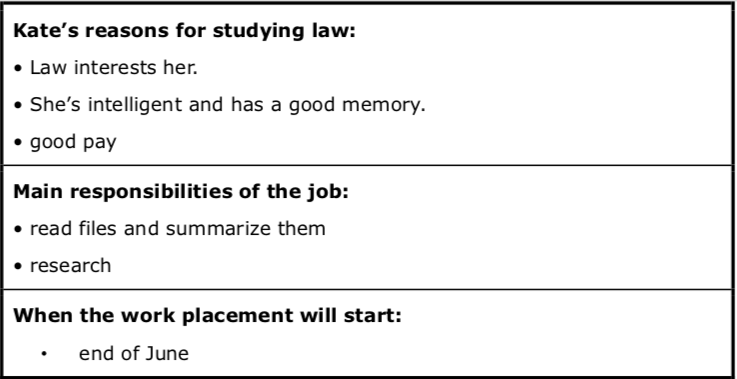
Answers:

  • Kate is attracted to law for three reasons: It is interesting; she has a good memory and is mentally suited to it; and the pay is good.

  • The main responsibilities of the internship will be reading and summarizing files, and conducting some legal research.

  • The work placement will start at the end of June.


5. Answers:

  1. (1)  go for an interview

  2. (2)  interests me a lot

  3. (3)  the money’s good

  4. (4)  work placement

  5. (5)  spend time with my family

  6. (6)  what does the job involve

  7. (7)  read files and summarize them

  8. (8)  learn a lot

  9. (9)  provided they’re OK

  10. (10)  accepted me


6. Answers:

1(b)     2(b)     3(a)     4(b)     5(a)

7. Example Answer:

Student A    Have you decided what you want to do after college?

Student B    Not really. I might go into software design, or maybe sell computers. There’s also a possibility of working in online advertising. 

Student A    Which would you enjoy the most?

Student B    I think advertising would be very interesting. I like being creative, and have lots of ideas for interactive ads.

Student A    You won a prize for web page design, didn’t you?

Student B    Yes, using Flash software. Anyway, what about you? Any plans? 

Student A    Yes, I really think one has to plan ahead, so I decided long ago to go into finance in the banking sector. I have been taking the necessary courses and exams and even making some contacts.

Student B    Wow, you are organized! I hope your dream comes true. 

Student A    You know, there’s a careers fair on at the City Hall. Let’s go and have a look around and see what there is about computing and advertising. It might help you reach a decision.

Student B    Thanks. That’s a very good idea!