-
1 Reading
-
2 Translation

In any crowded city in the world, one of the most important concerns in life is space. Space is very valuable. It is, therefore, often one of the most expensive items to buy. The most costly offices in the world can be found in cities such as Beijing, London, Hong Kong, New York, etc. But it isn’t only businesses that are constantly concerned about space. In less heavily populated areas, people will ask you “How many rooms does your home have?” In cities, the first question anyone will ask you about your home is, “How many square metres is it?” So, how does this affect the people who live in an environment where space is so valuable? How do people manage to cope on an individual basis with this shortage of space?
Everybody needs their own personal space — an area they regard as their own and in which they feel safe, relaxed and comfortable. There have been many experiments carried out to try and discover how people create and protect this personal space. An example of this can be seen in any public waiting area. When somebody goes into a waiting room in, for example, a doctor’s or a dentist’s surgery, it is possible to predict quite accurately where the next person to enter is most likely to sit. He/She will try to avoid sitting next to the first person, he/she will also avoid sitting at the opposite end of the room, as far away as possible from the first person. He/She is most likely to sit about halfway between these two points. The next person who comes into the room will take the largest space that remains, and sit approximately in the middle of that. This continues until eventually somebody enters the room and is forced to sit right next to somebody already there — but if possible he/she will place a bag between him/herself and the person nearest to him/her. This pattern can be seen in any similar situation, such as in a bus or train, a lecture theatre or cinema and so on.
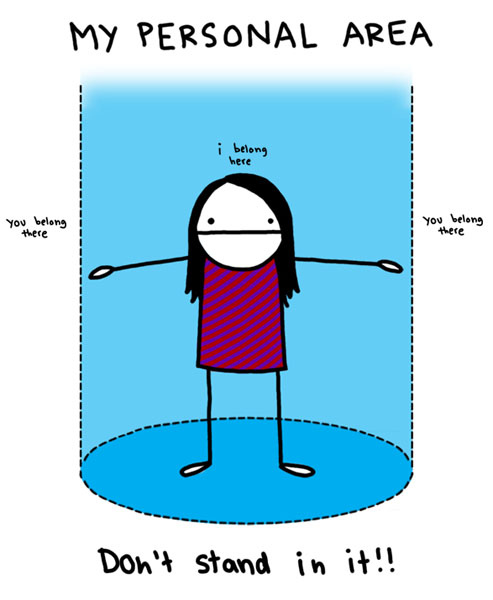
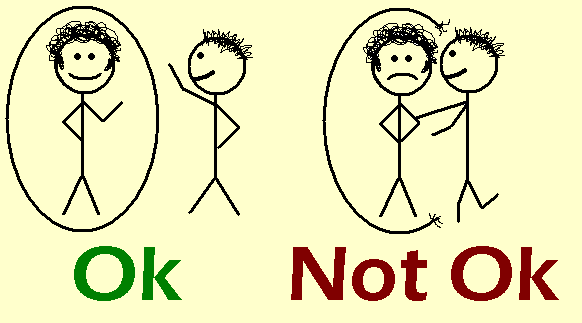
The kind of behaviour described above illustrates the idea that we have a kind of personal space that moves with us, wherever we go. If people move inside this space, we feel rather nervous and threatened. If they keep too far away, we feel a little insulted. If our environment becomes too crowded, we are forced to allow our personal space to become smaller and we also change our behaviour slightly to allow for this smaller personal space.
When we are crushed in a crowded lift, a rush-hour compartment of the subway, or a crowd at a sports event, we are forced to give up our personal space completely and accept other people touching us. What we tend to do in these situations is to pretend the other people don’t really exist. We very deliberately ignore them — and, in the same way, they ignore us. Imagine you have entered a packed lift; what do you do? You will probably try not to face anybody else in the lift — everybody faces the door. You will not look at anybody else in the lift — people usually study the panel that indicates the floor number. You may, perhaps, look at the ceiling or down at the floor. You will probably keep your face as expressionless as possible and will try not to move at all. You might even clasp your hands in front of you, or hold your bag in front of you, to “protect” yourself against the people around you.
People who have to spend most of their time in a crowded environment gradually become more used to having a smaller personal space, but no one can ever live without this space at all. Interestingly, different societies have different ideas about exactly how large a personal space is required. You can easily test your own personal space by standing up and talking to someone. Reach out with your arm and see where on your arm the nearest point on his/her body comes. If you are from a country in Western Europe, you will very likely find that your fingertips are touching his/her body. If you come from an Eastern European country, there is a good chance that he/she will be next to your wrist. If you are from the Mediterranean area, it is common for people to stand much closer and so you may find that he/she is next to your elbow. This need for different personal spaces can obviously cause problems when people from different societies are speaking to each other. Without really knowing they are doing it, one person will back away from the other, who will then move forward. Each person is trying to keep the space between them at the distance he or she feels most comfortable with. Each time one person moves forward, the other feels uncomfortable and so backs away; each time the second person backs away, the other feels uncomfortable and so advances. The couple move slowly across the room until one can move no further as their back is against the wall. At this point they will try to break off the conversation and “escape.”
Problems of personal space do not only exist when people are talking to each other. Similar problems exist when people have to share a working environment. When other people are close to us, we find it difficult to concentrate. Students often find this a problem when they have to share a study area. They solve it by using a variety of techniques or strategies to shut themselves off from the people nearby. They build small physical barriers like a pile of books or their bags or a single book stood up on end. Another method is to rest their elbows on the table and sit with their hands screening their eyes from the people on either side. In this way, they can pretend they are alone or at least a comfortable distance from the other people present.
Another method of telling other people that space belongs to you is to use personal markers. Books, papers and other personal belongings are scattered around the site to make it seem more private to others. Students often have small, personal items such as a toy or doll, which they place at the edge of their territory (usually the edge of the desk). You are basically telling other people that the area is yours and that they should stay away. Spreading out your belongings is also a well-known trick on public transport, where a passenger is trying to give the impression that the seats next to him are taken.
In these ways, and many others, we try to indicate to others the personal space we require. We are trying to help other people avoid making us feel threatened or uncomfortable without having to physically push them away. If these signs are ignored, or misunderstood, we sometimes resort to physical methods of protecting our space. Therefore, it is obvious that in any area of dense population and limited space, people must work harder to understand and respect the signals given out by others. Everybody does need his or her personal space, but to gain it at the expense of another’s space is sure to result in conflict.

