Text 5 Bridge Introduction
A bridge is a structure providing passage over an obstacle such as a valley, road, railway, canal, river, without closing the way beneath. The required passage may be for road, railway, cannel, pipeline, cycle track or pedestrians. The branch of civil engineering which deals with the design, planning construction and maintenance of bridge is known as bridge engineering. 1 Components of a bridge Figure 14-1a) shows the elevation while Fig. 14-1b) presents the plan of a bridge. Broadly, a bridge can be divided into two major parts: superstructure and substructure. The superstructure of a bridge is analogous to a single storey building roof and substructure to that of the walls, columns and foundations supporting it.
|
passage 通道; obstacle 障碍; closing 封闭; cycle track 自行车道; pedestrian 徒步的,行人; elevation 高程、海拔,正视图; superstructure 上部结构; substructure 下部结构; be analogous to 类似; storey 层; foundation 基础; |

Superstructure consists of structural members carrying a communication route. Thus handrails, guardstones and flooring supported by any structural system, such as beams, girders, arches and cables, above the level of bearings form the superstructure. Substructure is a supporting system for the superstructure. It consists of piers, abutments, wingwalls and foundations for the piers and abutments. The other main parts of a bridge structure are the approaches, bearings and river training works, such as the aprons, and the revetment for slopes at abutments, etc. Some of the important components of a bridge are explained in this section. Piers: These are provided in between the two extreme supports of the bridge (abutments) and in the bed of the river to reduce the span and share the total load coming over the bridge. Piers are provided with foundation which is taken below the bed of the river where hard soil is available. Abutments: The end supports of a bridge superstructure are called abutments. It may be of brick masonry, stone masonry, R.C. or precast concrete block. It serves both as a pier and as a retaining wall. The height of an abutment is equal to that of the piers. The functions of an abutment are the following: (1) To transmit the load from the bridge superstructure to the foundations. (2)To give final formation level to the bridge superstructure. (3) To retain earth work of embankment of the approaches. Wing walls: The walls constructed at both end of the abutments to retain the earth filling of bridge approaches are called wing walls. Normally, the wing walls have steadily decreasing cross section. The design of wing walls is independent. Generally, water face of these walls is kept vertical. Foundations: The lowest artificially built parts of piers, abutments etc. which are in direct contact with the subsoil supporting the structure are called foundations. The factors which affect the selection of foundation include the type of soil, the nature of soil, the type of the bridge, the velocity of water and the superimposed load on the bridge. Well foundation is the most commonly adopted foundation in India. The foundation may consist of a single large diameter well or a group of smaller wells of circular or other shapes. Approaches: These are the lengths of communication route at both ends of the bridge. Approaches may be in embankment or in cutting depending upon the design of the bridge. It is recommended (as per Indian Road Congress) that the approaches must be straight for a minimum length of 16 m on either side of the bridge. Its function is to carry the communication route up to the floor level of the bridge. Hand Rails and Guard Stones: Hand rails are provided on both sides of a bridge to prevent any vehicle from falling into the stream. Footpaths are also provided for pedestrians to walk along without interfering with the heavy vehicular traffic. In order to prevent a vehicle from striking the parapet wall or the hand rails, guard stones painted white are provided along the edge of the footpaths at the ends of the road surface. Guard stones are also provided along both sides of the approach roads in filling to prevent the vehicles from toppling over the sides of the embankments. Bearings for the Girders: The longitudinal girders have to rest over the piers which bears the thrust of the load coming over them. In order that the girder ends should rest on proper seats, the same are provided with bearing blocks made of cement concrete, so that the load may be uniformly distributed over the structure on which they rest. Due to the expansion and contraction of the longitudinal girders during severe heat and cold, rollers are provided on the abutment ends to allow the movements without causing the girder to buckle. 2 Types of bridges 2.1 Arch bridge Arch bridge are often used because of their pleasing appearance. These are more graceful and suited for deep gorges with rocky abutments. Arch bridges can be economically adopted up to a span of 250 m. In this type of bridge, the roadway is constructed on an arch which rests on piers and abutments. An example of an arch bridge is the rainbow bridge across Niagara river over a span of 290m.
rainbow bridge The advantages of an arch bridge are: There will be no bending anywhere in the arch, vibrations due to impact forces are minimum, and pleasing appearance. 2.2 Slab bridge This is the simplest type of R.C. bridge and easiest to construct. Slab bridges are generally found to be economical for span up to 9 m. The thickness of slab is quite considerable but uniform, thereby requiring simple shuttering. Though the amount of concrete and steel required are more, the construction is much simpler and placement of material is easy. 2.3 T-beam and slab bridge This consists of T-beams supported over piers and abutments. The deck slab is supported over the T-beams. This type of bridge is suitable for span between 9-20 m. T-beam bridge is cheaper and requires less quantity of materials. For example, the longest R.C. T-beam bridge in India is the Advai Bridge in Goa with a pier spacing of 35 m. 2.4 Bow string girder bridge Bow string girder bridges are economical when sufficient head room is needed under a bridge. The main components here are resembling the bow and a tie beam resembling the string of the bow. As the major portion of the load will be borne by the beam, the thrust on the abutments from the arch will be limited. Hence, the abutments need not be too heavy. The roadway is actually suspended from the arch rib by means of vertical suspenders as presented in Fig. 14-2. These bridges can be adopted for spans of 30-45 m.
| handrail 护栏; guardstone 护石; beam 梁; girder(大)梁; bearing 支座; pier 桥墩; abutment 桥台、拱座; wingwall 翼墙; approach 引道、引桥; apron 围裙; revetment 锚固、铆钉; support 支承; precast 预制的、预浇筑的; retaining wall 护壁、挡墙;
earth work 土压力;
artificially 人工地、人造地;
velocity 速度; superimpose 把…放在另一物上面,加上; well 井;
up to 直到;
footpath 人行道; interfere 干涉、妨碍;
parapet 护墙、女儿墙; topple over 倒塌、倒下; contraction 收缩、缩短; severe 严肃的、剧烈的; roller 滚筒、辊子; buckle 弯曲;
arch bridge 拱桥; gorge 峡谷;
vibration 振动、颤动、摆动;
slab bridge 板桥; shuttering 模板; T-beam T梁;
deck 甲板、桥面;
bow string girder 系杆拱桥; tie beam 系梁; rib 肋骨、拱肋; suspenders 吊杆; by means of 依靠;
|

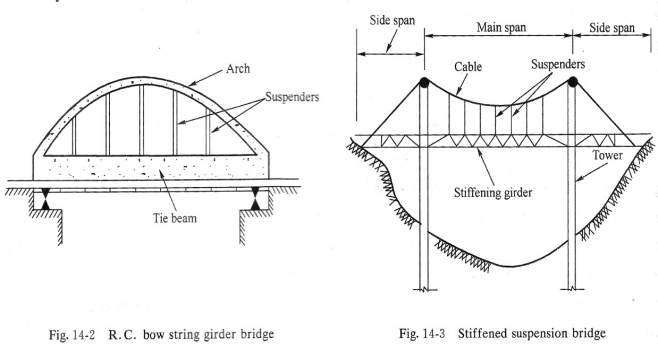
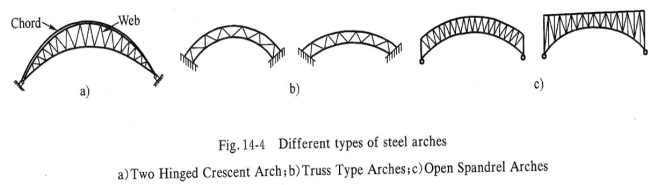
2.5 Suspension bridge Superstructure of a suspension bridge consists of two sets of cables over the towers, carrying the bridge floor by means of suspenders as shown in Fig. 14-3. This bridge is best suited for light traffic for large spans exceeding 600 m. These bridges are flexible and hence the vertical oscillations will be more than the other bridges. The entire load will be borne by the cables which are anchored to the ground. 2.6 The cable-stayed bridge Cable-stayed bridges are constructed along a structural system which comprises an orthotropic deck and continuous girders which are supported by stays, i.e. inclined cables passing over or attached to towers located at the main piers. Modern cable-stayed bridges present a three-dimensional system consisting of stiffening girders, transverse and longitudinal bracing , orthotropic-type deck and supporting parts such as towers in compression and inclined cables in tension, The important characteristics of such a three-dimensional structure is the full participation of the transverse construction in the work of the main longitudinal structure. This means a considerable increase in the moment of inertia of the construction which permits a reduction in the depth of the girders and economy in steel. 2.7 Steel bridges Steel bridges are commonly used for supporting highways, water, oil or gas pipes, a railway track, etc. They can be classified as follows: 2.7.1 Steel Truss bridges Steel truss bridges are provided for long railway bridges, as they are less affected by wind pressure. It is easy to erect steel truss bridges since its component members are relatively light in weight. The primary forces in its members are axial forces. Steel truss bridges which are commonly used are the following. 2.7.2 Steel Rigid Frame Bridge These type of bridges, carry the roadway at the top of the portal frames. No bearing and fixtures are required in such bridges. These bridges have more clearance below them and heavy abutments are not required. 2.7.3 Plate Girder Bridges A plate girder bridge is used to carry heavier loads over longer spans. Hence, they are mainly used for railway bridges. These are used for spans up to 20 m. In order to increase the lateral stability, box girder which consists of four plates connected by angles are used. 2.7.4 Steel Arch Bridges Steel arch bridges are constructed where it is not possible to construct intermediate pier. It can be used for a very long span, i.e. up to 150 m. Steel arches may either be of the spandrel braced or trussed arch type as shown in Fig. 14-4. 2.7.5 Steel Bow String Girder Bridges In steel bow string girder bridges, in order to bear horizontal thrust, a steel tie is provided which joins the two ends of an arch. In these bridges, suspenders are provided from the arch-ribs to carry the roadway.
|
suspension 悬吊、悬浮; oscillation 振动、振幅; anchor 锚固、抛锚,桩;
cable-stayed bridges 斜拉桥; comprise 包含、由…组成; orthotropic 正交的, stay 支柱、支撑物; stiffen 硬化、加强; transverse 横向,横切的; bracing 使拉紧的、支柱; orthotropic 支架桥面合一的; participation 关系、参与、合作、分享; moment 矩; inertia 惯性、惯量; moment of inertia 惯性矩; reduction 减少; truss 桁架; erect 架设; rigid 坚硬的、刚性的; frame 构架; rigid Frame Bridge 刚架桥; portal 入口、门; portal frame 门架; clearance 净空; plate 板、用板加固,镀;
intermediate 中间的、居间的; spandrel 拱肩、拱上建筑; brace 支撑、张、拉紧;
|