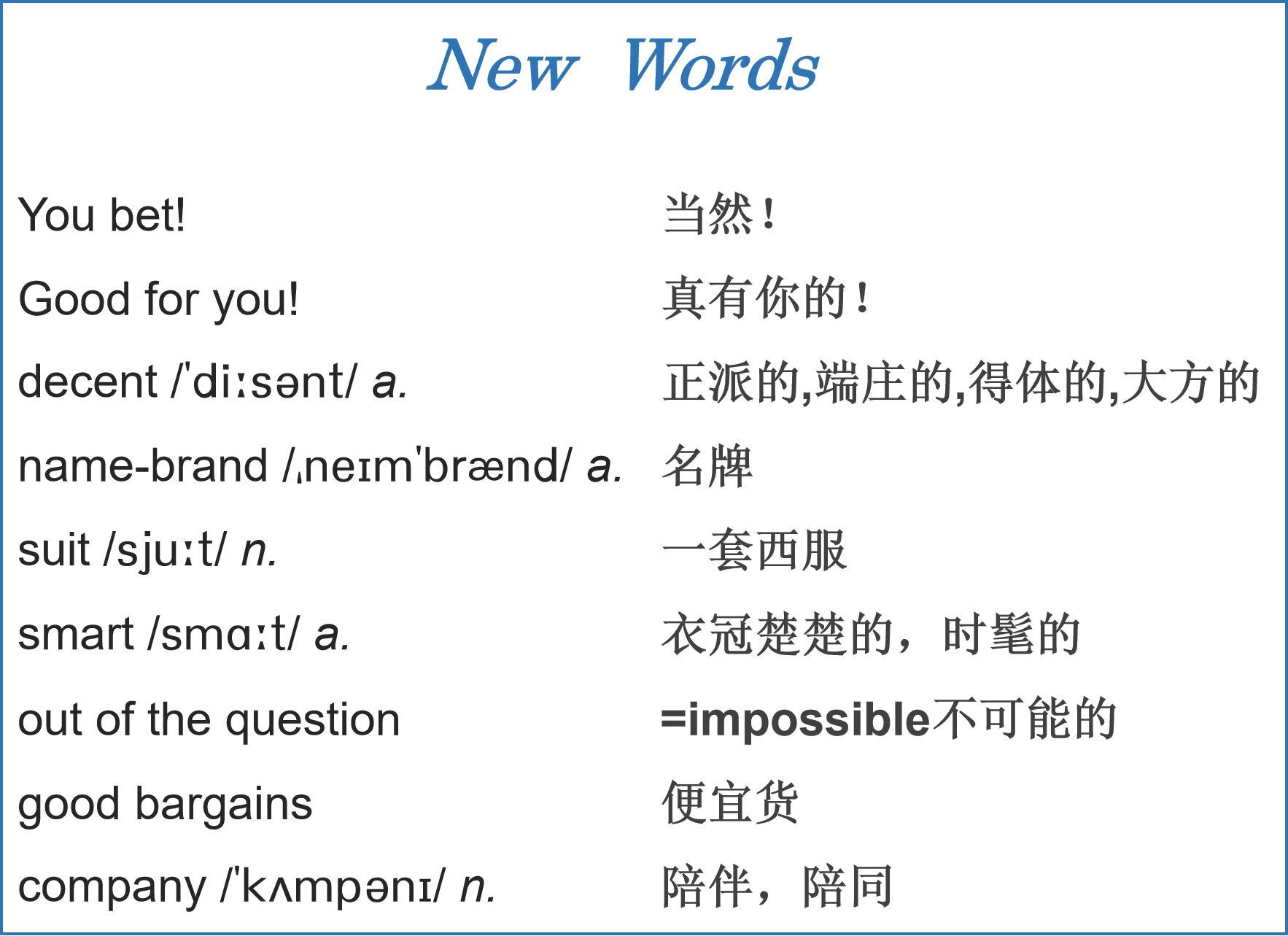
● 4. Read the following words and expressions which may be new to you.
A. Read silently the brief advice below while listening to the recording.
What to Wear to an Interview
While dress codes vary in different industries, professions and workplaces, it is generally wise when attending an interview to note the following advice. Women should wear a smart skirt or trousers and blouse, or a business suit. For men, smart trousers and a shirt with a collar and tie are appropriate. Dressing on the conservative side is generally advised unless you think that a more individual style of dress would be appreciated. Personal grooming is very important: neat, freshly combed hair, clean fingers and nails, and clean shoes are recommended. Clothes may not make the man or woman, but they do say a lot about who you are and how well you will fit into the company.
Physical appearance is a factor too; get a good rest the night before your interview so that you look and sound your best.
● 5. Read aloud the above advice in class. Next, your instructor will give a brief talk on what to wear to an interview. Get ready to ask questions.
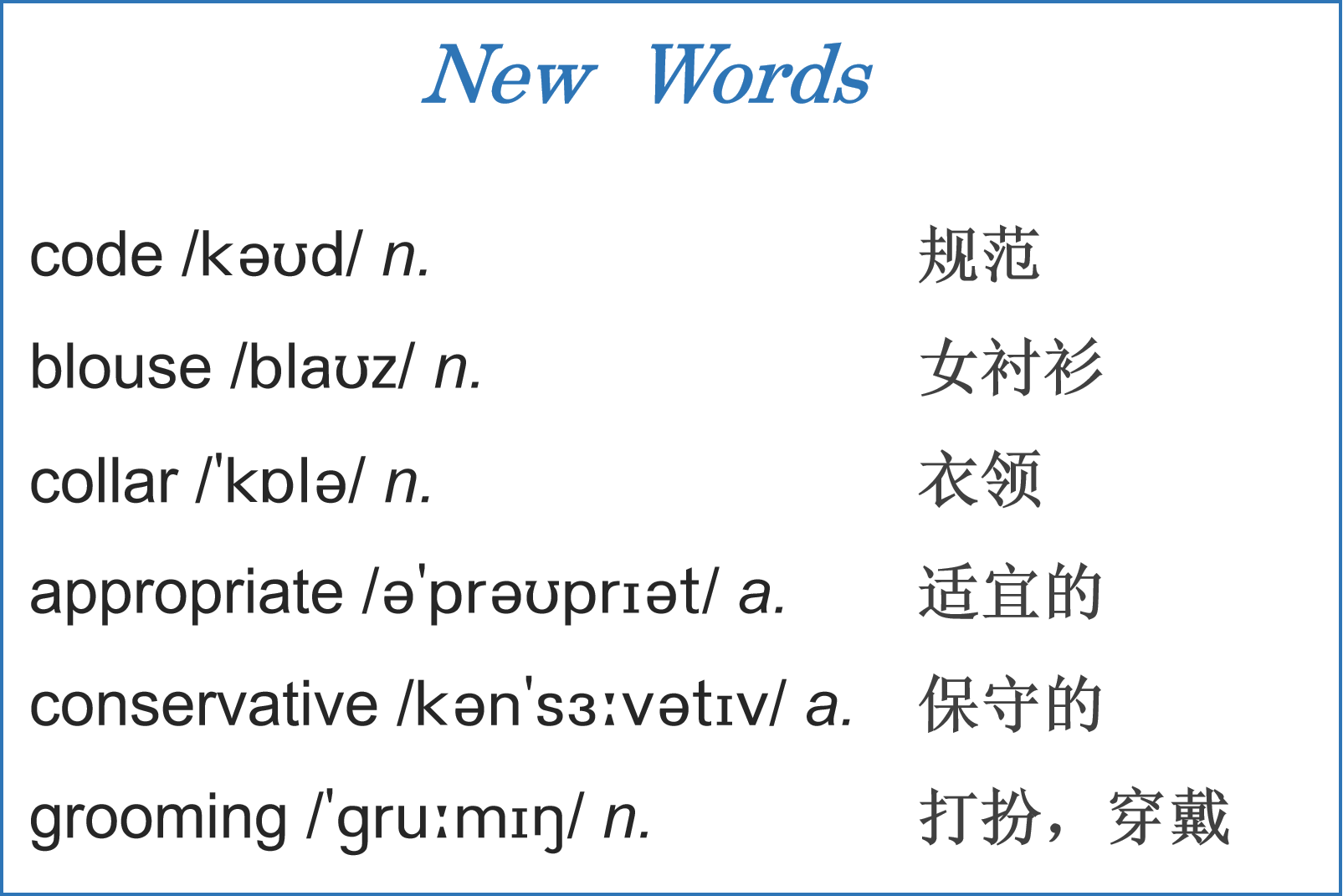
● 6. Read the following words and expressions which may be new to you.
A. Read the following advertisement for information.
" I used to have everything to lose,
Now I have everything to gain."
I look better.
I feel better.
I’m more alert, more energetic.
I have a new confidence that comes from doing something good for myself.
I lost the weight I wanted to without drugs, crash diets, or special foods.
And I’ve gained the knowledge and support I need to keep up the good work.
I was looking for a healthy way to lose weight.
Now that I’ve found it, I know it will stay with me for the rest of my life.
DIET
CENTER
Lose weight
without losing your mind.
Call the Weight Loss Professionals for your first free consultation.
Look under “Diet” in the white pages of your phone book.
1900 locations
B. Ask the manager three questions over the phone to get further information (write down your questions first if necessary).
* Question 1 about the approach (方法) :
a. What is your approach?
b. Can you tell me something about your approach?
* Question 2 about the length of the diet plan:
a. Can you tell me how long it takes?
b. How long does the diet plan last?
* Question 3 about potential dieters:
a. Does the plan apply to any dieter?
b. Are there any limitations?
c. Can any dieter follow it?
C. Act out the above short conversation in class.
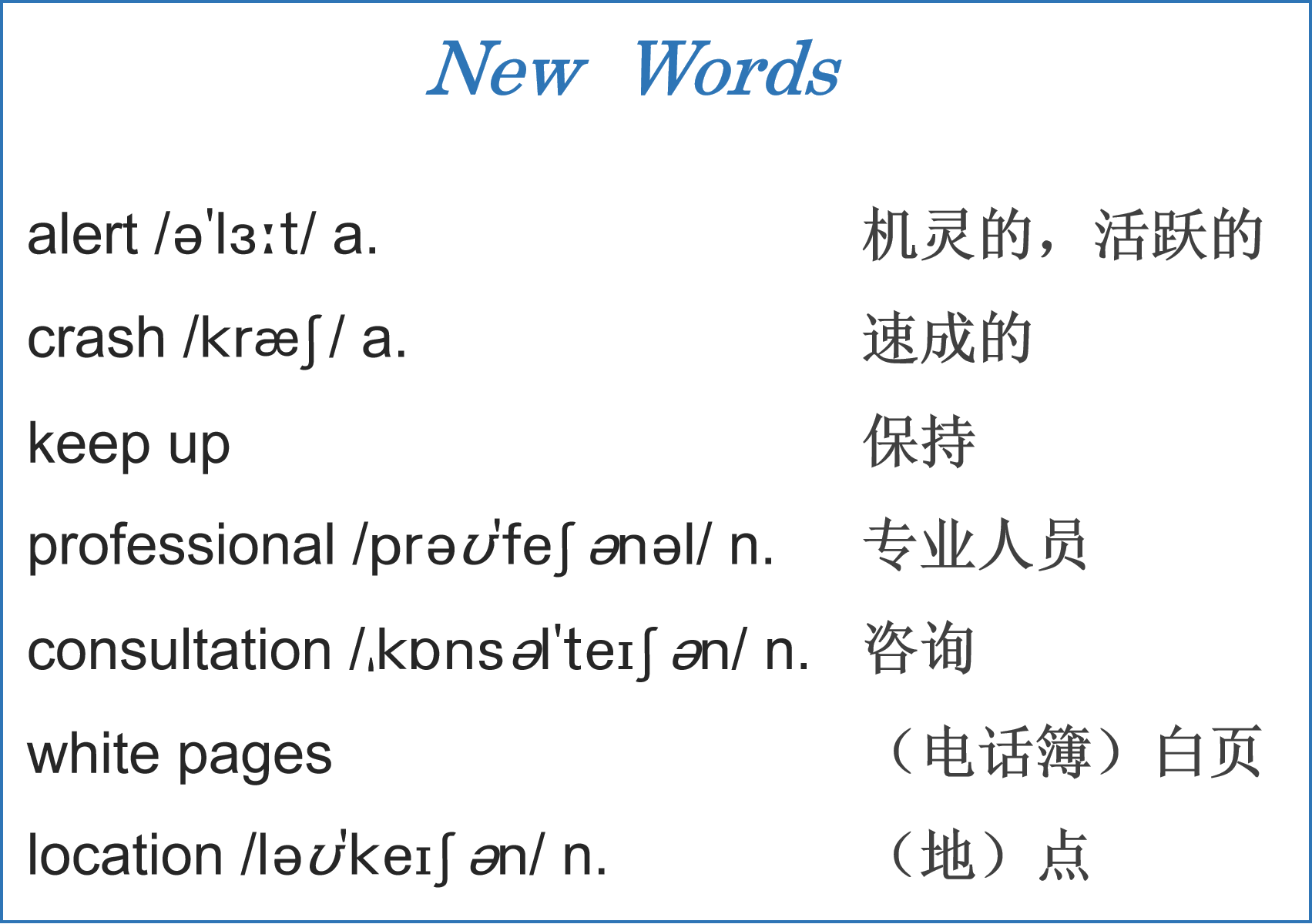
● 7. Read the following words which may be new to you.
A. Listen twice to the taped phone dialogue below between a receptionist and a tourist whose role you are supposed to play. First, put down your answers to the receptionist’s three questions during the timed pauses. Second, speak your answers out loud.
Receptionist: Good afternoon. Can I help you?
Tourist: Yes, we called and made a reservation — the name’s Lewis.
Receptionist: Just a minute, let me check on the computer. Oh yes, is that Mr. and Mrs. Lewis?
Tourist: That’s right.
Receptionist: Would you mind signing the register?
Tourist: Not at all.
Receptionist: Could I see your ID card?
Tourist: Here you are.
Receptionist: Have you stayed here before?
Tourist: No, this is our first visit.
Receptionist: Welcome to Beach City.
Tourist: Thank you.
Receptionist: OK. It’s room 202. It faces the sea, and it’s got a nice view. I’ll just get the porter to take your luggage up.
Tourist: Thank you.
B. Act out the above conversation in class.
● 8. Listen and, during the timed pauses, translate orally into English the Chinese sentences in each of the following three short conversations.
1. A Male Voice: I am not sure. It will be at least four days, but it could be longer.
You: 没问题。我们先预定7月15日到18日。如果你以后需要延长停留时间,只要通知我们一下就行了。
2. A Female Voice: Do you have a conference room I could use for business meetings?
You: 有的。我们有好几个很好的会议室,里面有会议桌、冰箱和酒吧台。如果你乐意的话,我们可以给你一间与会议室相邻的(adjoining) 房间。
3. A Male Voice: Yes. We have a non-smoking room with a queen-size bed (大号床) . The control for the climate control system is beside the entry door, and there is a refrigerator with beverages (饮料) and snacks (小吃) for your enjoyment. Will you pay by cash or credit card?
You: 信用卡。给你,我的卡。今晚我要打几个电话。房间里有直拨电话吗?
A. Transcript & key:
1. A Male Voice: I am not sure. It will be at least four days, but it could be longer.
You: That’s no problem. We will make the reservation for July 15th through the 18th. Just let us know if you need to extend your stay.
2. A Female Voice: Do you have a conference room I could use for business meetings?
You: Yes, we have several nice rooms with conference tables, refrigerator and bar. If you’d like, I could give you a room adjoining the conference room.
3. A Male Voice: Yes. We have a non-smoking room with a queen-size bed (大号床) . The control for the climate control system is beside the entry door, and there is a refrigerator with beverages (饮料) and snacks (小吃) for your enjoyment. Will you pay by cash or credit card?
You: Credit Card. Here it is. I’ll be making some phone calls this evening. Does the room have a direct-dial phone?
B. Act out the above conversations in class.
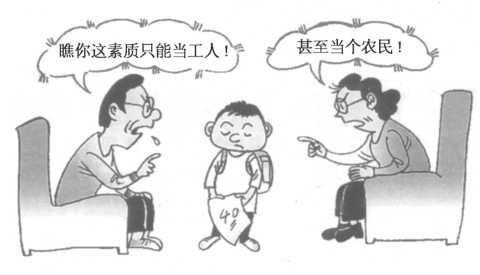
● 9. Take a close look at the picture below. Think about it for one minute. Then give a two-minute oral presentation in which you tell the class its message.
Parenting
The following expressions may help your presentation:
1. hang one’s head helplessly 无奈地垂着头
2. imagine sb.’s parents yelling 想象父母在大叫大嚷
3. be nothing but a laborer or a farmer 只能当一个工人或农民
4. look down on oneself as a failure 因为自己是个失败者而看不起自己
5. make fear a part of one’s daily life 使恐惧成为自己日常生活的一部分
6. model (教育)模式
7. serve today’s society 服务于今天的社会
8. only succeed as white-collar employees, not blue-collar ones 当白领才是成功,而当蓝领就是失败
9. a harmonious society 和谐社会
10. join society through meaningful, respected roles 融入社会,扮演有意义的、受人尊敬的角色
11. emotional health 心理健康
12. don’t behave as the parents do in the picture 不要学图中父母的做法
* Suggested Presentation:
An unfortunate boy is standing between his parents, holding a test paper and hanging his head helplessly. His parents are angry because he has failed his school test.
From the picture we imagine the parents yelling: “You’ll be nothing but a laborer or a farmer if you go on like this!” This teaches their son to look down on himself as a failure, and to make fear part of his daily life. He also learns to look down on laborers and farmers, fearing to become one of them.
How can this model serve today’s society? Can parents truly encourage their children to study harder this way? In our country, many parents feel their kids can only succeed as white-collar employees, not blue-collar ones. This perspective is damaging to all. How can it result in a harmonious society?
Children deserve to grow up and join society in meaningful, respected roles. They need to feel that what they do and their peers do — whether young or grown-up — is worthwhile.
Parents play a crucial role in children’s education. Their kids rely on them for love, strength and safety. Social success is important, but emotional health also is. Children’s wellbeing is the root of a harmonious society. Parents need to learn not to behave as the ones in the picture do.
● 10. Have a discussion on the topic below.
The following expressions may help your discussion:
* Try This Discussion:
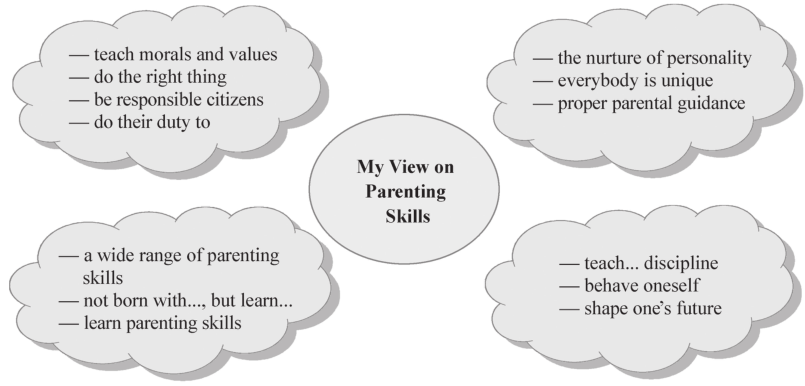
Student A: First and most importantly, parents should attach great importance to teaching morals and values to their children. They should teach their children to know what is right and what is wrong, and how to do the right thing. For eventually children are expected to be responsible citizens when they grow up, and do their duty to society.
Student B: Exactly. But I’d like to add one more thing to the parenting skills we are talking about, and that’s the nurture of personality. Everybody is unique. And everybody has the right to develop their personality in their own right. But that doesn’t necessarily mean that we don’t offer proper parental guidance.
Student C: My own view is that what’s most important for parents to do is to teach their children discipline. And shouldn’t parents also have the skills to educate their children about how to behave themselves? For children, discipline helps shape their future. Wouldn’t you say so?
Student D: Actually, there is a wide range of parenting skills that help raise children. Most parents are not born with them, but learn them. Wouldn’t you agree that parents have to learn parenting skills themselves?