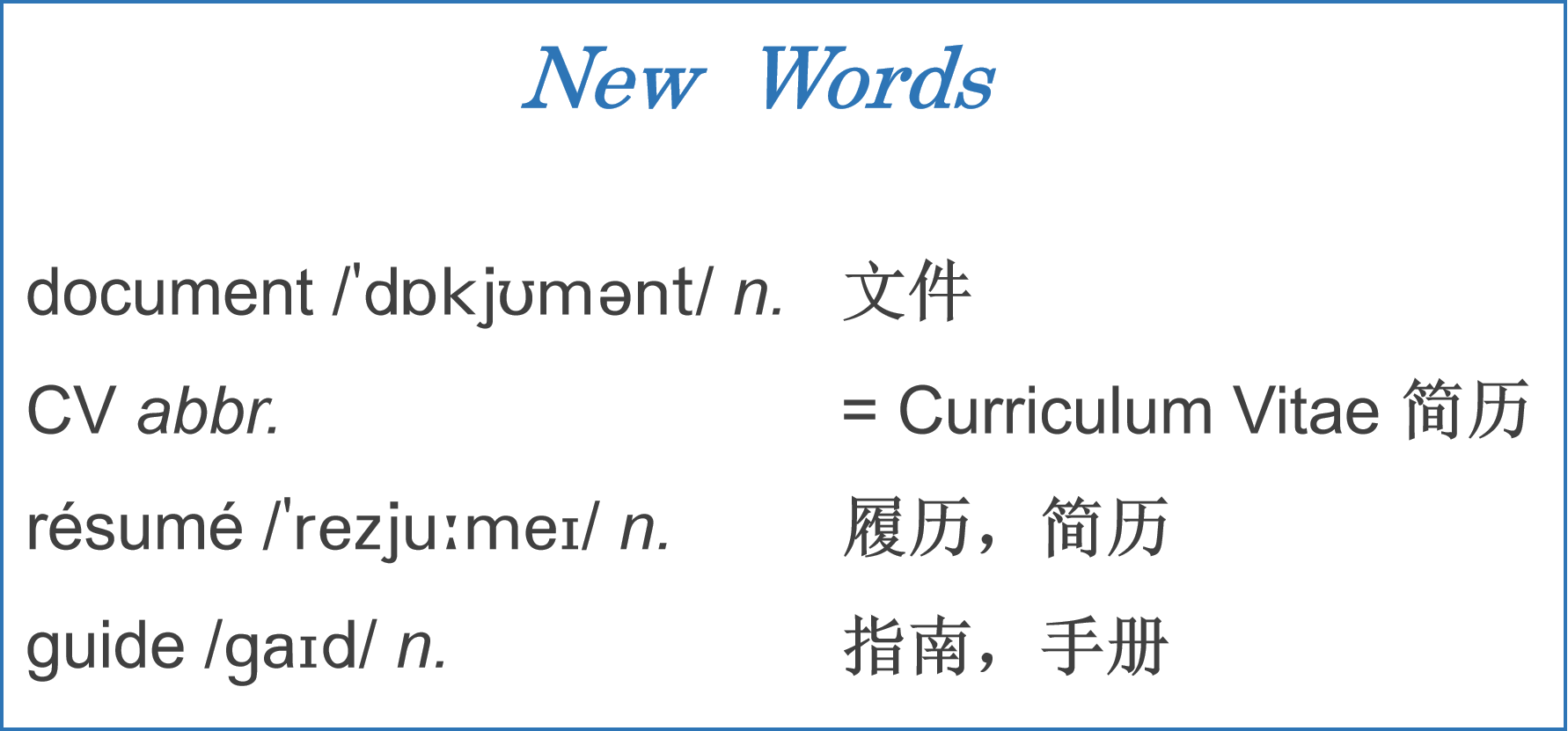
● 4. Read the following words and expressions which may be new to you.
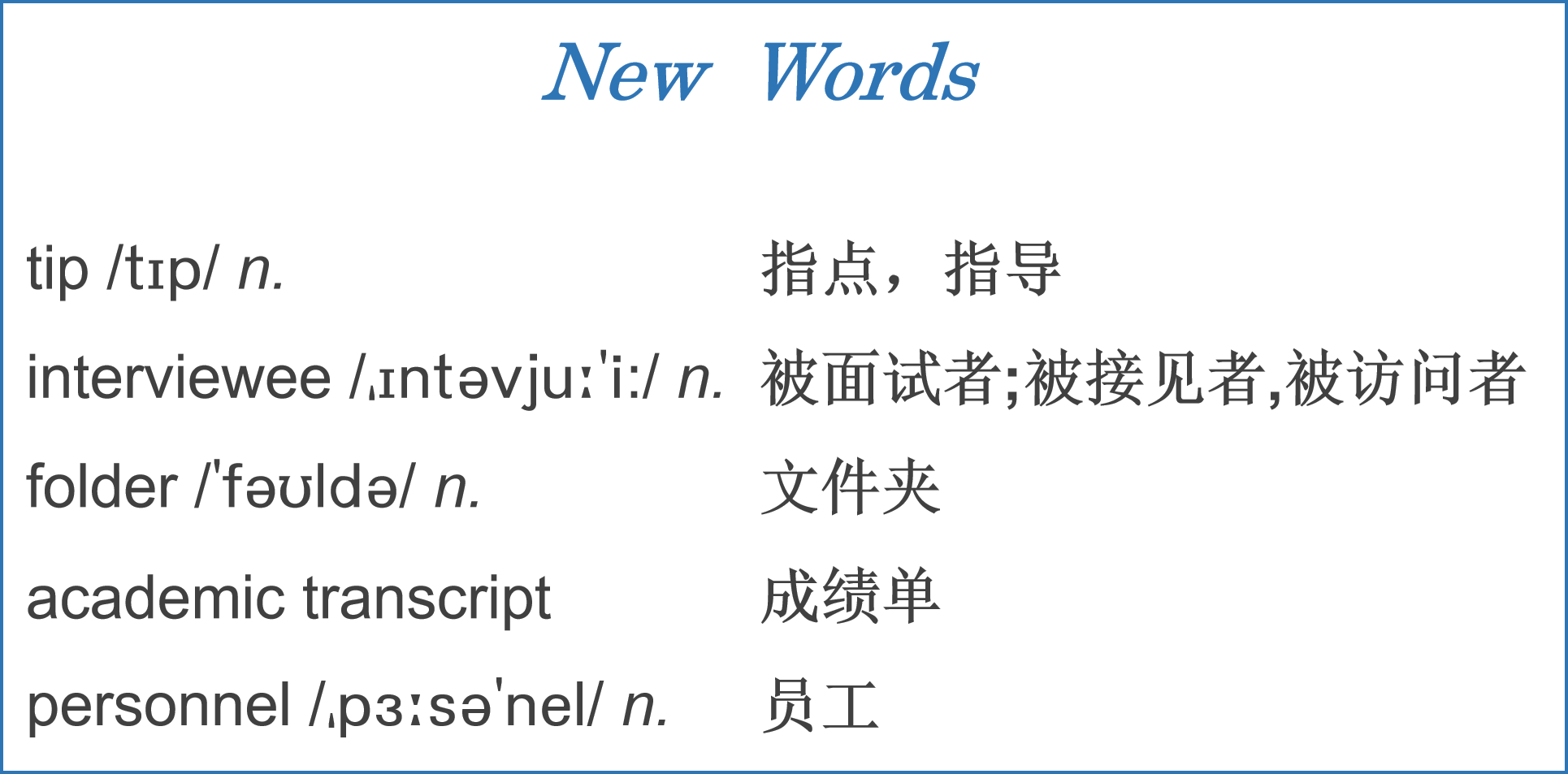
A. Read the following professional advice silently while listening to the recording.
Tips for First-time Interviewees
Prepare a folder with personal job-related information: originals of academic transcripts, references, samples of work. In addition, include a copy of the information you have already supplied to the employer/interviewer and know what you have written in your résumé.
Review the job advertisement and statement of duties (if provided). These can often be the basis for the questions that are asked during the interview.
Research the organization with which you are having an interview and find out all you can about its structure, history, personnel and goals (remember, the Internet can be useful here).
Prepare questions you want to ask the interviewer.
Practice answering likely questions. Don’t try to be word perfect, but prepare your thoughts and ideas about what you want to include in your answers.
Know the exact place and time of the interview, and the correct pronunciation of the interviewer’s (or interviewers’) name(s).
● 5. Read the above professional advice aloud in class. Then deliver the advice as a brief (摘要) in class.
● 6. Read the following words and expressions which may be new to you.
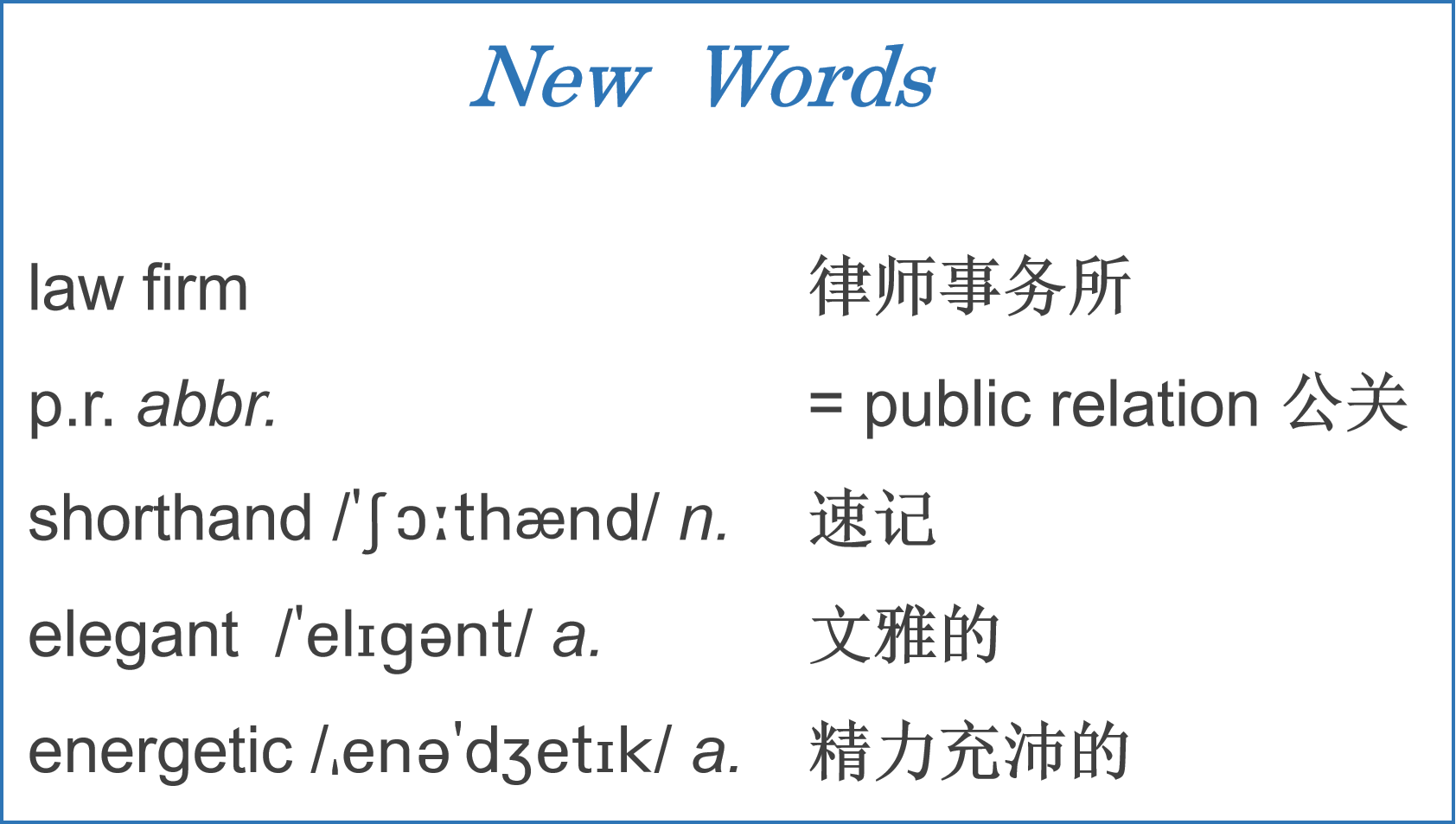
A. Read the following want ad for information.
WANTED, A SECRETARY
■ Two years of experience (preferred in a law firm)
■ Good at p.r.
■ Working knowledge of computer operation
■ English competence in both spoken and written forms
■ Able to take notes in shorthand
■ Elegant and energetic
Tel: 021 — 1053 — 8750, 1053 — 8751
Fax: 021 — 1053 — 8752
http://www.legalservice.com
B. Ask the receptionist three questions over the phone to get further information (write down your questions irst if necessary).
* Question 1 about the delivery of your résumé:
a. Can you tell me how I should send my résumé to you?
b. In what way should I send my résumé to you?
c. What’s the best way to send my résumé to you?
* Question 2 about the interview:
a. I was wondering when you could possibly arrange an interview for me.
b. When will my interview be scheduled?
c. Can you give me some information about the interview?
d. When can I be interviewed?
* Question 3 about the firm’s reply:
a. When am I going to get your reply?
b. When will you give me a reply?
C. Act out the above short conversation in class.
● 7. Read the following words which may be new to you.
A. Listen twice to the taped phone dialogue below between a receptionist and an applicant whose role you are supposed to play. First, put down your three questions for the receptionist during the timed pauses. Second, speak your questions out loud.
Receptionist: Shanghai Legal Services, may I help you?
Applicant: Oh, yes. I’m calling about the position you advertised in the newspaper.
Receptionist: Yes? Do you have any questions?
Applicant: Yes. What’s the best way to send my résumé to you?
Receptionist: Please send it by mail.
Applicant: Should the résumé be written in English or in Chinese?
Receptionist: In English, please.
Applicant: Do you need any other documents?
Receptionist: Please include all other relevant documents with it.
Applicant: I got it.
Receptionist: For more information please visit our home page.
Applicant: Thanks.
B. Act out the above conversation in class.
● 8. Listen and, during the timed pauses, translate orally into English the Chinese sentences in each of the following three short conversations.
1. A Male Voice: They told me that he has mailed out twenty résumés already.
You: 今年的就业市场很紧张。恐怕今年的毕业班中不少人得接受比愿望低的工作或者去国内较差一些的地方。
2. A Female Voice: There are a lot of companies that are downsizing (精简) right now. That probably doesn’t make job-hunting easy.
You: 我首先要联系一家人才公司( headhunter )。我的简历很不错,或许他们能帮我找到一份跟现在一样好甚至更好的工作。
3. A Female Voice: Why don’t you ask your parents for extra money?
You: 我真的不想问我父母多要钱。我真正需要什么的时候,他们总是帮助我。不过我发现约会( dating )很花钱,而且觉得这应该由我自己付钱。
A. Transcript & Key:
1. A Male Voice: They told me that he has mailed out twenty résumés already.
You: The job market is very tight this year. I’m afraid that many from this year’s graduating class will have to settle for something less than they hoped for or go to a less desirable part of the country.
2. A Female Voice: There are a lot of companies that are downsizing (精简) right now. That probably doesn’t make job-hunting easy.
You: The first thing I’m going to do is contact a headhunter. I have an impressive résumé, so perhaps they’ll be able to find me something as good or maybe even better.
3. A Female Voice: Why don’t you ask your parents for extra money?
You: I really hate asking my parents for extra money. They’re very good about helping me out when I really need something, but I find dating is quite expensive and feel I ought to be paying for it myself.
B. Act out the above conversations in class.
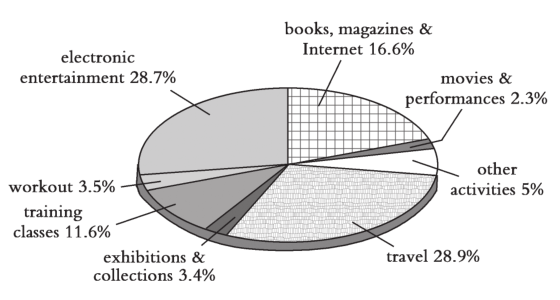
● 9. Take a close look at the following diagram. Think about it for one minute. Then give a two-minute oral presentation to tell the class the information in the diagram.
Entertainment Consumption in Shanghai
The following expressions may help your presentation:
1. specific entertainment activities 具体的娱乐活动
2. interests and hobbies 兴趣和爱好
3. take the highest share of... 占…最大的份额
4. leisure pursuits 业余爱好,消遣
5. travel for relaxation 旅游放松
6. the most contemporary 最当代的
7. entertainment culture 娱乐文化
8. self-improvement and skills development 自我修养和技能培养
9. take much interest in... 对…有浓厚的兴趣
10. physical workouts 体育锻炼
11. health-conscious 有健康意识的
* Suggested Presentation:
This picture describes the popularity of specific entertainment activities in Shanghai. It reflects the local citizens’ interests and hobbies.
According to the statistics, travel represents Shanghai’s most popular entertainment activity. At 28.9%, it takes the highest share of all leisure pursuits. Traveling for pleasure is probably important. But Shanghai is a very competitive city with a lot of development, so people may also like to travel for relaxation.
About one third of total entertainment activity goes to electronic entertainment. This is one of the most contemporary of leisure pursuits. It has grown out of the development of modern technology.
Books, magazines and the Internet are third on the popularity list: they make up about one fifth of Shanghai’s entertainment activity. Though third, this figure shows that knowledge and information are of great importance in Shanghai’s entertainment culture.
Moreover, the statistics shows that quite a few people attend training classes in their free time. This reflects a strong desire for self-improvement and skills development.
According to the statistics, the Shanghainese are not too interested in movies, performances, exhibitions and collections. Nor do they take much interest in physical workouts. Apparently they are not stimulated by the arts and are not very health-conscious.
● 10. Have a discussion on the topic below.
The following expressions may help your discussion:
* Try This Discussion:
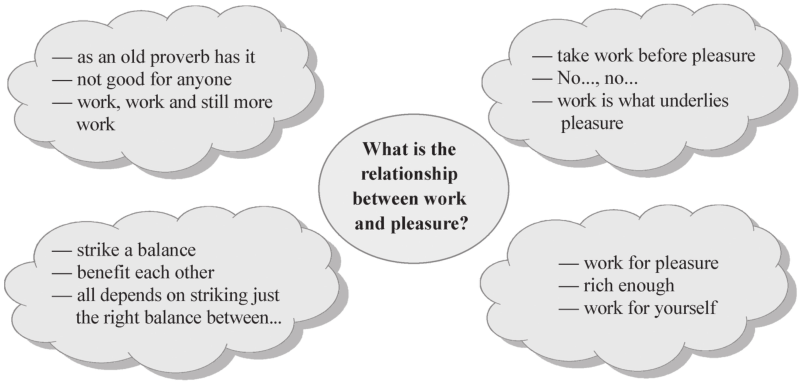
Student A: As an old proverb has it, all work and no play makes Jack a dull boy. This means that too much work without time out for play or enjoyment is not good for anyone. It will harm you if all you do is work, work and still more work. Don’t you think so?
Student B: As I see it, the most importance thing is to take work before pleasure. No work, no pleasure. All I’m trying to say is that work is what underlies pleasure. Work’s first, then comes pleasure.
Student C: Surely you know that some people don’t work just for money; they work for pleasure. I hope I’ll be rich enough to work for pleasure. It’s a true joy to work for yourself.
Student D: Well, I’d like to argue that it’s important to strike a balance between work and pleasure. When you do, they benefit each other. Today, managing stress so you can live better all depends, I think, on striking just the right balance between work and pleasure.