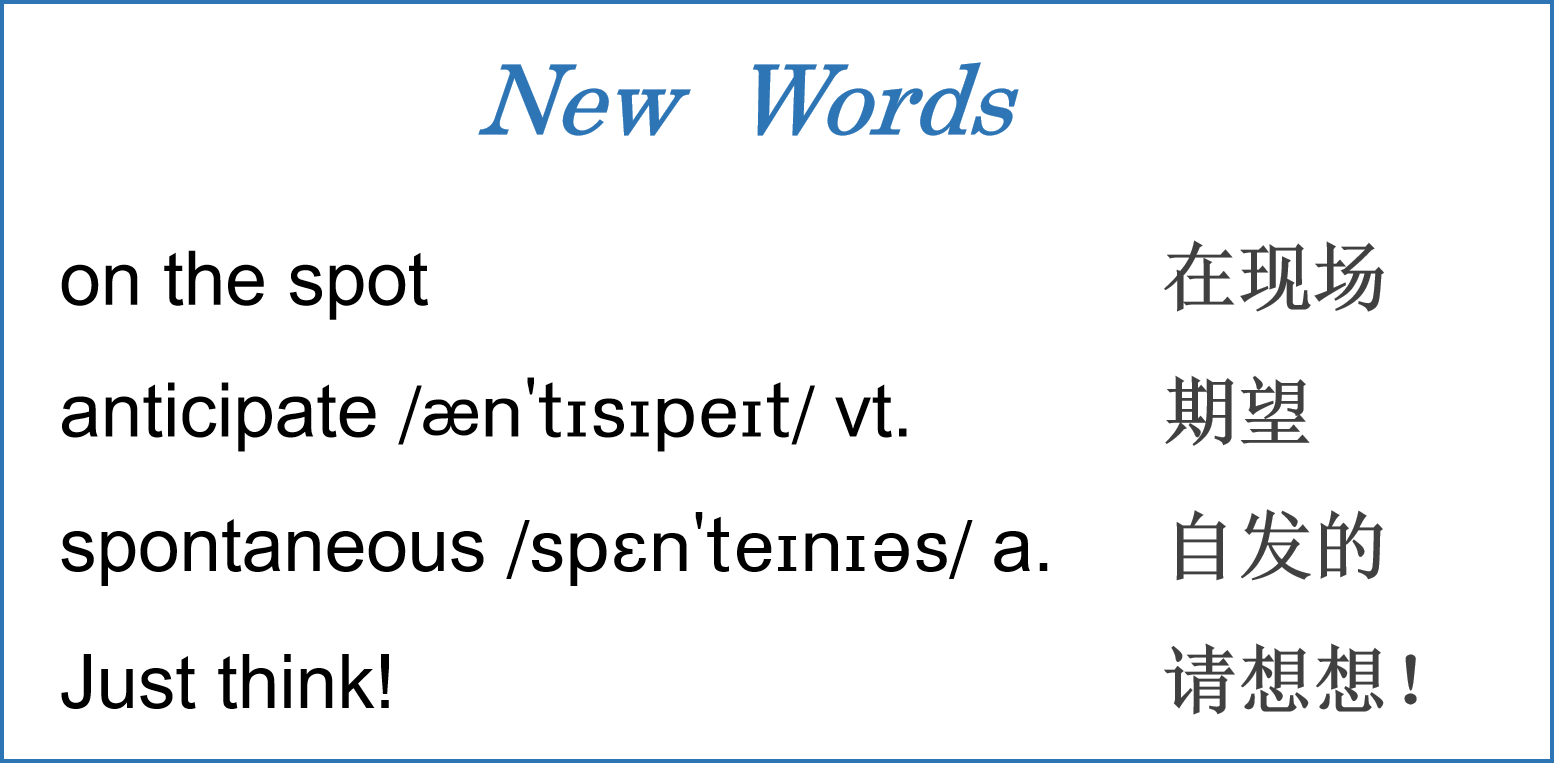
● 4. Read the following words which may be new to you.
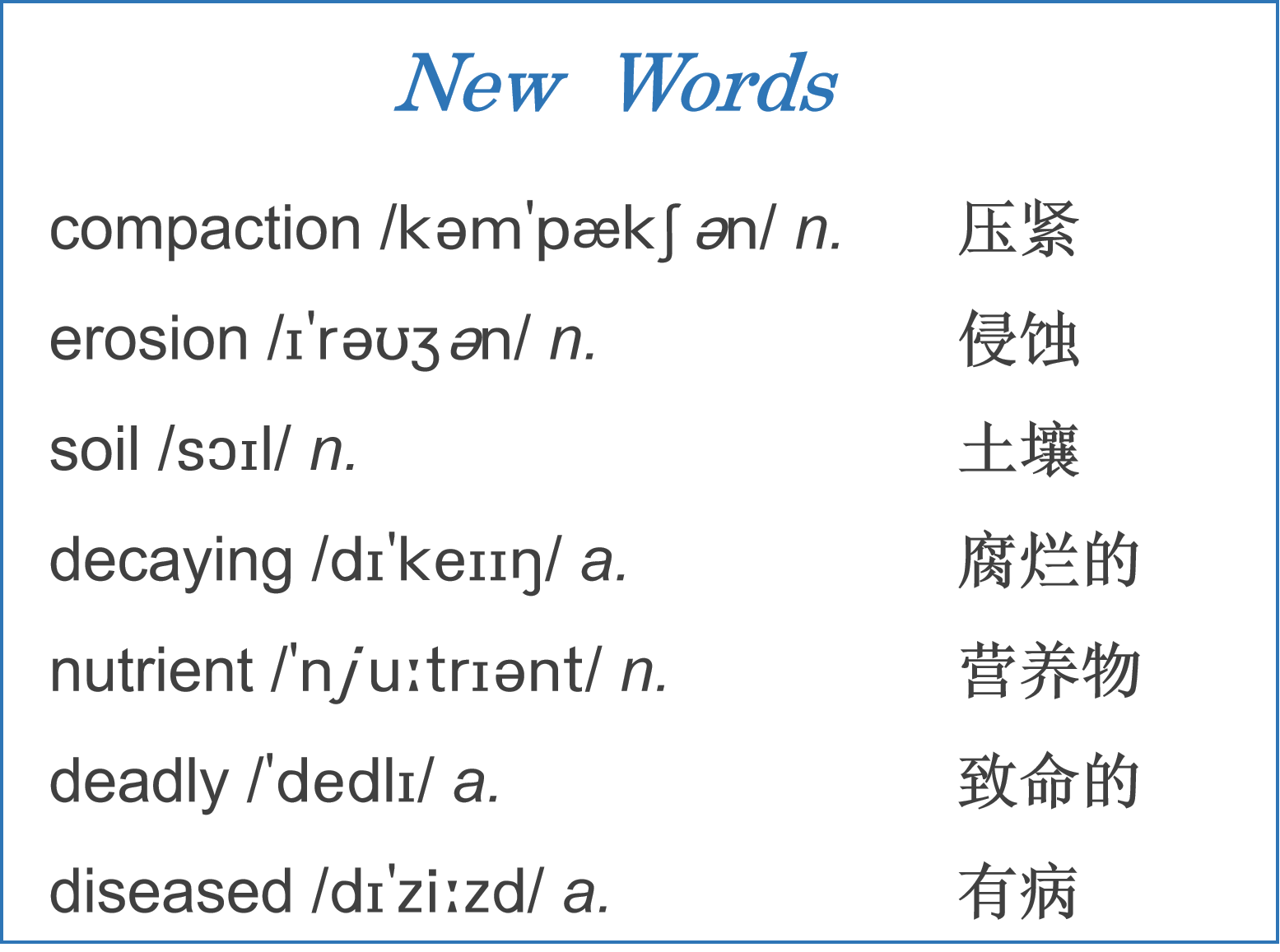
A. Read the following notice on a public bulletin board (布告栏) silently while listening to the recording.
WANT TO HELP?
You can play a major role in protecting the forest. Stay on paved walkways to prevent compaction and erosion of the soil. Don’t collect wood or plants from the forest loor. Decaying plant material provides necessary nutrients that strengthen old trees and give young trees a ighting chance to survive. You can help prevent the spread of deadly tree diseases to new areas by not collecting and transporting diseased wood from the forest back to your home.
● 5. Read aloud the above notice in class. Then act out the role of a guide who is informing his/her tourists about environmental protection.
● 6. Read the following words and expressions which may be new to you.
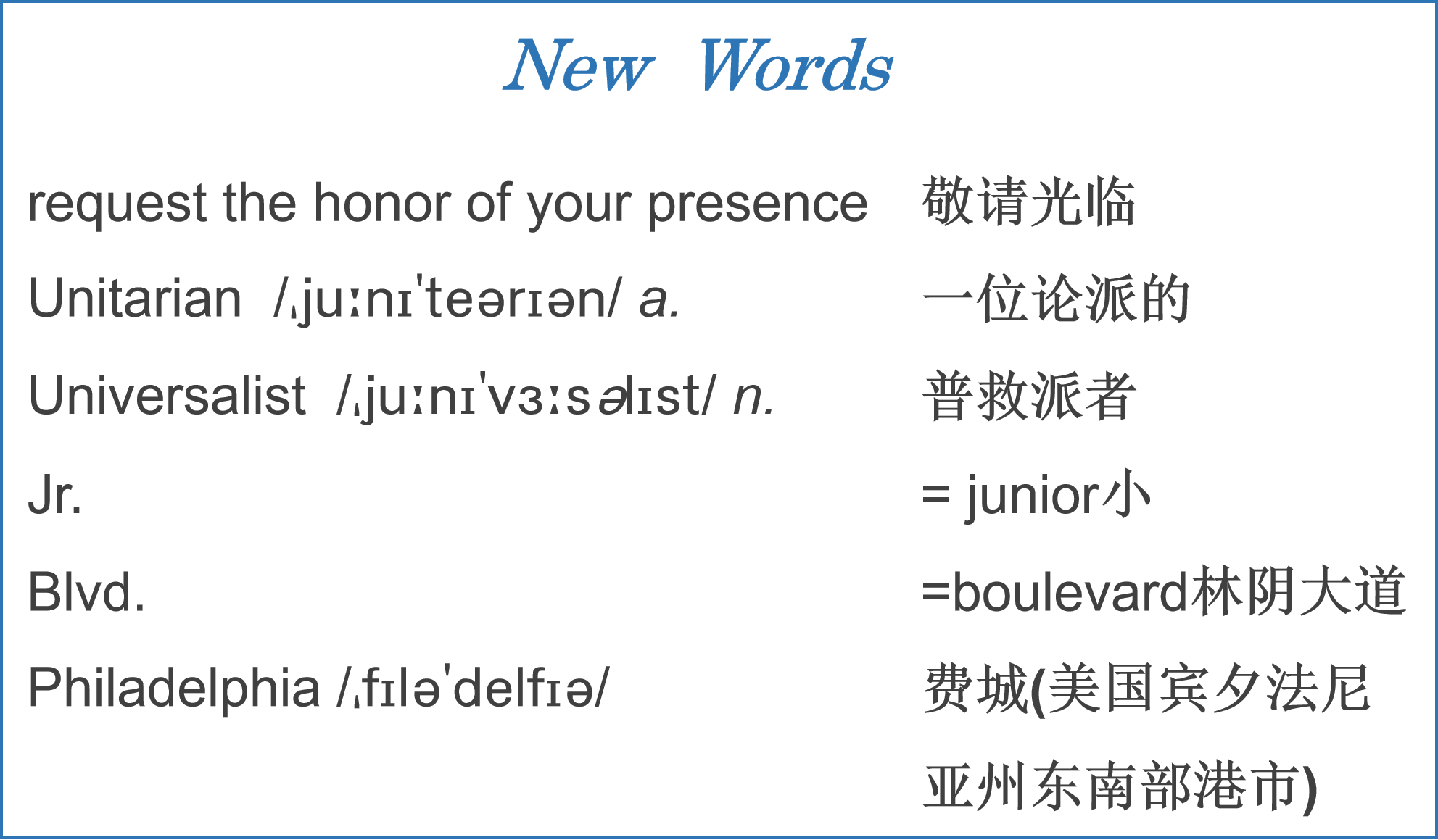
A. Read the following wedding invitation for information.
Mr. and Mrs. David Wei Chen
request the honor of your presence
at the marriage of their daughter
Ann Qing Chen to
Robert Lewis Shepherd
on Saturday, the twenty-first of May
Two thousand and five
At two o’clock in the afternoon
Unitarian and Universalist Church
202 Martin Luther King, Jr. Blvd.
Philadelphia, Pennsylvania
B. Ask three questions of your partner, who is reading the wedding invitation for information (write down your questions if necessary).
* Question 1 about the hosts:
a. Tell me who’s inviting us to the wedding?
b. Who’s inviting us to the wedding?
c. Who does the wedding invitation come from?
* Question 2 about the time:
a. When is the wedding?
b. When is the wedding going to take place?
* Question 3 about the place:
a. Where is the wedding?
b. Where is the wedding going to be held?
C. Act out the above short conversation in class.
● 7. Read the following words and expressions which may be new to you.
A. Listen twice to the taped conversation below between a professor and a student whose role you are supposed to play. First, put down your questions for the professor during the timed pauses. Second, ask your questions out loud.
Student: How many times have you been to China, Prof. Rice?
Prof. Rice: Let me see, it’s my third trip to this country.
Student: When did you come for the first time?
Prof. Rice: Two years ago.
Student: How long are you going to stay here this time?
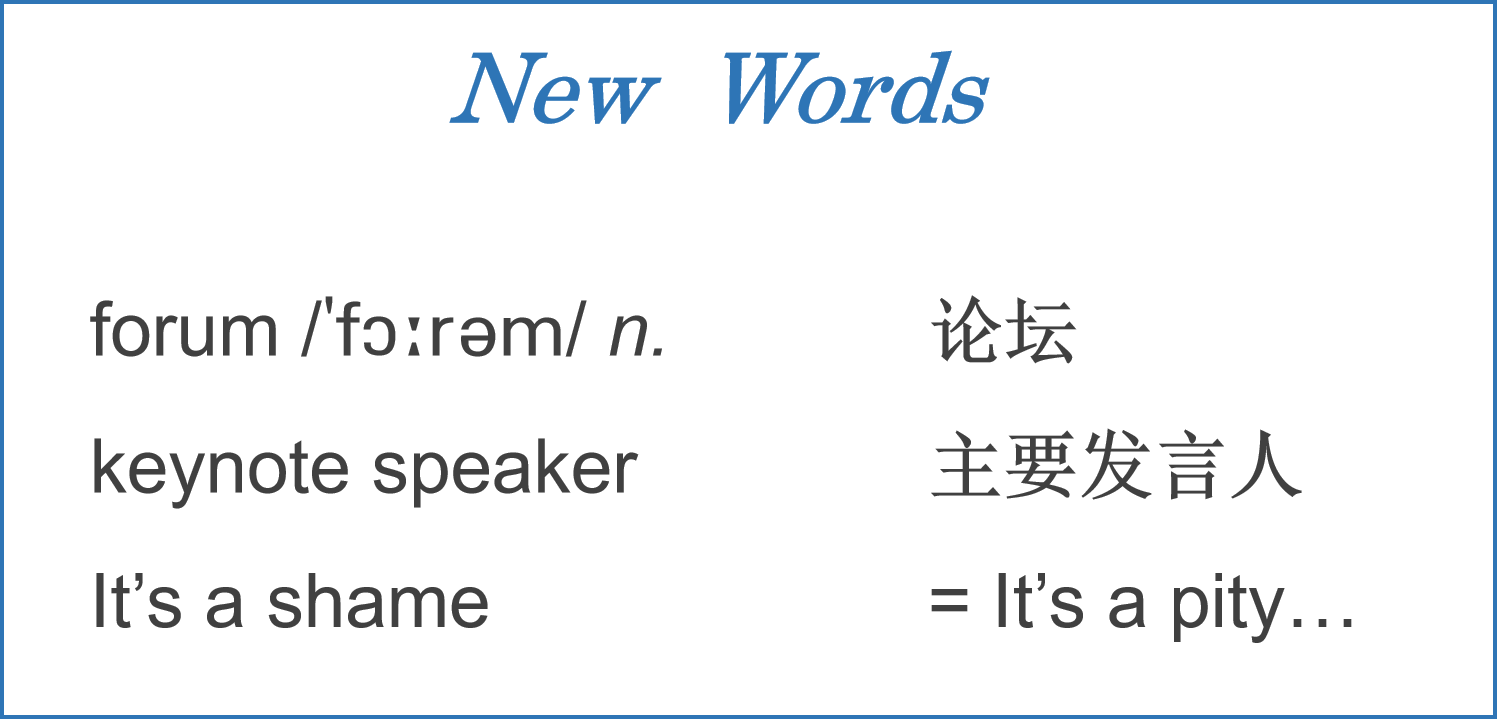
Prof. Rice: My plan is to stay for a week. I came here to attend a forum on the global economy.
Student: Are you going to give a presentation?
Prof. Rice: Oh, yes. I’m invited to the forum as the keynote speaker.
Student: Are you? I wonder if you’ll have any chance to do some sightseeing in the city.
Prof. Rice: Actually, it’s a shame I won’t. I’ve got a busy schedule this time. Maybe next time.
Student: Have a nice stay here.
Prof. Rice: Thank you.
B. Act out the above conversation in class.
● 8. Listen and, during the timed pauses, translate orally into English the Chinese sentences in each of the following three short conversations.
1. A Male Voice: When in Rome, do as the Romans do! This is China, so I would urge you to drink a cup of Maotai Liquor. This is the most famous liquor in the country. Now let’s drink to the signing of our contract!
You: 啊,我希望你不要生气( to be offended ),因为个人的原因,我不能喝酒( alcoholic beverages )。我当然想和你为我们的合同干一杯( in a toast ),我能不能以可乐代酒?
2. A Female Voice: I love to go to fashion shows. They give you some idea about what kinds of clothes are coming into fashion and what are going out.
You: 那些漂亮的模特儿穿着艳丽的( gorgeous )衣服在舞台( runway )上走确实很好看。不过坦率地说,我觉得那些衣服日常穿并不实际。
3. A Male Voice: Excuse me. Can you tell me where I get the bus to the University City?
You: 你可在这里坐3路公共汽车,然后在购物中心街换乘8路公共汽车,一直到那里。
A. Transcript & Key:
1. A Male Voice: When in Rome, do as the Romans do! This is China, so I would urge you to drink a cup of Maotai Liquor. This is the most famous liquor in the country. Now let’s drink to the signing of our contract!
You: Well, I don’t want you to be offended, but for personal reasons I can not drink alcoholic beverages. I certainly want to join you in a toast to our contract. May I use a Coke?
2. A Female Voice: I love to go to fashion shows. They give you some idea about what kinds of clothes are coming into fashion and what are going out.
You: It’s nice to see those beautiful models walk down the runway in gorgeous clothing. But to be frank, I don’t think those clothes are practical for everyday wear.
3. A Male Voice: Excuse me. Can you tell me where I get the bus to the University City?
You: You can take the Number 3 bus right here and then change at Shopping Center Street for the Number 8. That takes you right there.
B. Act out the above conversations in class.
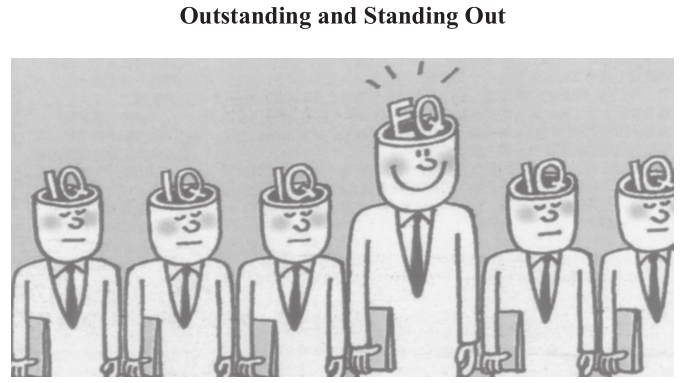
● 9. Take a close look at the picture below. Think about it for one minute. Then give a two-minute oral presentation to tell the class what you think it means.
The following expressions may help your presentation:
1. stand higher than all the rest 鹤立鸡群
2. stand out 突出,优秀
3. seem like a winner 看上去像个成功者
4. EQ/IQ factors 情商/智商因素
5. weigh more in terms of... 在…方面影响更大
6. convey the clear message that... 传递以下清晰的信息…
7. social creatures 社会动物
8. live in a social environment 生活在社会环境中
9. good interpersonal skills 良好的人际交往技能
10. self-motivation 自我激励
11. mood management 心情调节
12. impulse control 冲动控制
13. have an important impact on the way we view education 对我们的教育观有重大影响
14. dull brainpower 无生气的智力
15. not living, breathing intelligence 而非有生命气息的智力
* Suggested Presentation:
Which causes success, IQ or EQ? The answer is both. But which contributes most? The picture gives us the response to this question.
It shows a person with a high EQ standing higher than all the rest of the high IQ people. As the only person with a high EQ, he stands out and seems like a winner. The picture is trying to tell us that EQ factors weigh more in success than IQ factors do. In short, the illustration conveys the clear message that EQ is more important than IQ.
Human beings are social animals. We live in a social environment, so we feel emotions. We depend upon our human relationships, and so we must also be responsible for these emotions. Factors such as good interpersonal skills, self-motivation, mood management and impulse control make it more likely for us to succeed. To become a winner, we have to develop such qualities. These are EQ qualities, not IQ ones.
The message the picture conveys can have an important impact on the way we view education. The development of EQ cannot be neglected in education. Without it we have only dull brainpower — not living, breathing intelligence.
● 10. Have a discussion on the topic below.
The following expressions may help your discussion:
* Try This Discussion:
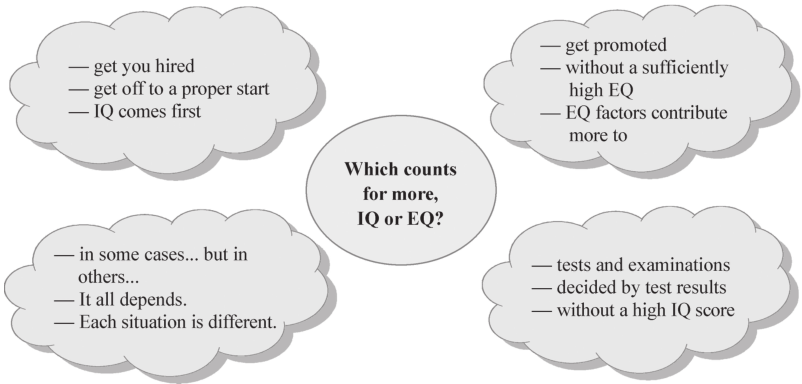
Student A: Don’t you agree that IQ helps the most to get you hired when you’re looking for a job? The first impression made at an interview comes mainly from your examination results. How can you get off to a proper start without a job? So I say that IQ comes first in the real world.
Student B: Sure. IQ may help get you hired. But EQ can help you get promoted. It is difficult to get a promotion without a sufficiently high EQ, even if you are lucky enough to get hired. EQ factors contribute more to future success.
Student C: I am not with you there. Don’t forget that tests and examinations are used everywhere, at many different levels and for lots of purposes. In fact, in many cases promotions and career success are decided by test results. How can you qualify for a higher position in your profession without a high IQ score?
Student D: OK, in some cases, IQ does count more. But in others, EQ does. It all depends. Each situation is different.