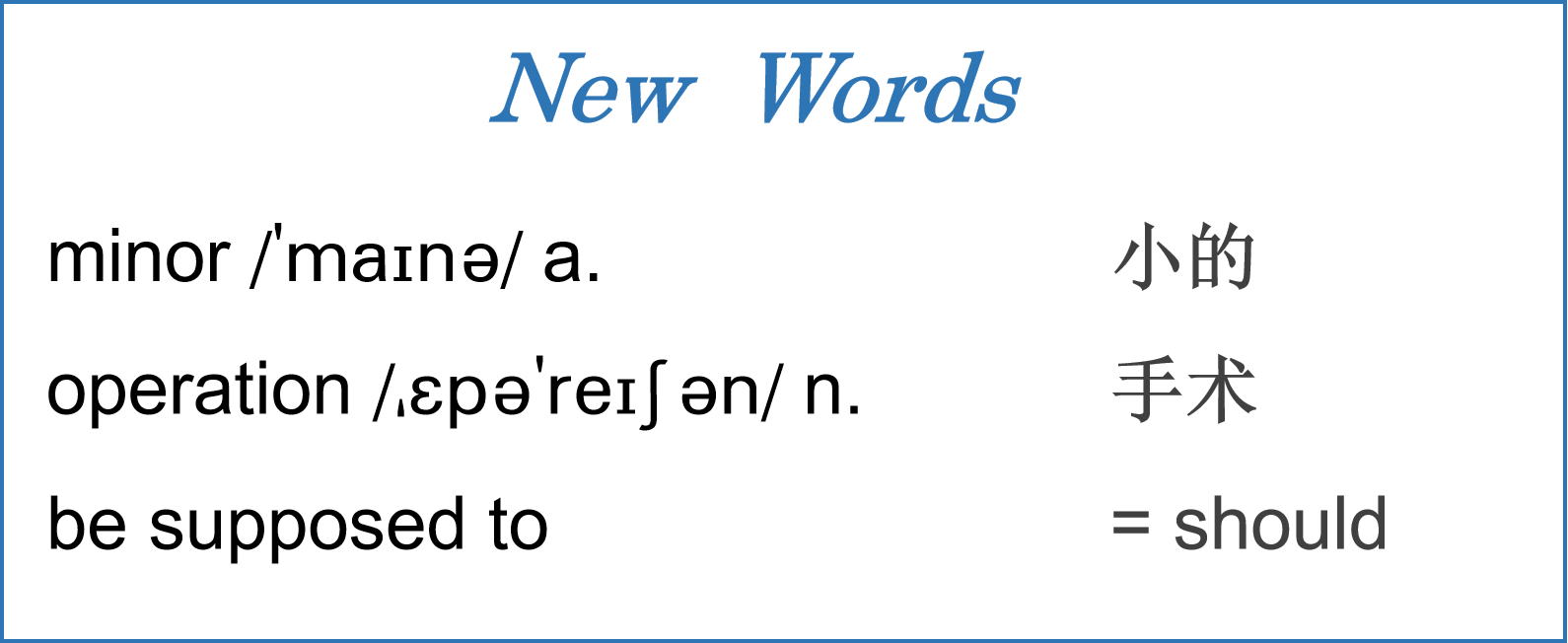
● 4. Read the following words and expressions which may be new to you.

A. While listening to the recording, read silently the following information on the transportation in Shanghai.
The Shanghai Metro is most favored by foreign tourists since it is easily manageable. The metro system in Shanghai includes subway, light railway lines and maglev. There are 15 metro lines, including the Shanghai Maglev Train, 334 stops and 599 km of tracks in operation, making it the longest metro tracks in the world.
The metro system is still developing with more new metro lines and extensions are under construction. The 2020 plan covers a system consisting of 20 lines in 877 km track length.
● 5. Read the above passage aloud in class. Ask and answer questions about the Shanghai Metro. Put down any useful information about it and then act out the role of a guide before a group of tourists.
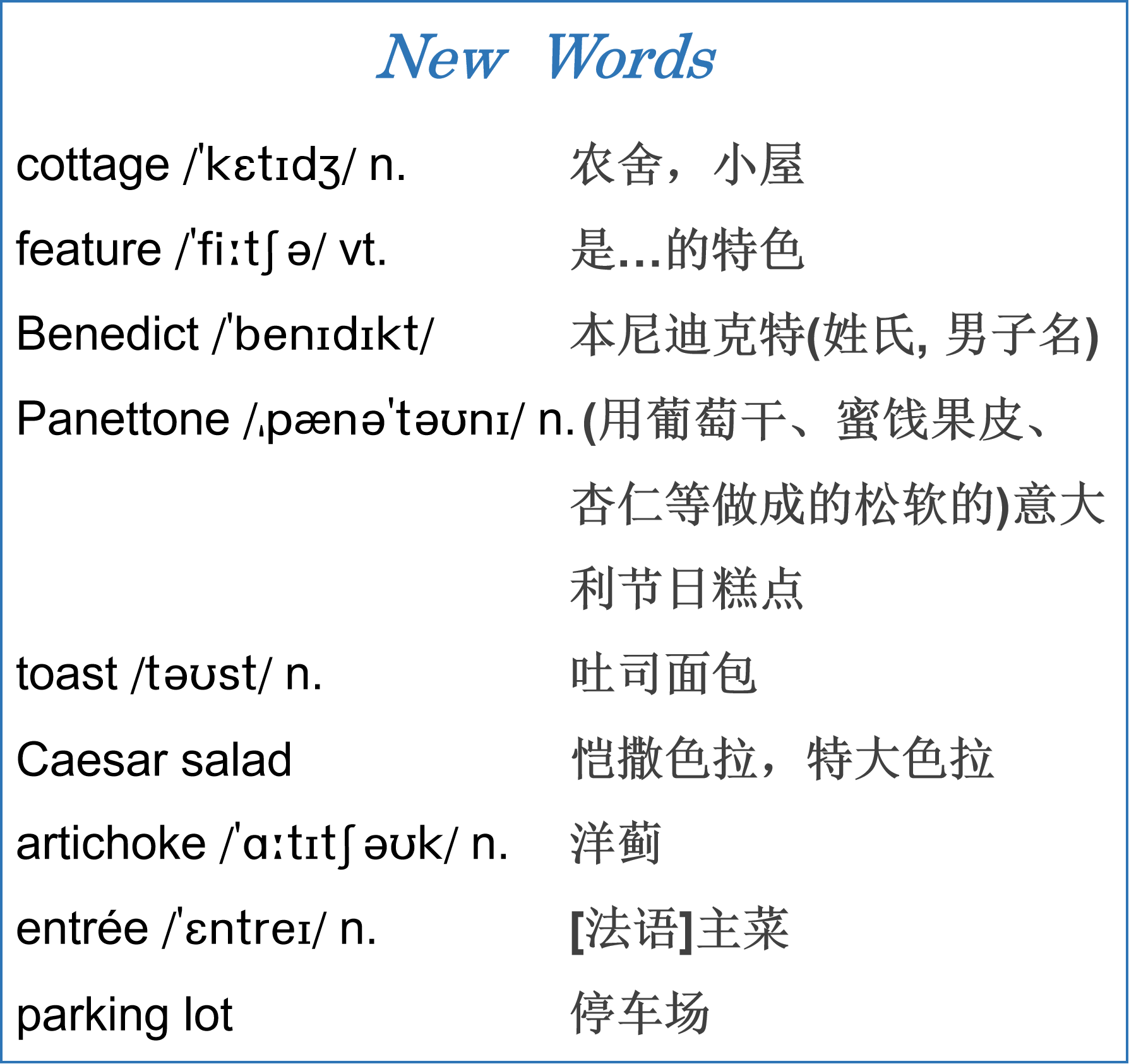
● 6. Read the following words and expressions which may be new to you.
A. Read the following advertisement for information.
THE COTTAGE RESTAURANT!
Breakfast 7 days 7:30 AM — 3:00 PM
Lunch 11:00 AM — 3:00 PM
Dinner Thurs-Sat Starting at 5:00 PM
Dining features homemade meals from Eggs Benedict &
Panettone French toast to our famous Caesar salad &
artichoke soup. Choose from over 100 entrées.
Breakfast, lunch, dinner.
Lincoln St. btwn Ocean & 7th, Carmel, CA 93921
(831) 625 — 6260
B. Pretend you are interested in the above restaurant and ask the manager three questions over the phone for more information (write down your questions irst if necessary).
* Question 1 about its specialties:
a. Do you have any specialties?
b. What kind of specialties do you serve?
c. Are there any particular specialties that you serve?
* Question 2 about the parking lot:
a. Do you have a parking lot?
b. Is it convenient to park my car?
* Question 3 about the location:
a. Where are you?
b. What is your address?
C. Act out the above short conversation in class.
● 7. Read the following words and expressions which may be new to you.

A. Listen twice to the taped phone dialogue below between a manager and a customer whose role you are supposed to play. First, put down your answers to the manager’s questions during the timed pauses. Second, speak your answers out loud.
Manager: Peking Duck Restaurant, may I help you?
Customer: Oh, yes. I’d like to make a reservation.
Manager: When will it be?
Customer: Six o’clock this evening.
Manager: OK, a table for how many?
Customer: A table for two, please.
Manager: That’s it?
Customer: Yes. Oh, do you accept credit cards?
Manager: Yes, we do.
Customer: Great.By the way,do you serve any other specialties apart from roast duck?
Manager: Certainly, some Peking-style stir-fried entrées.
Customer: Sounds good to me. Thanks. See you at six.
B. Act out the above conversation in class.
● 8. Listen and, during the timed pauses, translate orally into English the Chinese sentences in each of the following three short conversations.
1. A Male Voice: Then how come there are all these French words on the menu — starting with “menu”?
You: 法国人和中国人被认为在世界上拥有最好的烹饪(cuisine)——这不,又是一个法语单词。因为早期的美国人大多数是欧洲血统(of European origin),所以我们在菜单里采用了(adopt)法语单词(terminology)。
2. A Female Voice: OK. What else are we going to serve?
You: 听着,我有一个想法,晚餐吃火锅,而不是做一道道菜,怎么样?
3. A Male Voice: How was the dinner?
You: 味道好极了。蒸鱼是我最喜欢的。当然,你的服务也是一流的。能用信用卡付账吗?
A. Transcript & Key:
1. A Male Voice: Then how come there are all these French words on the menu — starting with “menu”?
You: The French and the Chinese are considered to have the best cuisines — another French word — in the world. Since most early Americans were of European origin, we adopted French terminology for our menus.
2. A Female Voice: OK. What else are we going to serve?
You: Listen, I’ve got an idea. Instead of making a lot of separate dishes, how about a Mongolian hot pot dinner?
3. A Male Voice: How was the dinner?
You: It was delicious. That steamed fish was my favorite! And your service is excellent. Can I put it on my credit card?
B. Act out the above conversations in class.
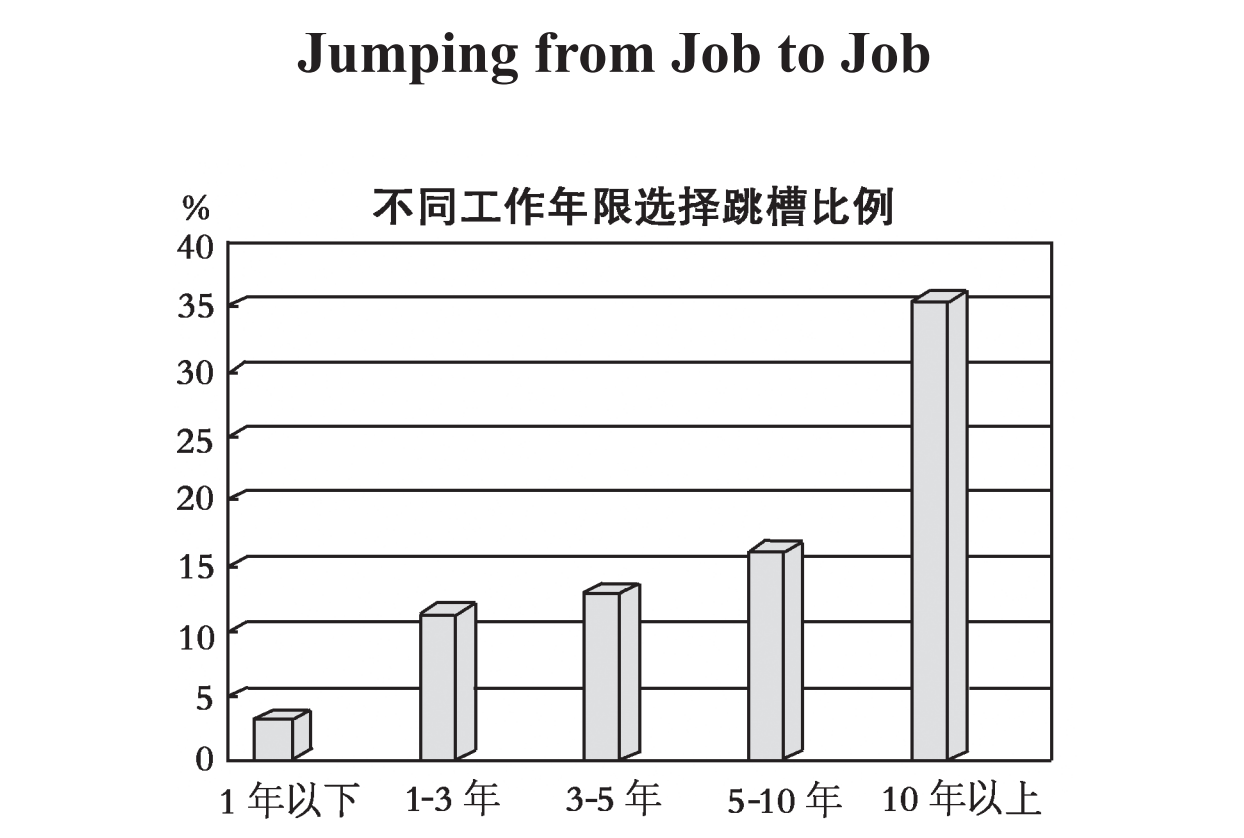
● 9. Take a close look at the following diagram. Think about it for one minute. Then give a two-minute oral presentation to tell the class what you think the information means.
The following expressions may help your presentation:
1. from the chart 从图表来看
2. at different rates 以不同的速度
3. newcomers 新员工
4. experienced workers 富有经验的工人
5. keep one job for one’s whole life 终生只从事一份工作
6. challenge oneself 挑战自我
7. stay satisfied with the status quo 满足于现状(或已有的东西)
8. beyond one’s current financial, academic and/or social situation 超越目前的经济、学术和/或社会地位
9. adapt to changing times 适应变化的时代
10. leave behind 掉队,落后
11. part of human nature 人性的一面
* Suggested Presentation:
From the chart, we can see that people jump from job to job at different rates. The rate has much to do with years of work experience. The more work experience people have, the more likely they will move from job to job.
Those with over 10 years of work experience have the highest rate of job jumping. It is almost 10 times higher than that of newcomers who have worked less than a year. Well-seasoned workers are the ones most likely to change their minds.
In today’s changing world, people don’t usually stay at one job their whole life. They tend to move from one position to the next because they have a strong desire to grow and develop. Needing to challenge themselves, people find it difficult to stay satisfied with what they already have. They like to move out of or beyond their current financial, academic and/or social situation. This makes them feel their life is worthwhile.
Everything is always changing. Nothing ever stands still in the world. Human beings are part of this movement. Not only do they have to adapt to the changing times, but also they have to feel they’re not left behind. It is understandable that people tend to jump from job to job. Growth, change and transformation are part of human nature.
● 10. Have a discussion on the topic below.
The following expressions may help your discussion:
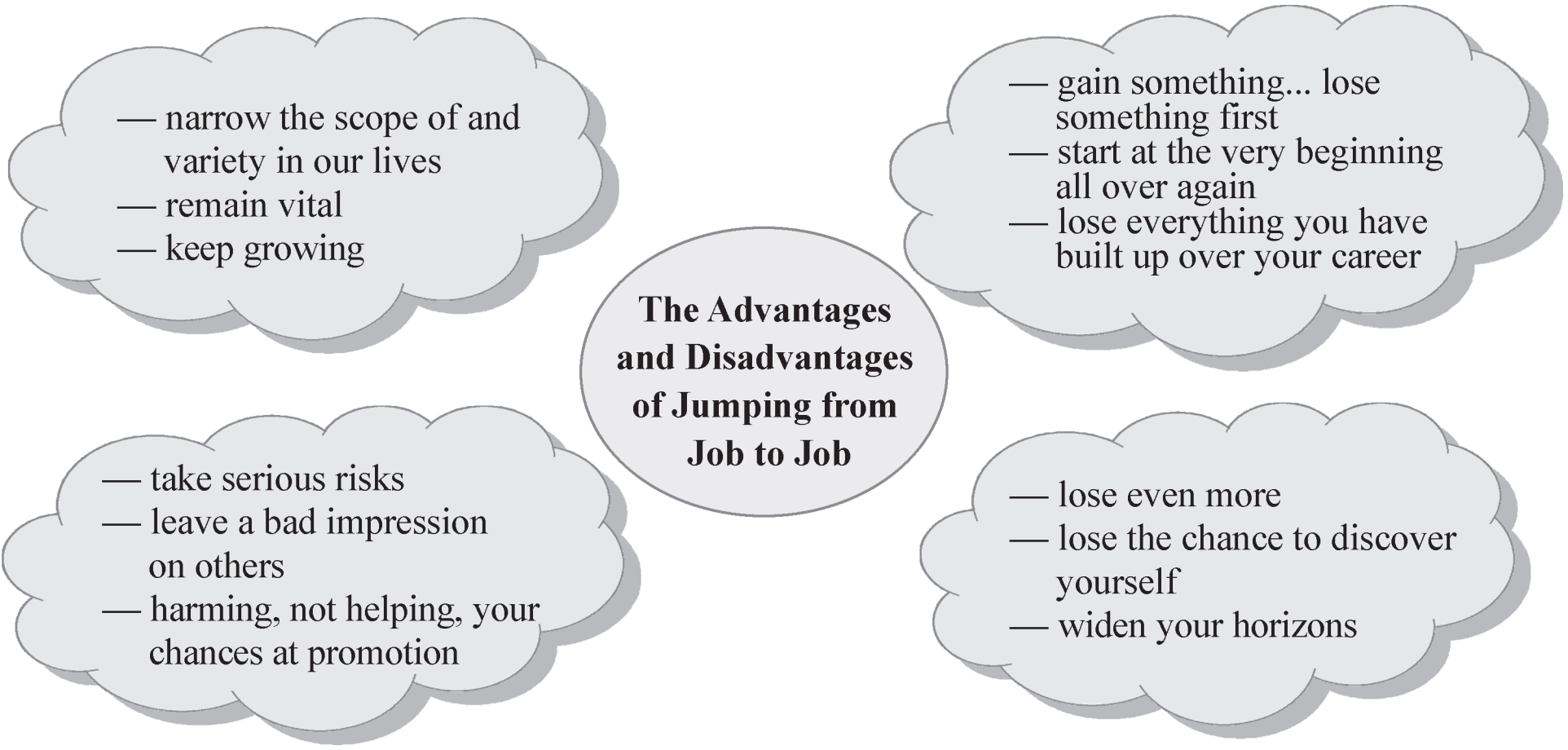
* Try This Discussion:
Student A: We tend to narrow the scope of and variety in our lives as we grow. And how can we remain vital if we stay at one job our whole life? I say that those who jump from job to job are the ones who keep growing. They keep pushing themselves into bigger challenges and higher positions.
Student B: Fair enough. But in life if you want to gain something, often you have to lose something first. When you leave for a new job, you have to start at the very beginning all over again. That can be such a waste. You can lose everything you’ve built up over your career.
Student C: Maybe so, but you could lose even more if you stay at one job your whole life. You could lose the chance to discover yourself, by limiting your path just to the job you are holding down. Doing something new could widen your horizons.
Student D: I get your point, but you are taking serious risks when you jump from job to job. You run the risk of leaving a bad impression on others with such behavior. If you jump from job to job, I’m sure you’re actually harming, not helping, your chances at promotion. It’s no good making quick changes.