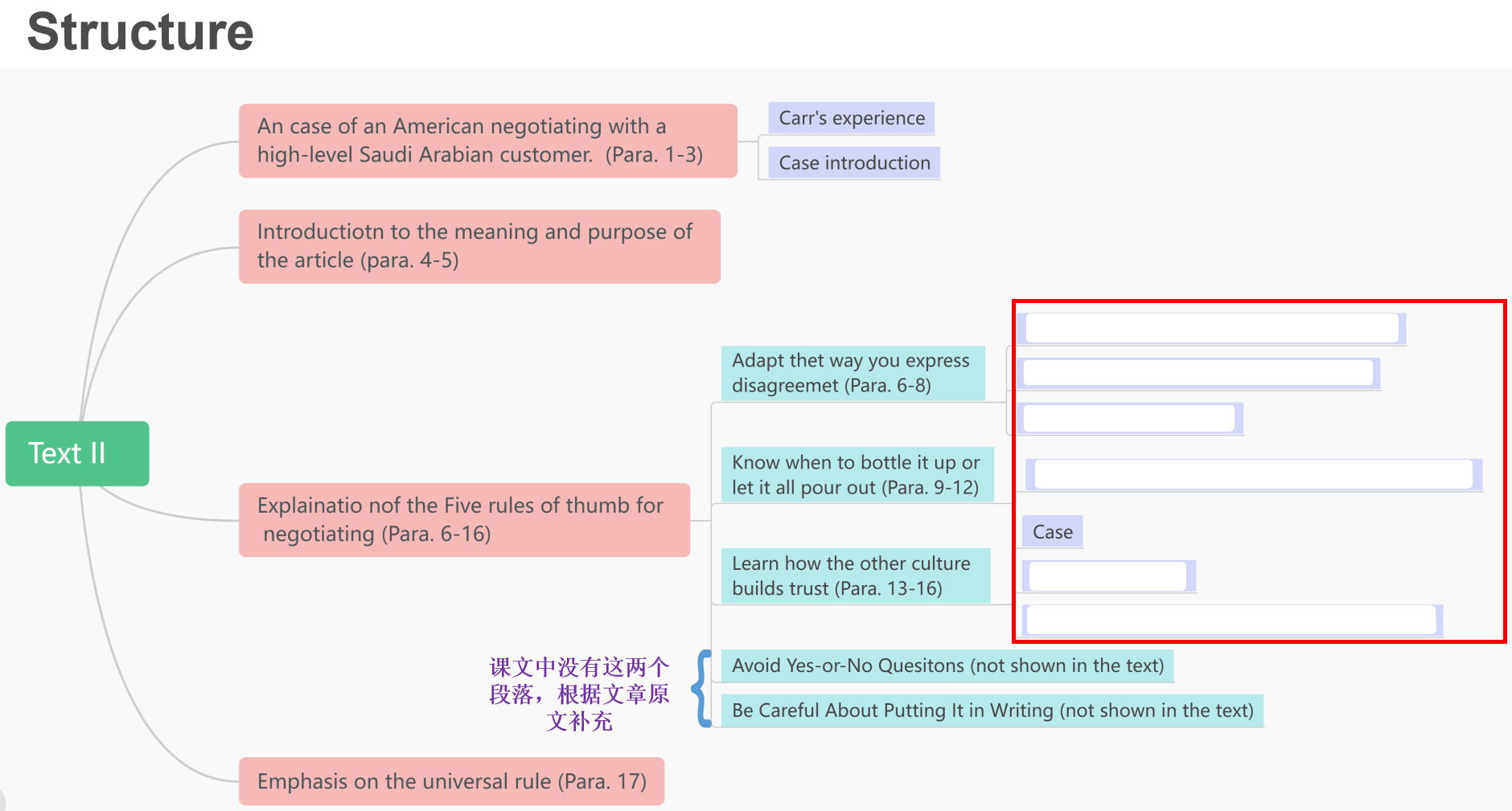
课文语法知识预习:同学们根据以下要求在下周线上课(3月25日)前完成预习任务,以提高课堂学习效率。
1. 课前分析以下句子中的划线部分存在的语法现象,准备参与课堂学习任务---句型分析
para 1.
Tim Carr, an American working for a defense company based in the Midwestern United States, was about to enter a sensitive bargaining session with a high-level Saudi Arabian customer, but he wasn’t particularly concerned.
Para. 2
1)“So let me just review, ” he said “You’ve agreed that you will provide the supplies for next year’s project and contact your counterpart at the energy office to get his approval. Next you’ve said that you will….”
2)But when Carr finished his detailed description of who had agreed to what, he was greeted with silence. Finally a soft but firm voice said, “I told you I would do it. You think I don’t keep my promises? That I’m not good on my word?”
Para. 4
1). What gets you to “yes” in one culture gets you to “no” in another.
2). To be effective, a negotiator must have a sense of how his counterpart is reacting.
Para. 5
1) I draw on my work on cross-cultural management to identify five rules of thumb for negotiating with someone whose cultural style of communication differs from yours.
Para. 6
2) If your Russian counterpart tells you passionately that he completely disagrees with every point you have made, it’s not a sign that things are starting poorly.
Para. 7
An American manager named Sean Green, who had spent years negotiating partnerships in Mexico, told me that he quickly learned that if he wanted to make progress toward a deal, he needed to say things like “I do not quite understand your point” and “Please explain more why you think that.”
Para. 8
1). The key is to listen for verbal cues—specifically, what linguistics experts call “upgraders” and “downgraders.”
2). Upgraders are words you might use to strengthen your disagreement, such as “totally,” “completely,” “absolutely.” Downgraders—such as “partially,” “a little bit,” “maybe”—soften the disagreement.
Para. 10
1). What makes international negotiations interesting (and complicated) is that people from some very emotionally expressive cultures—such as Brazil, Mexico, and Saudi Arabia—may also avoid open disagreement.
2). If you disagree with me too strongly, I would read that as a signal that you don’t like me.”
Para.12
1). So the second rule of international negotiations is to recognize what an emotional outpouring signifies in the culture you are negotiating with, and to adapt your reaction accordingly.
2). Was it a bad sign that the Swedish negotiators sat calmly across the table from you, never entered into open debate, and showed little passion during the discussion?
3). But if you encountered the same behavior while negotiating in Israel, it might be a sign that the deal was about to die an early death.
Para. 13
How we come to trust someone varies dramatically from one part of the world to another.
para. 14
1). Initially, he felt he was struggling to get the information his side needed, so he asked his company’s China consultant for advice.
2). The consultant suggested that Katz was going at the deal too quickly and should spend more time building trust.
3). The problem is that you need to approach them from a relationship perspective, not a business perspective.
4). You won’t get what you want unless you develop trust differently.
para. 17
When you are negotiating a deal, you need to persuade and react, to convince and finesse, pushing your points while working carefully toward an agreement.
2. Find out all the sentences that omit the relative pronoun "that" to introduce the attributive clause. 找出文中所有省略关系代词that的定语从句。