Read Text II on page 13, and fill in the blanks to complete the mind map of the structure of the text.
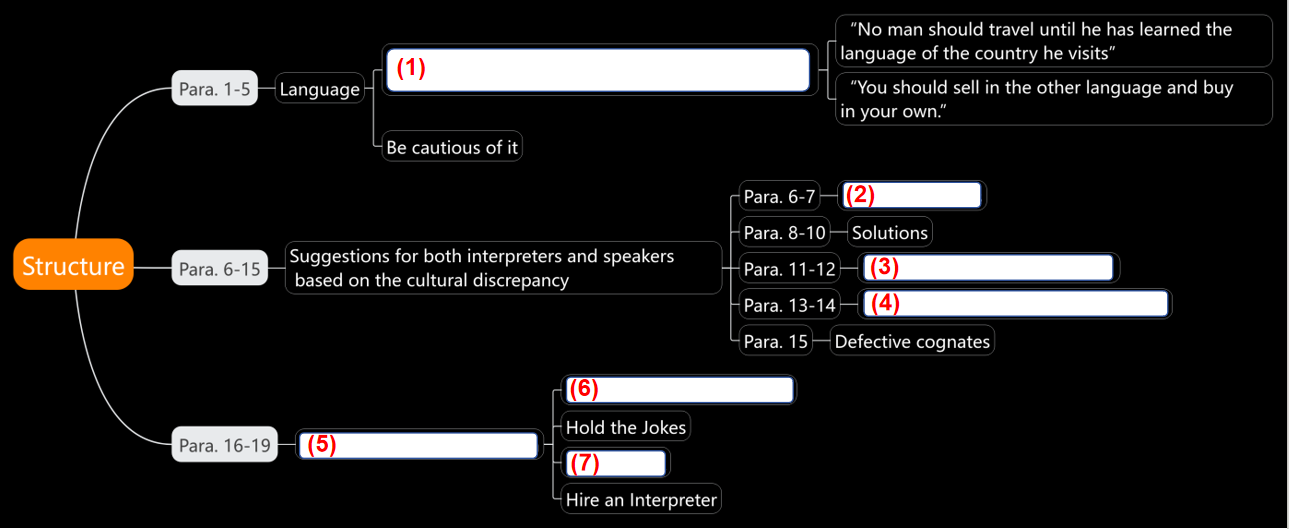
1. Match: After reading the text and having a general idea about the structure, please analyze the following 10 sentences and try to understand the meaning of each sentence, and then finish the following language tasks.
1). But unless you can really cope in a language, it is usually best to save it for social chat.
2). Although it may be worth remembering the old German adage that you should sell in the other language and buy in your own, for most people this means speaking through interpreters.
3). There was the case of a former German chancellor who was presented to the queen during a visit to London. He had brushed up his English for the occasion.
4). You have to make sure that your message is well received in a cultural as well as a linguistic sense.
5). “It can be quite disconcerting with simultaneous interpretation,” Pooley says.
6). Experts recommend that both parties in a negotiation bring their own people to interpret for important discussions.
7). Keep sentences short and simple but avoid oversimplifying — which may give an impression that you’re condescending — and pause frequently.
8). When it comes to the Far East, it’s not so much “read my lips” as “read my mind.”
9). These are more than dictionaries, translating entire sentences.
10). If the Japanese have a reputation for inscrutability, it is because they have developed ambiguity of expression to an art form.
2. Vocabulary: choose the best answer for each sentence. 把答案输入下面测试里。
Comprehension CheckDirections: Read the text through and answer the following questions.