
Writing Skill: Describing a Person
If you want to immerse a reader in an essay, there's no better way to do it than witha crisp, vivid descriptive paragraph. Whether you're describing a person, place, or thing, your paragraph should make your reader feel like they're right there with you or your characters, experiencing the moment first hand.
Here are some principles you can follow when describing a person.
1. Start your paragraph with a general topic sentence that introduces the person.
Keep this first sentence clear and concise, focusing on one aspect of their appearance soyou don't overwhelm your reader with too much description right away. You can also split your topic sentence into 2 sentences for clarity and flow. Star twith something like:
“Mr. Bixler was the tallest person I'd ever seen.”
“Melanie's hairis the biggest thing about her.”
“To understand John's thoughts, all you had to do was look at his hands. They never stopped moving.”
2. Focus on the most striking part of their appearance first.
To hook your readers in even more, go straight from your general introduction to the most interesting or unusual part of the person's appearance. For example:
“I didn't usually notice people's skin, but Natasha's glowed. It was almost alien. Night could be falling, or we could be sitting in a dark classroom, and I'd still seeher out of the corner of my eye, faintly golden.”
“His arms looked too long for his body, and disproportionately muscular, like pale twin boa constrictors.”
3. Focus on physical details that hint at the person's personality.
Bycarefully choosing your descriptive words, your paragraph can paint a vivid picture of the person while giving the reader a sense of who they really are. For example:
Kindness or friendliness:“He had a tendency to slope his back and shoulders to smile right in my eyes.”
Rudeness: “He towered over everyone else in the room, staring over everyone's heads as though looking for something more interesting.”
Ambition: “She walked with energy that seemed to start in her legs, striding purposefully, and went all the way up through her hair, which swept behind her in a smooth ponytail.”
4. Fill in any last details to give a good general picture.
Make sure that your reader has a good sense for the most important parts of this person's appearance. You want to at least touch on key aspects of their body and clothing, as well as their face, since these are the parts of the person thatthe reader will be most interested in.
To describe a face: “Her nose and her two front teeth were just slightly crooked. She was constantly pulling her long hair forward and throwing it back again, blinking her bangsout of her eyes like she had no idea how they'd gotten there.”
To describe someone's body or clothing: “He was a big guy, but carried himself like he wanted to apologize for it. He hunched his shoulders and bent his neck over his phone, and wore gray clothes so he could blend into the walls.”
5. Use figurative language and strong adjectives throughout your paragraph.
Metaphors, similes, and striking, descriptive language will help you paint a picture ofthe person without losing the reader's interest.
Simile: “Her baby's ears were as tiny and delicate as seashells.”
Metaphor: “In class, Mrs. Sherman was an actress. She flew around the room and boomed out each story we read, using different voices and facial expression for every character.”
6. End the paragraph with a resonant description orconclusion.
Try to make your last sentence the most interesting one, either with an unexpected final description or by summarizing the material in a unique, surprising way. For example:
“I'd known Lulu for years, but I'd never seen her wear a pair of shoes. In the summer, I'd watch the soles of her feet turn black and callused from the asphalt, which baked so hot under the sunit would let off waves of steam. It had to burn, but she just rose up on her tiptoes and laughed.”
“In spite of the loud voice, the confident set of his shoulders, and the easy smile, Henry was the saddest person I'd ever met.”
Writing Task
You are going to write a paragraph on the following topic:
Suppose you metan alien. Using your imagination, describe its appearance.
Step 1 Brainstorming for ideas
Note two or more ideas and then share them with a partner.
Step 2 Planning
Follow the outline to make notes for your paragraph. Don't write complete sentences.
Outline
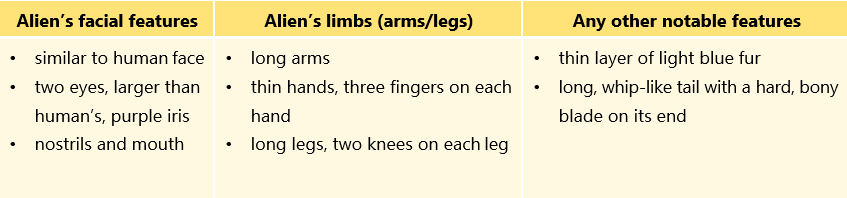
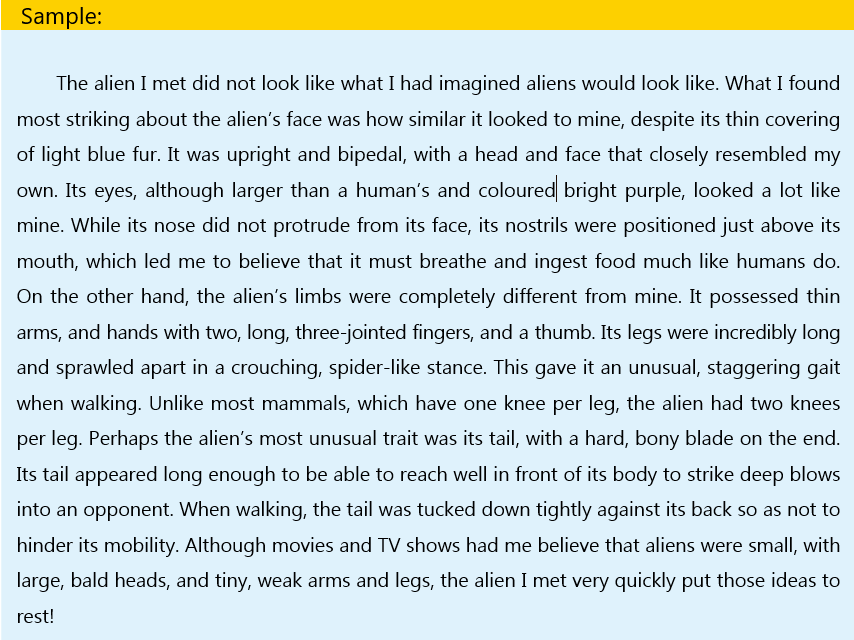
Topic sentence: Thealien I met did not look like what I had imagined aliens would look like.
Trait 1: What I found most striking about the alien's face was how similar it looked to mine.
Detail: It was upright and bipedal, with a head and face that closely resembled my own. Its eyes, although larger than a human's and coloured bright purple, looked a lot like mine. While its nose did not protrude from its face,its nostrils were positioned just above its mouth, which led me to believe that it must breathe and ingest food much like humans do.
Trait 2: On the other hand, the alien's limbs were completely different from mine.
Detail: It possessed thin arms, and hands with two, long, three-jointed fingers, and a thumb. Its legs were incredibly long, and sprawled apart in acrouching, spider-like stance. This gave it an unusual, staggering gait when walking. Unlike most mammals, which have one knee per leg, the alien had two knees per leg.
Trait 3: Perhaps the alien's most unusual trait was its tail.
Detail: It had a hard, bony blade on the end of its whip-like tail. Its tail appeared long enough to be able to reach well in front of its body to strike deep blows into an opponent. When walking, the tail was tucked down tightly against its back so as not to hinder its mobility.
Concluding sentence: Although movies and TV shows had me believe that aliens were small, with large, bald heads, and tiny, weak arms and legs, the alien I met very quickly put those ideas to rest!
Step 3 Use the notes in the outline to write the first draft of your paragraph. Practice the writing skill you have learned above.
Step 4 Now edit your draft, and correct the mistakes.

