-
1 Section A&nb...
-
2 Section B&nb...
-
3 Section C&nb...
Task 1Connecting with the topic
Check (√) your answers to these questions about maintaining cultural traditions.
1. How strongly do you agree with the statement that young people today do not care about maintaining their cultural traditions?
A. Strongly agree.
B. Agree.
C. Disagree.
D. Strongly disagree.
2. How important do you think it is to maintain one's cultural traditions?
A. Very important.
B. Somewhat important.
C. Neither important nor unimportant.
D. Unimportant.
3. How well do you feel that you maintain your cultural traditions?
A. Very well.
B. Somewhat well.
C.
Not very well.
D. Not well at all.
Task 2Pair work
Compare your answers to Task 1 with a partner's. How important do you both think it is to maintain one's cultural traditions? Talk with your partner.
Example:
A: Do you think that it is important to maintain your cultural traditions?
B: No, I do not.
A: Really?
B: Yes. I think that as the world becomes more connected, people's cultural traditions will slowly fade, anyway.
A: That is why I think that it is important to maintain our cultural traditions.
B: You think that our cultural traditions are in danger of being lost?
A: Yes. I do not think that we should exclude other cultures or isolate ourselves, but I think that the world would be very boring if we lost the practices that make us unique.
B: I can understand your point of view.
Task 3Previewing the passage
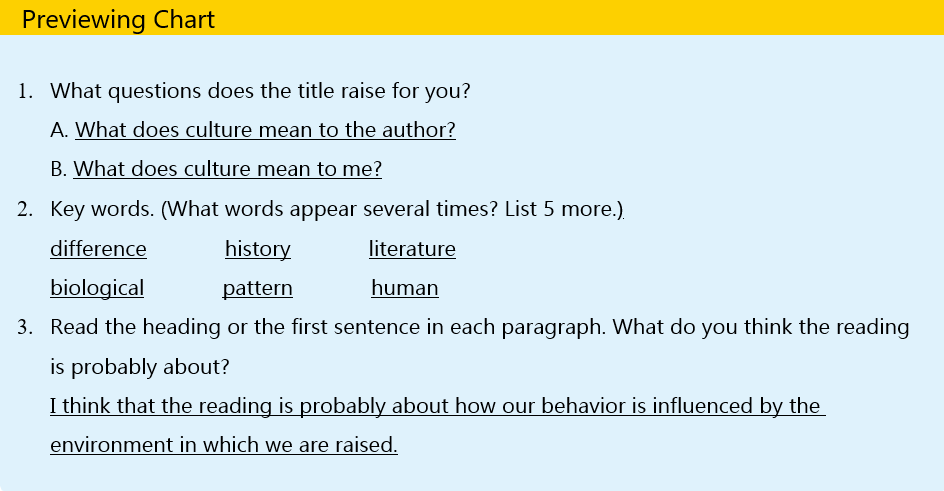
Scan Passage A to complete the Previewing Chart below.
Task 4Vocabulary skills
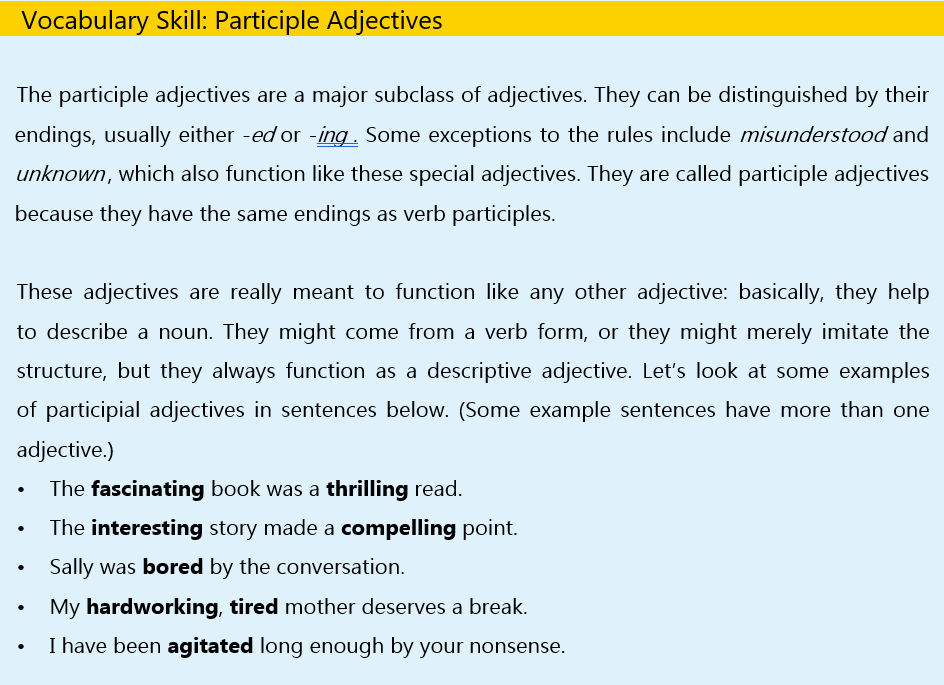
Learn participial adjectives. Complete the following sentences with the correct participial adjectives.
1. The most (annoying/annoyed) thing was that she did not speak up forme.
2. Tara was (amazed/amazing) by the dinosaur bones at the museum.
3. After the nine-hour bus ride, we were(tired/tiring).
4. I hate spiders. I think that they are(terrifying/terrified).
5. Sasha fell asleep during the movie, because she thought it was(boring/bored).
 Passage A
Culture
Clyde Kluckhohn
Cultural note:
Clyde Kluckhohn (1905–1960) was an American anthropologist and social theorist. He is known for his field work among the Navaho Indians, his contributions to the theory of culture, and his attempts to unify social sciences through interdisciplinary communication.
(译文)文化
1 By culture, anthropology means the total life way of a people, the social legacy the individual acquires from his group. Or culture can be regarded as that part of the environment that is the creation of man.
anthropology n. 人类学
...the social legacy the individual acquires from his group.
Note:“the individual acquires...” 是省略了关系代词的定语从句,修饰 “social legacy”。先行词在定语从句中做 acquire 的宾语。
legacy n. money or property that is given to you by sb. when they die 遗产;遗赠财物
e.g. The nephew got a large legacy from his late uncle.
这位侄子从他已故的叔叔那里得到了一笔很大的遗产。
We should treasure valuable cultural legacy.
我们应该珍惜宝贵的文化遗产。
acquire v . to gain sth. by your own efforts, ability or behavior 获得,得到
e.g. She acquired the property in 2015.
她在 2015 年获得这处房产。
The new colleague acquired a reputation of being hard to deal with.
新同事获得了难以对付的名声。
比较 get,gain,obtain 和 acquire,这组动词均可表“获得”。
get 用得最广,可指以各种方式获得各种东西。
gain 多指付出极大努力后获得或赢得给自己带来优势的东西,如某种利益、好处、经验等
obtain 多指凭努力或恳求得到急需或很想得到的东西
acquire 强调通过不断的、持续的努力而获得某物,也指日积月累地渐渐地获得(书面语用词)
Where can I get enough information?
我从哪儿能得到足够的资料?
What he had done in the war gained their respect.
他在战争中的事迹赢得了大家的尊敬。
She had failed to obtain a scholarship.
她没能得到奖学金。
After several years of study, these African students acquired a good knowledge of Chinese culture.
经过几年的学习,这些非洲学生对中国文化有了很好的了解。
(译文)从文化的角度来说,人类学是指一个民族的整体生活方式,是个体从群体中获得的社会遗产。或者文化可以被看作是人类创造的环境的一部分。
2 This technical term has a wider meaning than the culture of history and literature. A cooking pot is as much a cultural product as is a Beethoven sonata. In ordinary speech, a man of culture is a man who can speak languages other than his own, who is familiar with history, literature, philosophy, or the fine arts...To the anthropologist, however, to be human is to be cultured. There is culturein general, and then there are the specific cultures, such as Russian, American, British, Hottentot...Each specific culture constitutes a kind of blueprint for all of life's activities.
Beethoven sonata 贝多芬的奏鸣曲
familiar (with) a. to have a good knowledge or understanding of something 熟悉;通晓
e.g. His face is familiar but I forget his name.
他的脸很熟悉,但我忘了他的名字。
As a local person, he is very familiar withthe historical sites in the city.
作为当地人,他非常熟悉这座城市的历史遗迹。
fine arts 美 术
To the anthropologist, however, to be human is to be cultured.
Paraphrase: To the anthropologist, however, culture is anindispensable part of human being.
in general通常;一般而言
Hottentot n. 霍屯督人(南非一个游牧民族的名称)
constitute v. be a part of whole 组成,构成
e.g. His behavior constitutes a threat to the peace of the country.
他的行为对该国的和平构成威胁。
His refusal to buy a condo constituted a major blow to my plan.
他拒绝买公寓,这对我的计划是个沉重的打击。
比较 consist of;be composed of;comprise;constitute
这组动词的一般含义为“组成”或“构成”。
consist of 用于主动语态
e.g. Water consists of hydrogen and oxygen.
水由氢和氧组成。
be composed of 是被动语态
e.g. Water is composed of hydrogen and oxygen.
水由氢和氧组成。
comprise 是及物动词,可以表示“包含”或“包括”:
e.g. The former Soviet Union comprised several socialist republics.
前苏联包括几个社会主义共和国。也可以表示“组成”或“构成”:
Women comprise nearly half of gamer population.
女性占游戏玩家总数近一半。
还可以用 be comprised of,等同于 be composed of
e.g. The United Kingdom is comprised of Great Britain and Northern Ireland.
英国由大不列颠和北爱尔兰组成。
constitute 是及物动词,一般多用于机构、组织的构成
e.g. Great Britain and Northern Ireland constitute the United Kingdom.
(译文)这个专业术语比历史和文学组成的文化有更广泛的含义。烹饪锅是一种文化产物,贝多芬奏鸣曲也是一样。在日常用语中,文化人是指能说自己母语以外的语言,熟悉历史、文学、哲学或美术的人。然而,对人类学家来说,人类具有文化性。有一般的文化,也有特定的文化,如俄罗斯文化、美国文化、英国文化、霍屯督文化……每种特定的文化都构成了人类生命活动的一种蓝图。
3 A good idea of human behavior can be understood and predicted, if we know a people's design for living. Many acts are neither accidental nor due to personal peculiarities nor caused by supernatural forces nors imply mysterious. Even those of us who pride ourselves on our individualism follow most of the time a pattern not of our own making. We brush our teeth on arising. Weput on pants—not a loincloth. We eat three meals a day—not five or two.
peculiarity n. something that is a feature of only one particular place, person, situation, etc.
特点,独特性
e.g. The peculiarity of his appearance made him easy to remember.
他外表的独特性使他容易被记住。
His writing characterizes a Latin American peculiarity.
他的作品具有拉丁美洲特色。
mysterious a. difficult to understand or explain; strange 神秘的;奇怪的
e.g. The death of the famous actress was mysterious to the public.
这位著名女演员的死亡对公众来说是神秘的。
Recently, she kept receiving mysterious gifts in her office.
最近,她一直在办公室里收到神秘的礼物。
individualism n. the quality of being different from other people 个人主义;利己主义
pattern n. the regular way in which something happens, develops, or is done 模式;形式
e.g. The girl in the program was so intelligent that she discovered the pattern of those numbers very quickly.
节目中的女孩非常聪明,很快发现了这些数字的模式。
The police found out the pattern of these cases.
警方发现了这些案件的模式。
Even those of us who pride ourselves on our individualism follow most of the time a pattern not ofour own making.
Paraphrase: For most of the time, even the most unique individuals of us have a certain set of
behaviors that conforms to common practice.
arisev.to get up; to happen; to start to exist 起床;发生;出现;
e.g. If the opportunity arises, I'd like to revisit Chongqing.
如果有机会,我想重访重庆。
A conflict arose because of misunderstanding between the couple.
这对夫妻由于误解而产生了冲突。
pants n. 裤子;长裤
loincloth (某些热带国家男子的)缠腰布,遮羞布
(译文)如果我们知道一个民族对生活构想,那么关于人们行为的想法就可以被理解和预测。
许多行为既不是偶然的,也不是由个人的特性导致而成,也不是由于超自然的力量或简单的神秘力量。即使是那些为自己的个性感到自豪的人,大多数时候也遵循着一种不是我们自己创造的模式。我们一起床就刷牙。我们穿长裤而不是缠腰布。我们一天吃三顿饭,而不是五六顿。
4 To the American woman asystem of plural wives seems “instinctively”abhorrent. She feels it is “unnatural”. On the other hand, a Koryak woman of Siberia, for example, would find it hard to understand how a woman could be so selfish and so undesirous of feminine companionship in the home as to wish to restrict her husband to one mate.
instinctively ad . based on instinct and not involving thought 本能地
e.g. Human beings can know a person instinctively.
人类能本能地认识一个人。
She knew instinctively that the man was dangerous.
她本能地知道这个男人很危险。
abhorrent a. causing hatred, especially for moral reasons 令人厌恶的,令人憎恨的
e.g. The man committed an abhorrent crime.
该男子犯下了令人憎恶的罪行。 Racial segregation is abhorrent to me. 种族隔离让我感到厌恶。
On the otherhand, a Koryak woman of Siberia, for example, would find it hard to understand how a woman could be so selfish and so undesirous of feminine companionship in the home as to wish to restrict her husband to one mate.
Paraphrase: On the other hand, a Koryak woman of Siberia, for example, cannot understand
why a woman doesn't want her husband to have more wives. They believe it is a selfish act and they like to have female companions at home.
Koryakn. 科利亚克人(居住在西伯利亚的东北部区域)
Siberia n. 西伯利亚
undesirous (of) a. 无欲望的
e.g. Sometimes a bad mood makes people undesirous of food.
有时心情不好会让人不想吃东西。
I am undesirous of going shopping because of an upcoming exam.
因为即将到来的考试,我不想去逛街。
feminine a. 女性的;阴性的
e.g. The star was famous for hip-hop and being feminine.
这位明星以嘻哈和女性化而闻名。
In some languages, words are feminine or masculine.
在一些语言中,词是阴性或者阳性的。
maten. a husband, wife or other sexual partner 配偶;性伴侣
(译文)对美国妇女来说,一夫多妻制似乎是“本能地”令人憎恶的。她们觉得这是“反自然的”。另一方面,例如,一个西伯利亚的科利亚克女人,会发现很难理解一个女人怎么会如此自私,如此不希望在家里有女人做伴,以至于希望限制她的丈夫寻找多个配偶。
5 Some years ago I met in New York City a young man who did not speak a word of English and was obviously bewildered by American ways. By “blood” he was American, for his parents had gone from Indiana to China as missionaries. Orphaned in infancy, he was reared in a remote village. All who met him found him more Chinese than American. The facts of his blue eyes and light hair were less impressive than a Chinese style of gait, Chinese arm and hand movements, Chinese facial expression, and Chinese modes of thought. The biological heritage was American, but the cultural training had been Chinese. He returned to China.
Some years ago I met in New York City a young man who...
Note:该句中,地点状语从句 “in New York City” 置于宾语 “a young man” 前,是为了突出句尾的宾语结构。
bewilderv. to confuse sb. 使迷惑;使糊涂
e.g. The little boy looked at the stranger, bewildered.
小男孩看着这个陌生人,感到不知所措。
His foreign accent bewildered me.
他的外国口音让我感到困惑。
Indiana n . 印第安纳州(美国中部的州)
missionary n. 传教士
Orphaned in infancy, he was reared in a remote village.
Note: “Orphaned in infancy” 是过去分词结构做原因状语。
orphan n. a child whose parents are dead 孤儿 v. deprive of parents 使…成为孤儿
e.g. The orphan lived withher grandparents.
这个孤儿与她的爷爷奶奶住在一起。
He was orphaned after his parents' car crash.
父母车祸后,他成了孤儿。
infancy n . the time when a child is a baby orvery young 婴儿期;幼儿期
rear v. to care for young children or animals until they are fully grown 抚养;养育
e.g. It is parents' duty to rear the children.
抚养孩子是父母的责任。
After the parents passed away, the eldest son took the responsibility of rearing the sisters and brothers.
父母过世后,大儿子承担起抚养弟弟和妹妹的责任。
gait n . the way someone walks 步伐,步态
e.g. Although it is dark, I recognized him by his gait.
虽然天黑,我通过走路的姿态认出是他。
The old lady walked with a slow stiff gait.
这位老太太步态缓慢又迟钝。
faciala. 脸上的;面部的
e.g. When I talk to strangers, I like to notice their facial expressions.
当我和陌生人交谈时,我喜欢注意他们的面部表情。
She likes to buy facial cosmetics when travellingaboard.
在国外旅行时,她喜欢购买面部护肤品。
mode n. a particular way of doing sth. 方式;风格
e.g. The press often discussed her changing mode of dress.
媒体经常讨论她不断变化的着装风格。
There are differences in the thinking modes between Chinese and Westerners.
中国人和西方人的思维方式存在差异。比较 mode 和 pattern
mode 指某一方面特定的行事模式,如衣着、举止等
pattern 指已经发生的或正在发生的事情模式、形式
e.g. Nowadays, people advocate the mode of low-carbon living.
如今,人们倡导低碳生活模式。
In digital era, the traditional learning mode is changing.
在数字时代,传统的学习模式正在发生变化。
There are different patterns of education in Germany and China.
德国和中国有不同的教育模式。
The show is asuccess in that it departs from the normal patterns of reality show.
该节目取得了成功,因为它偏离了真人秀节目的正常模式。
heritage n . the traditional beliefs, values, customs, etc. of a family, country, or society 遗产; 传统
e.g. We should teach our children to appreciate our country's heritage.
我们应该教育我们的孩子欣赏我们国家的传统。
The researcher talks with a lot of people to study the heritage of Wu dialect.
研究人员与很多人交谈,研究吴方言语言遗产。比较legacy 和 heritage
heritage 作可数名词或不可数名词均可。可以指传给后嗣或世代相传的任何物质的或精神的东西,包括传统、权力、手艺、事业、影响等
legacy 作可数名词。可以指按遗嘱继承的动产;引申义指从祖先继承下来的品质、理论、权力等精神方面或物质方面的东西
(译文)几年前,我在纽约遇到一个年轻人,他一句英语也不会说,显然对美国人的生活方式感到困惑。从血缘上来说他是美国人,因为他的父母是从印第安纳州去往中国的传教士。他幼年时成了孤儿,在一个偏僻的村庄里长大。所有见过他的人都认为他更像是中国人而不是美国人。虽然他的眼睛是蓝色的,头发是浅色的,但他那中国式的步态、中国式的手臂和手的动作、中国式的面部表情和中国式的思维方式更令人印象深刻。他的生物学遗产是美国的,但文化培训是中国的。后来他回到了中国。
6 A teacher with long and successful experience in the public schools of Chicago was finishing her first year in a North American Indian school. When asked how her Navaho pupils compared in intelligence with Chicago youngsters, she replied, “Sometimes they seem just as bright. Other times they just act like dumb animals. The other night we had adance in the high school. I saw a boy in my English class standing by himself. So I took him over to a pretty girl and told them to dance. But they just stood there with their heads down.” I inquired if she knew whether or not they were members of the same clan. “What differenc ewould that make?”
When asked howher Navaho pupils compared in intelligence with Chicago youngsters, she replied...
Note: 此处 when 引导的时间状语从句中省略了主语和助动词 “she was”,这是因为从句中的主语和主句一致,因此可以省略。
Navaho n . ( 北美印第安人 ) 纳瓦霍人
youngster n . a young person or a child 年轻人;少年
dumb a . unable to speak; stupid 哑的;笨的
e.g. The teacher has never imagined such a dumb and ill-behaved student would become a famous scientist.
老师从来没有想到这样一个迟钝和表现差的学生会成为一名著名的科学家。
He used body gestures to make himself understood by the deaf and dumb girl.
他用肢体语言让这个聋哑女孩明白他的意思。
inquire v. ask someone for information 询问,打听
e.g. It's impolite toinquire about a person's salary if you are not intimate.
如果你们关系不亲密,询问一个人的工资是不礼貌的。
He called his friend to inquire about his recovery.
他打电话给他的朋友询问他的恢复情况。比较 ask 和 inquire
ask 指问有关……情况
inquire 通常含有对知识或真理进行全面探索的意思,在这个意义上,它指对某种情况简单咨询
e.g. I ask a passer-by how to get the destination.
我问路人如何到达目的地。
The journalist asked too many questions in the press conference.
这位记者在新闻发布会问了太多的问题。
You need to call the travel agency to inquire about the ticket price and schedule.
您需要致电旅行社查询机票价格和时间表。
clan n. a large group of families who oftenshare the same name 家族,宗族
e.g. The whole clan gathered for the Spring Festival.
整个家族聚在一起迎接春节。
There are two big clans in the village.
村里有两个大家族。
(译文)一位教师在芝加哥公立学校有着长期的成功经验,她即将结束在北美印第安人学校教学的第一个年头。当被问及她的纳瓦霍学生在智力上与芝加哥的年轻人相比如何时,她回答说 :“有时他们看起来和芝加哥的孩子一样聪明。其他时候他们就像愚蠢的动物一样。前几天晚上, 我们在高中举办了一场舞会。我看见有一个我英语班上的男孩独自站着。所以我把他带到一个漂亮的女孩面前,让他们跳舞。但他们只是低着头站在那里。”我问她是否知道他们是否属于同一个家 族。“那又有什么关系呢 ?”
7 “How would you feel aboutgetting into bed with your brother?” the teacher walked off, but, actually, the two cases were quite comparable in principle. To the Indian, the type of bodily contact involved in our social dancing hasa sexual connotation. The incest taboos between members of the same clan are as severe as between true brothers and sisters.
in principle with regard to thebasics 大体上,原则上
e.g. In principle, I support his plan but it still needs improving.
大体上,我支持他的计划,但它仍需要改进。
He has no difficulty in principle paying off the debts.
原则上,他偿还债务没有困难。
sexual a. 性的;性别的
connotation n. an idea suggested by a word in addition to its main meaning 含义;隐含意义
e.g. The word has a negative connotation in such circumstance.
在这种情况下,这个词具有负面含义。
France holds aconnotation of romance and fashion.
法国意味着浪漫和时尚。
incest n. sex between people who are closely related in a family 乱伦;近亲通婚
taboo n . a cultural or religious custom that does not allow people to do,use or talk about a
particular thing as people find it offensive or embarrassing (文化或宗教习俗方面的)禁忌,忌讳
e.g. Abortion is a tabootopic in some countries.
在一些国家,堕胎是一个禁忌话题。
When you talk with foreigners, be careful not to mention some taboo subjects.
当你与外国人交谈时,要注意不要提及一些禁忌话题。
(译文)“你觉得和你哥哥上床怎么样 ?”老师走开了,但实际上,这两种情况在原则上是相当相似的。对印第安人来说,我们的交际舞中身体的接触具有性的内涵。同族成员之间的乱伦禁忌和真正的兄弟姐妹之间的乱伦禁忌一样严重。
8 All this does not mean thatthere is no such thing as raw human nature. The very fact that many of the same institutions are found in all known societies indicates that, at bottom, all humanbeings are very much alike. The members of all human groups have about the same biological equipment. All men undergo the same poignant life experiences, such as birth, helplessness, illness, old age, anddeath. The biological potentialities of the species are the blocks with which cultures are built. Some patterns of every culture crystallize around focuses provided by the inevitables of biology: the difference between the sexes, the presence of persons of different ages, the varying physical strength and skill of individuals.
The very factthat many of the same institutions are found in all known societies indicates that, at bottom, all human beings are very much alike.
Note: 该句的主语是由“fact+ 同位语从句”构成。跟在 fact 后由that 引导的从句为同位语从句。
equipment n . 设备;器材
undergo v. to experience sth., especially a changeor sth. unpleasant 经历,经受
e.g. You can't imagine what the woman has undergone in that tough time.
你无法想象那个女人在那个艰难时期经历了什么事情。
After the accident, she had toundergo major surgery.
事故发生后,她不得不接受大手术。
比 较 undergo 和 undertake
undergo 指经历某事,通常是变化或者令人不快的事情
undertake 指着手做和从事,侧重担负起责任
e.g. To avoid bankruptcy, the company needs to undergo a radical reform.
为避免破产,公司需要进行彻底的改革。
The students had to undergo a test right before the holiday.
学生们在假期前要考试。
He undertook the design of the new bridge.
他承担了新桥的设计任务。
You should think twice before undertaking the formidable task.
在承担这项艰巨的任务之前,你应该三思而后行。
poignant a. having a strong effecton your feelings, especially in a way that makes you feel
sad 令人沉痛的;悲惨的
e.g. The photograph evoked poignant memories of his childhood.
这张照片唤起了他童年的悲惨回忆。
It is poignant that her father died on the day of her wedding.
她的父亲在她婚礼那天去世,这让人感到沉重。
Some patterns of every culture crystallize aroundfocuses provided by the inevitables of biology: the difference between the sexes, the presence of persons of differentages, the varying physical strength and skill ofindividuals.
Paraphrase: Biology causes some inevitable phenomenaand outcomes in human society, such as the existence of two sexes, people at varying ages, difference in physical strength and skill among different people. They have provided sources for developing certain culture patterns.
potentiality n . a power or a quality that exists andis capable of being developed
潜力 ; 潜在的可能性
e.g. There is a strong potentiality for her mother to stop her from getting married to him.
她的母亲很有可能阻止她与他结婚。
The girl has great potentiality to become a star.
这个女孩有很大的潜力成为明星。
species n . a group of animals or plants whose members are similar and can breed together to produce young animals or plants(动植物)物种,种类
crystallize v. 使结晶;使成形;使具体化
e.g. Discussion is helpful to crystallize the thought.
讨论有助于使思想成形。
A presentation crystallized our ideas to reconstruct the earthquake-stricken area.
展示使我们重建地震灾区的想法具体化。
presence n. the fact of being in a particular place or thing 存在;出现
e.g. The young performer was overwhelmed by the presence of so many audience.
如此多的观众使这位年轻的表演者感到不知所措。
I was usually quiet in his presence.
在他面前,我通常很安静。
(译文)所有这些并不能否认原始人性的存在。在所有已知的社会中都发现了许多相同的制度,这一事实表明,从根本上说,所有的人类都非常相似……所有人类群体的成员都拥有相同的生物学器官。所有的人都经历着同样痛苦的人生经历,如出生、无助、疾病、衰老和死亡。物种的生物潜能是构成文化的基石。每种文化的某些模式都围绕着生物学不可避免的特性所提供的焦点而具体化:性别差异、不同年龄的人的存在、因个体而异的体力和技能。
Understanding the Reading
Task 1 Identifying main ideas
Complete the summary with key information from the passage. More than one answer may be possible.
We usually think of people of culture as being able to 1. speak languages other than their own, and who are familiar with literature and the arts. To anthropologists, however, all humans are 2. cultured, in that the world's cultures constitute a sort of blueprint for different human activities. For example, to an American woman, a system of 3. plural wives may seem abhorrent, but this system is the norm in other cultures. All humans share 4.the same biology and undergo the same life experiences, but it is the culture that we 5. grow up in that truly shapes us.
Task 2 Reading for details
The following statements about the details in the passage are incorrect. Correct them on the lines according to your understanding.
1. In ordinary speech, a person of culture is someone who is poorly educated and lazy. In ordinary speech, a person of culture is someone who can speak languages other than his/her own, who is familiar with philosophy, literature, and the fine arts.
2. None of the world's specific cultures have anything to do with why we behave the way we do.
Each of the world's specific cultures constitutes a blueprint for all of our human activities.
3. Those of us who pride ourselves on our individualism most of the time do things that no other people do.
Even those of us who pride ourselves on our individualism follow patterns that are not of our own making.
4. The Koryak women of Siberia are married to one man throughout their entire lives. The Koryak women of Siberia participate in a social system that allows men to have more than one wife.
5. The author met a man in New York City who was born to Chinese parents and raised in the UnitedStates.
The author met a man in New York City who was born to American parents, but orphaned as a baby and raised in a remote Chinese village.
Task 3Note answers to the questions below. Discuss with a partner.
1. What are three things that define a culture?
Suggested answer:
Three things that define a culture are traditional music, a common language, and traditional food.
2. Why do you think that culture is important?
Suggested answer:
I think that culture is important, because it influences every part of people's lives, such as their views and their values. Culture also creates a sense of unity and belonging among a group of people.
3. What are three respectful ways that people can explore cultures that are different from their own?
Suggested answer:
People can respectfully explore cultures that are different from their own by engaging with people ofother cultures and backgrounds in their community, traveling to and visiting places where they can be immersed in culture, and to make sure that, when buying art that is unique to another culture, they refrain from purchasing pieces which are sacred to the people of that culture.
Exploring Vocabulary
Task 4These sentences are about the passage. Complete them with the target words and phrases in the box. Change the form when necessary.

When anthropologists refer to culture, they refer to the social legacy that one acquires from his or her group.
Even those of us who identify as free thinkers follow patterns that we do not choose to follow, such as brushing our teeth when we arise, or eating three meals each day.
All people undergo the same patterns of human development.
The man who the author met in New York City was orphaned as a baby, and reared in a remote village.
A person of culture is generally understood to be someone who is familiar with the fine arts, philosophy, or literature.
Sometime ago, the author met a young man who spoke no English, and was bewildered by American ways.
The author inquired if the teacher knew whether or not the two Native American students were members of the same clan.
Manyof our actions are not caused by any mysterious forces, but are instead products of the environment we were raised in.
Every particular culture constitutes a sort of blueprint for all of life's activities.
Most American women would consider the system of having more than one wife to be abhorrent.
Task 5These sentences use the target words and phrases in new contexts. Complete them with the words and phrases in the box. Change the form when necessary.

1. His face looks so familiar that I am certain that I have seen him before.
2. Should the opportunity arise, I would love to go to Hawaii.
3. I need to inquire about the price of tickets.
4. The driver was confused by the bewildering road signs.
5. The planes now have to undergo very thorough safety checks.
6. How did the gallery acquire so many famous paintings?
7. Ten years constitutes a decade.
8. My mother reared four sons on her own.
9. Tara was curious to find out more about her mysterious newneighbour.
10. Discrimination is abhorrent in any civilized society.
Task 6Word forms
Lookback over the passage, or consult your dictionary to find the missing wordforms in the chart. After completing the chart, for each sentence below, look at the row in the chart with the same number, choose the correct word form to complete the sentence.
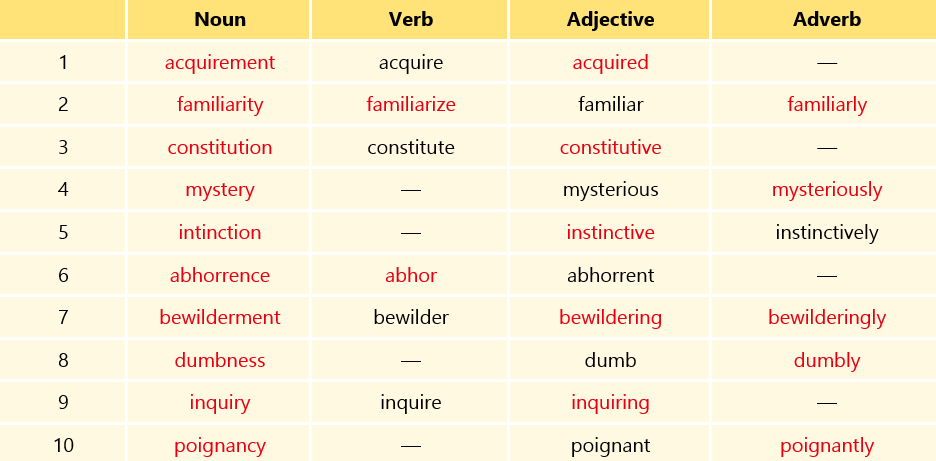
1. Yuri acquired his knowledge of French through careful study.
2. Employees must familiarize themselves with our new office policies.
3. Language is constitutive of thought.
4. The film is about a group of girls who mysteriously disappeared while on a picnic at
Hanging Rock.
5. Jane instinctively knew that her best friend was worried about something.
6. Spitting in the street is ahabit that I abhor.
7. I found the directions to her house completely bewildering.
8. I shook my head dumbly, refusing to believe the news.
9. A(n) inquiry was launched to determine the cause of the accident.
10. Of particular poignancy is this photo that he took with his sisters the day before he died.
Task 7Collocations
Use collocations from the passage to complete the sentences below. Some of the words or phrases are given in the brackets. More than one answer may be possible. Example:
I can't come over tonight, because I need to get over this mountain of math homework. (get over)
1. I am not familiar with that movie. What is it about?(familiar)
2. Go and stand by the door to make sure that no one leaves until we have counted everyone. (the door)
3. The little girl got into bed with her older sister after having had a bad dream.(bed)
4. I cannot imagine having to undergo such a frightening experience.(a frightening experience)
5. I usually brush my teeth after I eat breakfast.(teeth)
Task 8Reading in depth
There is a short passage with 10 blanks. You are required to selectone word for each blank from a list of choices given in the box following thepassage. Read the passage through carefully before making your choices. You maynot use any of the words in the bank more than once.
While many people may assume that Canada and the United States are nearly 1.identical culturally, there are several 2. notable differences between how people in Canada behave versus how people in the U.S. behave. Forexample, Canadians are known for 3. apologizing, which has earned them the global 4. reputation of being more polite than Americans. In Canada, when it comes to mild physical 5. blunders, such as stepping on someone's feet, or bumping into someone, both parties will often say “sorry” for the mistake. Canadians are also generally more 6.reserved than Americans in 7. conversation with strangers. Being overly familiar with someone, which is common in American customer service, may be interpreted as insincere or 8.disrespectful in Canada. In addition, it is commonly 9. accepted as polite behavior to remove one's shoes when entering someone's house in Canada. However, this 10. practice is less common in the United States.
Sentence Structures
Task 9Construct the sentences with the given words or phrases, following the model.
Model 1:
Many acts are neither accidental nor due to personal peculiarities nor caused by supernatural forces nor simply mysterious.
【neither...nor...(nor)...,表示“不是…也不是…(也不是)…”】
1. my mother, my father, came, meet withteacher
→ Neither my mother nor my father came to meet with my teacher.
2. my father, drink, smoke
→ My father neither drinks nor smokes.
3. my grandfather, read, write, still a very wise man
→ My grandfather could neither read nor write, but he was still a very wise man.
Model 2:
It is hard to understand how a woman could be so selfish and so undesirous of feminine companionship in the home asto wish to restrict her husband to one mate.
【so...as to..., 表示“如此…以至于…”】
1. angry with me, try to ruin my presentation
→ Do you think that Kim could be so angry with me as to try to ruin my presentation?
2. my parents, busy with theirwork, forget to take me to my dance class
→ It is common for my parents to be so busy with their work as to forget to take me to my dance class.
3. worry about the test today, stay home
→ I have trouble believing that Maia could be so worried about the test today as to stay home.
Task10 Sentence translation
Translate the followingsentences into English, using the words and phrases in the brackets.
1. 在学校,我们不仅学到了知识,而且学会了如何与人交流。(acquire)
In school, not only do we acquire knowledge but we learn how to communicate with people.
2. 你所做和所说的是对我的一种侮辱。(constitute)
What you have done and said has constituted an insult to me.
3. 他模棱两可的态度令我迷惑不解。(bewilder)
His ambiguous attitude bewilderedme.
4. 当我们去国外旅行时,我们要尊重他们的传统,不打破他们的禁忌。(taboo)
When we travel to foreign countries, we should respect their traditions and do not violate their taboo.
5. 所有人都会经历同样的痛苦生活。(undergo, poignant)
All men will undergo the same poignant life.
Task11 Passage translation
Translate the following passage into English. Try to use the words and phrases from Passage A as many as possible.
当你在国外学习时,你将沉浸在一个充满令人兴奋的新思想和传统的世界中。这对你来说是一个了解这个国家及其文化的好方法。但是,你会惊讶于一些小事在不同的文化中可能产生的误解。语言障碍是文化误解的主要来源。对于任何一个说外语的人来说, 他们会不可避免地误用某些单词,或者不小心说出一些冒犯性(offensive)的话。除了语言,礼仪上的差异也会引起误解。例如,当有人在讲话时,日本人经常说“是的”,“好的”,这是为了让说话者知道听者在听。然而,在美国,如果一个人在别人说话的时候不停地说话,这就表明他不是真的在听,或者他对这个话题不太感兴趣。
·
For your reference:
When you are studying in a foreign country, you will be immersed in a world of exciting new ideas and traditions. Studying abroad is a fantastic way for you to learn about a country and its culture. However, you'd be surprised by how some tiny things can cause huge misunderstandings in different cultures. Language barriers are a main source of cultural misunderstandings. For anyone who speaks a foreign language, it seems inevitable that you may use words incorrectly, or accidentally say something offensive. Besides differences in language, differences in mannerism can cause misunderstandings, too. For example, Japanese people often say words like "Yes" and "Okay" while someone is talking, to let the speaker know that the listener is following. However, in America, if a person keeps speaking while others are speaking, it suggests that he or she isn't really listening to what is being said or isn't very interested in the topic.
Critical Thinking and Discussion
Task12Work in a small group
Discuss the question: What are the pros and cons of marrying outside of your culture? Write your supporting ideas in the chart. Use the words or phrases in the passage when discussing in your group.