Writing Business Reports
Business and industry often use short reports. They may be proposals, progress reports, trip reports, completion reports, investigation reports, feasibility studies, or evaluation reports. These various reports have different purposes and sometimes different structures, but all are written to communicate to an audience.
Short reports may follow a formal format:
Title Page
• Title page includes the title of the report (indicates the maintopic and purpose of the report).
• The author's name and author's title.
• The person and/or organization who requested the report.
• Date of completion.
Table of Contents—In reports of six pages or less, the table of contents may be omitted. However, in longer reports, a table of contents is included to help the reader find information more quickly.
Executive Summary—This is a summary of the report's purpose and organization, the methods used, and any major conclusions and recommendations.
Body—It contains the substance of the report and generally includes the following sections in this order:
Introduction: Explains what the report is about and why it was written.
Discussion: Presents the facts and information that were gathered or examined.
Conclusion: Summarizes the findings and main points, does not introduce any new information.
Recommendation: If appropriate, recommend a plan ofaction based on the facts provided in the body of the reports.
Endnotes—If included, endnotes provide additional information, such as appendices, references and bibliographies.
New Your Turn:
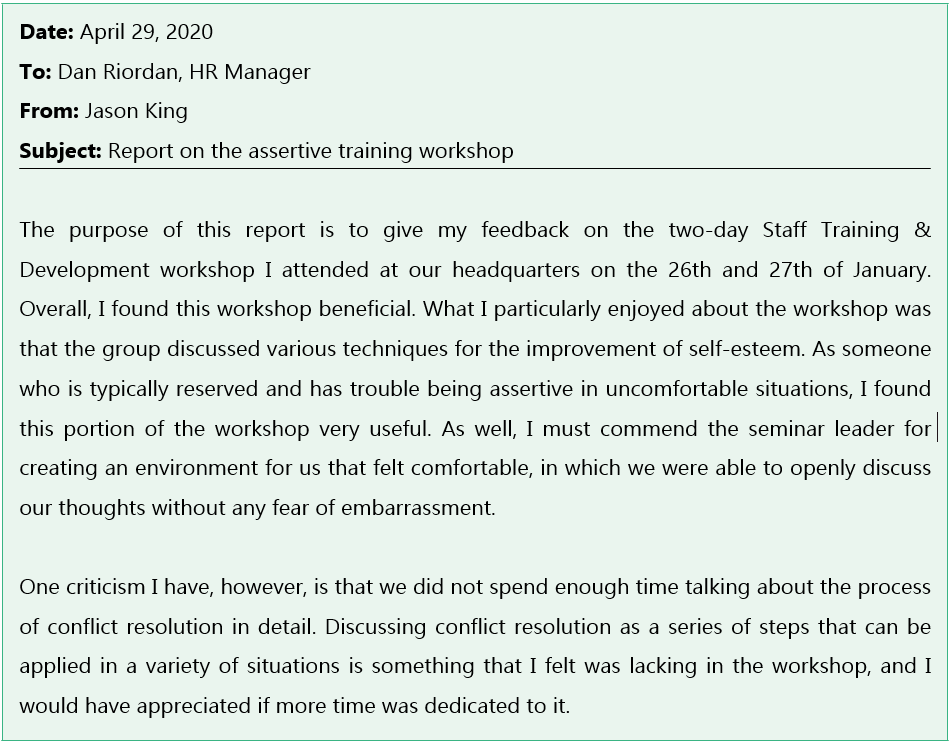
You recently attended an assertive training workshop organized by the department. The head of HR has asked you to write a short report (about 200 words) about the training.
In your report:
1. Describe what you liked about the workshop and what you found useful.
2. Mention one point that you didnot like and explain.
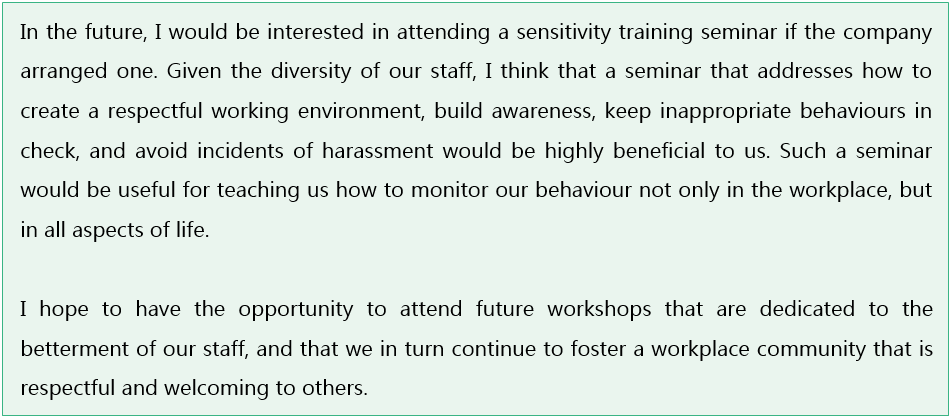
3. Describe one course or workshop you would like to attend in the future.
4. Explain how this course or workshop would be useful to you and to the company
For your reference: