
Writing Skill: Writing an Argumentative Paragraph
Being able to make strong arguments is an important part of academic writing. Arguments are used to convince other people that your view is true. Thus, the more logical your arguments are, the better they will be. The key to successful argumentative writing is, therefore, your ability to write a strong argumentative paragraph.
You may use the following outline as a guide to writing argumentative paragraphs:
1. Topic sentence(claim)
2. Example 1(evidence)
3. Development and explanation of example1
4. Example 2(evidence)
5. Development and explanation of example2
6. Concluding sentence
You may also use concessions in your argumentative writing. A concession is the acknowledgment of a point made by an opponent before rebutting it, or proving that it is wrong. For example:
Concession: Some critics argue that it is a good idea to allow students to usecell phones in class, because students can use them to look up new words and perform research.
Rebuttal: While this maybe true sometimes, it is more likely that cell phones in class are detrimental to students, because students grow too dependent on them, and become unable to think for themselves.
For a writing assignment, you may be asked to agreeor disagree with a particular viewpoint.
The following phrases can help your arguments flow more smoothly:
• One of the main argument in favour of...
• On the other hand... (use proper transitions to counter argue the same idea)
• Some people argue against...
• I generally agree with the idea that...
• There are a number of strong arguments to support the idea that...
• I do not share the view that...
Read the following argumentative paragraph. Underline the topic sentence and examples. Pay attention to the phrases the author uses to make an argument.
“The intensity of UV rays in a particular area is the most important factor in determining skin cancer fatality rates inthat area.” Do you agree? UV intensity is not the most important factor in skin cancer fatalities. While residents of Colorado (mean elevation of 2.1 km) have always been subjected to the highest UV intensities inthe United States, Colorado has one of the lowest skin cancer fatality rates of all the states. In contrast, New England, which has much lower UV intensities, has a death rate from skin cancer 25% higher than it is in Colorado.In addition, although equatorial regions have higher UV intensities, the lowest reported skin cancer death rates in the world come from Mauritius (0.2 per 100,000) and Nicaragua (0.2 per 100,000). On the other hand, Ireland (2.64 per 100,000) has the world's third-highest rate. The evidence is strong that UV intensity is not the principal factor in determining the skin cancer death rate. Genetic factors, skin pigmentation, behavioral characteristics, medical facilities, broad straw hats, and sunscreen lotion all have some influence on skin cancer fatalities.
Writing Task
You are going to write a paragraph on the following topic: How arts education benefits students
Step 1 Brainstorming for ideas
Note two or more ideas and then share them with a partner.

Step 2 Planning
Follow the outline to make notes for your paragraph. Don't write complete sentences.
Outline
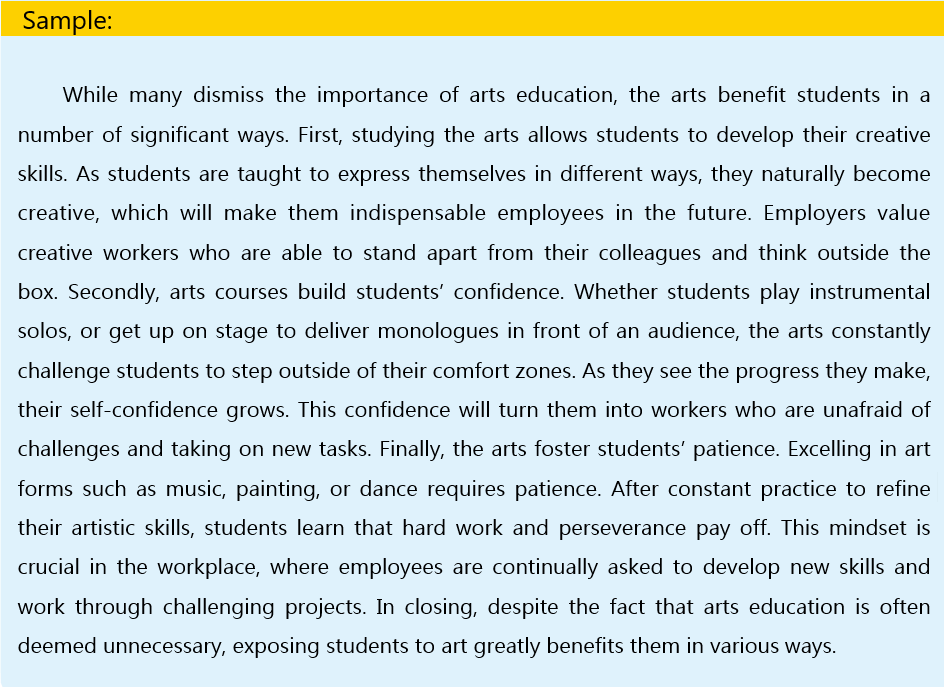
Main argument: Arts education benefits students.
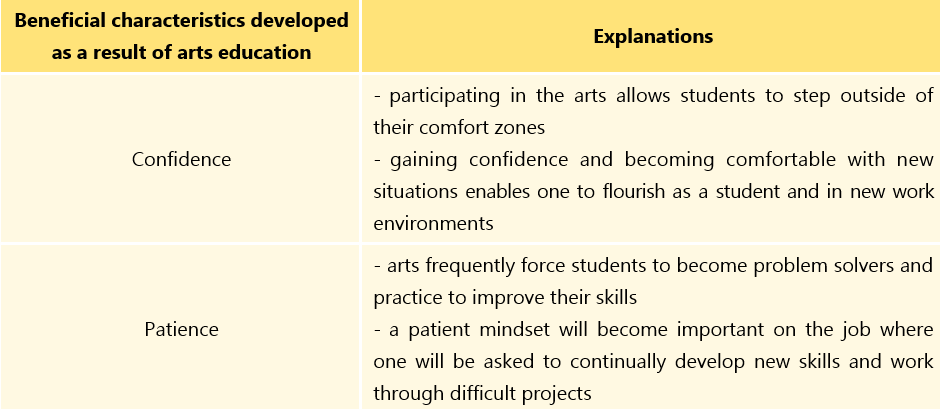
Supporting example 1: Studying the arts allows students to develop their creative skills. Concession(optional): Details:As students are taught to express themselves in different ways, they naturally become creative, which will make them indispensable employees in the future. Employers value creative workers who areable to stand apart from their colleagues and think outside the box.
Supporting example 2: Arts courses build students' confidence.
Concession(optional):
Details: Whether students play instrumental solos, or get up on stage to deliver monologues in front of an audience, the arts constantly challenge students to step outside of their comfort zones. As they see the progress they make, their self-confidence grows. This confidence will turn them into workers who are unafraid of challenges and taking on new tasks.
Supporting example 3: The arts foster students' patience.
Concession(optional):
Details: Excelling in art forms such as music, painting, or dance requires patience. After constant practice to refine their artistic skills, students learn that hard work and perseverance pay off. This mindset is crucial in the workplace, where employees are continually asked to develop newskills and work through challenging projects.
Step 3 Use the notes in the outline to write the first draft of your paragraph. Practice the writing skill you have learned above.
Step 4 Now edityour draft, and correct the mistakes.

