-
1 Section A&nb...
-
2 Section B&nb...
-
3 Section C&nb...
Task 1Connecting with thetopic
Check (√) your answers to these questions about art.
1. Which of the following art forms is the most appealing to you?
A. Filmmaking.
B. Creative writing.
C. Music.
D. Fine art (painting, sculpture, photography, architecture,etc.)
2. Which of the following do you think is the most important characteristic of good art?
A. Being displayed in a museum or gallery.
B. Being pleasing to look at.
C. Responding to society.
D. Connecting with humane motions.
3. Which of the following do you think is the most important reason that we need art?
A. It helps us express emotions.
B. It connects us to others.
C. It relieves stress.
D. It documents our history.
Task 2Pair work
Compare your answers toTask 1 with a partner's. Do you both find the same art forms most appealing? Talk with your Partner.
Example:
A: Do you like art?
B: I like most art forms.
A: Which art form do you like the best?
B: I enjoy fine arts. This includes painting, drawing, photography,and sculpture.
A: I do not have the patience for such art forms. I find them boring.
B: Which art form do you find most appealing?
A: I have always enjoyed music the most. I love hearing a song that connects with me emotionally. Some songs have made me cry.
B: Some songs have made me cry, too. I agree that music can be very powerful.
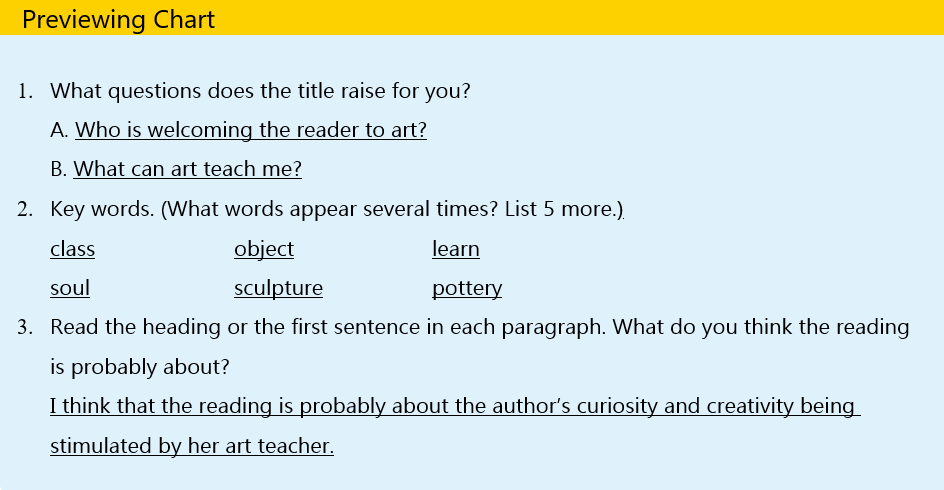
Task 3Previewing the passage
Scan Passage A to complete the Previewing Chart below.
Task 4Vocabulary skills
Learn figures of speech. Read the sentences from Passage A below, and identify the type of figures of speech for each sentence.
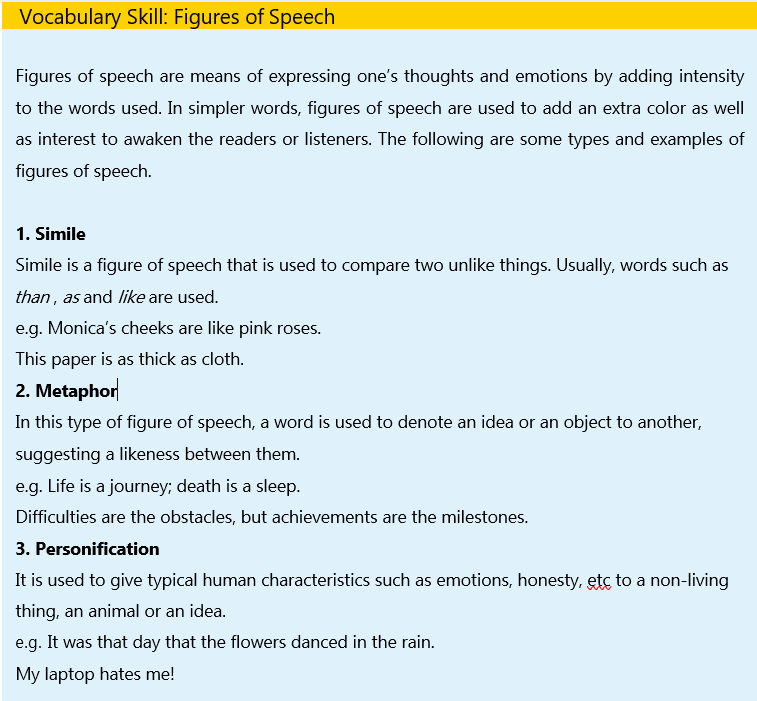
1. Art follows lunch, like dream follows nightmare. (Para. 1)—simile
2. Big old grasshopper body. (Para. 2)—metaphor
3. Nose like a credit card sunk between his eyes. (Para. 2)—simile
4. Can the plural possessive express the feelings in your heart? (Para.6)—
personification
5. But there's a catch—by the end of the year, you must figure out how to make your object say something, express an emotion, speak to every person who looks at it. (Para.10)—personification
Passage A
Welcome to Art
Laurie Halse Anderson
(译文)欢迎来到艺术课堂
1 Art follows lunch, like dream follows nightmare. The classroom is at the far end of the building and has long, south-facing windows. It is dusty in a clean-dirt kind of way. The floor is layered with dry splotches of paint, the walls plastered with sketches of tormented teenagers and fat puppies, the shelves crowded with clay pots. A radio plays my favorite station.
nightmare n. a very frightening dream 噩梦;梦魇
dusty a. covered with dust 布满灰尘的
e.g. There is a dusty sofa in the deserted room.
空无一人的房间里有一个满是灰尘的沙发。
We are driving on a dusty road.
我们驾车在一条尘土飞扬的路上飞驰。
splotch n. a smear of liquid 斑 点
paint n. 油漆;颜料 v . 在…上刷油漆;用颜料画
plaster v. to cover something with a substance to an excessive point 粘贴;涂以灰泥
e.g. Before they moved in, they plastered the wall.
在搬进来之前,他们重新涂了墙。They plastered the holes in the wall. 他们用灰泥把墙上的洞填上了。
sketch n./v. a simple picture that is drawn quickly and does not have many details 素描;速写
e.g. The artist made aquick sketch of the smiling girl.
这位艺术家快速勾勒出这个微笑的女孩。
He sketched a design for the new house.
他为新房子勾勒出一个草图。
The students are sketching the landscape.
学生们正在画素描风景画。
torment v. to experience intense pain especially mental pain 使痛苦,折磨
e.g. Don't torment yourself if the contract won't be signed.
如果合同没有签成功,不要折磨自己。
His disease was so serious that it tormented him for several years.
他的病很严重,已经折磨他好几年了。
At night, she has been tormented by the noises for several months.
几个月来,她在晚上都受到噪音的折磨。
tormented a. experiencing intense pain especially mental pain 饱受痛苦的,受尽折磨的
puppy n. 小狗;幼犬
crowd v. to fill a place so there is little room to move 挤满;塞满
e.g. Before Spring Festival, the railway station is crowded with migrant workers.
春节前,农民工挤满了火车站。
Audience crowded the auditorium to listen to the speech of the scholar.
观众挤满了礼堂,来听这位学者的演讲。
clay pot陶土罐
(译文)午饭后上艺术课,就像是摆脱噩梦迎来美梦一般。教室在大楼的尽头,那里有一扇扇朝南的长窗户。教室里积满灰尘,纯粹的灰尘。地板上是层层叠叠干透的油漆斑点。墙壁上贴着一张张草图,上面画着受难的少年和肥嘟嘟的小狗。书架上堆满陶土罐子。收音机里播放着我最喜欢的电台节目。
2 Mr. Freeman is ugly. Big old grasshopper body. Nose like a credit card sunk between his eyes. But he smiles at us as we file into class.
ugly a. unpleasant to look at 丑陋的;难看的
e.g. The beautiful natural scenery was replaced by the ugly new buildings.
美丽的自然风光被丑陋的新建筑物所取代。
She deliberately hid her ugly scar with her long hair.
她故意用长发掩盖她丑陋的伤疤。
grasshopper n. 蚱 蜢
a credit card sunk between his eyes.
Note: 该处 “sunk between his eyes”是过去分词结构做后置定语修饰 “a credit card”。
sink v. to go down below the surface 下沉,下陷
e.g. After the marathon ended, the exhausted girl sank to the ground.
马拉松结束后,这个疲惫不堪的女孩瘫倒在地。
After attacked by enemy aircraft, the battleship sank.
在被敌机袭击后,这艘战舰沉没了。
file into to walk in aline of people, one after the other, in a particular direction
鱼贯而入 ,排队进去
e.g. The students filed into the auditorium to attend a lecture.
学生们排着队进礼堂听讲座。
The cupcakes were so popular that customers filed into the store to buy them.
这家的纸杯蛋糕很流行,顾客们排队进店购买。
(译文)弗里曼先生长相丑陋。魁梧苍老的身躯活似一只大蚱蜢。鼻子就像插在两眼中间的一张信用卡。不过,当我们陆续进入教室时,他微笑着看着我们。
3 He is hunched over a spinning pot, his hands muddy red. “Welcome to the only class that will teach youhow to survive,” he says. “Welcome to Art.”
hunch v. to bend the top part of your body forward 弯腰驼背
e.g. He hunched over the type writer, preoccupied by his thoughts.
他坐在打字机前,弓着背,全神贯注地思考。
As a new driver, he hunched nervously to see clearly the road ahead.
作为一个新手司机,他非常紧张地耸起肩,想看清前方的路况。
spinv. to turn round and round quickly(使)快速旋转
e.g. The Earth spins all the time and never stops.
地球始终在旋转且永不停止。
To train yourself, spin yourbody quickly until you won't feel dizzy.
要训练你自己,就快速旋转你的身子直到你不会头晕。
pot n. 罐,瓶
(译文)他弓着身子,下面是一个旋转中的陶罐,他手上沾满暗红色的陶泥。“欢迎来上课,这是唯一可以教授你们如何生存的一门课,”他说,“欢迎来上艺术课。”
4 I sit at a table close to his desk. Ivy is in this class. She sits by the door. I keep staring at her, trying to make her look at me. This happens in movies, people can feel it when other people stare at them and they just have to turn around or say something. Either Ivy has a great force field, or my laser vision isn't very strong, she won't look atme. I wish I could sit with her. She knows art.
I keep staring at her, trying to make her look at me.
Note: “trying to make her look at me” 是现在分词结构做伴随状语。
Either Ivy has a great force field, or my laser vision isn't very strong, she won't look at
me.
Paraphrase: Either Ivy has a great force field that my vision cannot go through, or my stare is
too weak forher to feel it, she just won't look at me.
force field(分子 ) 力场
laser n. 激 光
vision n. 视线;视力
e.g. That's my vision of how the school could be.
那是我对学校的想象。
Diabetes can cause vision loss.
糖尿病会导致视力下降。
I wish I could sit with her.
Note: 该句使用了虚拟语气,是对现在的虚拟。
(译文)我坐在靠近讲台的座位上。艾维也在这里上课。她坐在靠门的地方。我一直盯着她, 想让她看我一眼。这是电影中的情节,在被人盯着看时,人们能有所感觉。他们只需扭过头,或者说些什么。要不是艾维有力场,或是我的激光视觉不够强,她没有看向我。我希望能跟她坐在一起,她懂艺术。
5 Mr. Freeman turns off the wheel, and grabs a piece of chalk without washing his hands. “SOUL,” he writes on the board. “This is where youcan find your soul, where you can touch that part of you that you've never dared look at before. Do not come here and ask meto show you how to draw a face. Ask me to help you find the wind.”
wheel n. 转动;车轮
grab v. to take or hold sb./sth. with your handsuddenly, firmly or roughly 抓住;攫取
e.g. His friend grabbed him before he fell down.
在他跌倒之前,他的朋友抓住了他。
As a student, he grabbed every chance to learn something novel.
作为一个学生,他抓住每一个学习新鲜事物的机会。
chalk n. 粉 笔
This is where you can find your soul, where you can touch that part of you...
Note:该句中 where 引导的是表语从句。更多例子:
This is where I grew up.
这是我成长的地方。
That's where you are wrong.
那是你犯错的地方。
soul n. 心灵;灵魂
dare v. have the courage to do sth. 敢 于
e.g. He dared not to fight for equality at the workplace.
他不敢在工作场所争取平等。
The senior worker wanted to ask her employer for a pay raise, but she didn't dare.
老员工想要求她的雇主加薪,但她不敢。
(译文)弗里曼先生停下了制陶轮,手都不洗一下,就拿起一支粉笔。“灵魂,”他在黑板上写上这个词,说:“在这个课堂上,你们可以发现自己的灵魂。你们可以触摸过去你们看都不敢看一眼的那一部分自我。你们走进这间教室,可别让我教你们如何画一张脸。你们要请我帮助你们找到风的足迹。”
6 He continues. “Why not spend that time on art: painting, sculpting, charcoal, pastel, oils? Are words or numbers more important than images? Who decided this? Does algebra move you totears?”(Hands raise,thinking he wants answers.)“Can the plural possessive express the feelings in your heart? If you don't learn art now, you will never learn to breathe!!!”
painting n. 绘画;油画
sculpting n. 雕 塑
charcoal n. 炭笔 ( 画 ) pastel n. 彩色粉笔画;蜡笔画oils n. 油 画
algebra n. 代 数
move to tears to elicit an emotional response from someone 使…感动得落泪
e.g. The audience were moved to tears at the end of the movie.
观众在电影结束时感动得流下了眼泪。
The speech given by the president at the graduation ceremony moved me to tears.
校长在毕业典礼上的讲话让我感动到流泪。
plural possessive复数所有格
breathe v. 呼吸,呼气
(译文)他继续说:“为什么不把时间花在绘画、雕塑、木炭画、蜡笔画和油画这些艺术上呢?词语和数字比图像更重要吗?这是由谁决定的呢?代数会让你们感到得泪流满面吗?”(有人举起手,以为他想请同学们回答这些问题。)“复数所有格可以表达你心中的感受吗?如果你现在不学艺术,你将永远无法学会呼吸!!!”
7 There is more. For someone who questions the value of words, he sure uses a lot of them. I tune out for a while and come back when he holds up a huge globe that is missing half of the Northern Hemisphere. “Can anyone tell me what this is?” he asks. “Aglobe?” ventures a voice in the back. Mr. Freeman rolls his eyes. “Was it an expensive sculpture that some kid dropped and he had to pay for it out of his own money orthey didn't let him graduate?” asks another.
tune outto ignore 不理睬;走神
e.g. If you talk abouts omething uninteresting to them, the students will rapidly tune out.
如果你说的事情学生们不感兴趣,他们马上就会走神。
The kid was so focused on playing with blocks that he tuned out the noises around him.
孩子如此专注地玩积木,以至于他听不到周围的噪音。
Northern Hemisphere北半球
venture v. to say a question in an uncertain way; to take risks in doing sth. 试探地提出(问题或观点 );冒险去做
e.g. She hardly dared to venture an opinion.
她几乎不敢亮明观点。
He ventured into the investment after much persuasion.
他被极力劝说后冒险加入了投资。
sculpture n. 雕 塑
(译文)还不止这些。虽然他质疑词语的价值,他可是用了许多的词语。我开了一会小差,回过神的时候看见他拿着一个大大的地球仪,不过北半球缺了一半。“谁可以告诉我这是什么吗?” 他问,“一个地球仪吗?”教室后面有一个声音小心翼翼地回答。弗里曼先生翻了个白眼。“是不是一个昂贵雕塑?有个孩子把它摔了,得出钱赔偿这个玩意,不然学校不让他毕业?”另一位同学问道。
8 Mr. Freeman sighs. “No imagination. What are you, thirteen? Fourteen? You've already let them beat your creativity out of you! This is an old globeI used to let my daughters kick around my studio when it was too wet to play outside. One day Jenny put her foot right through Texas, and the United States crumbled into the sea. And voilà—an idea! This broken ball could beused to express such powerful visions—you could paint a picture of it with people fleeing from the hole, with a wet-muzzled dog chewing Alaska—the opportunities are endless. It's almost too much, but you are important enough to give it to.”
sighv./n. 叹息,叹气
e.g. He made a deep sigh.
他深深地叹了口气。
beat sth. out of to take sth. out of by force 把…逐去
e.g. Watching TV for too long can beat imagination out of you.
看电视时间太长会影响你发挥想象力。
No one can beat this idea out of his mind.
没有人可以使他消除这个想法。
studio n. 工作室;播音室
crumble v. to fall to pieces 粉 碎
e.g. The chair was so old that it finally crumbled into pieces.
椅子太旧了,最后散架了。
When he was having something on mind, he crumbled the bread into pieces.
当他的脑子里在想事的时候,他把面包捏成了碎屑。
voilà a French expression meaning “There it is” (法语)那就是
flee v. to leave somewhere very quickly 逃离,逃走
e.g. He successfully fled from the deep forest.
他成功地从茂密的森林里逃离出来。
After turning 16 years old, he fled from his cold-hearted uncle.
当他长到 16 岁时,他逃离了冷酷无情的叔叔。
...with a wet-muzzled dog chewing Alaska.
Note: 这是 with 伴随状语的用法。此类伴随状语的结构一般为“with + 名词 / 代词 + 不定式 /现在分词 / 过去分词 / 形容词等 ”。
wet-muzzled a. referring to a dog with a wet mouth 流口水的
chew v. 咀 嚼
e.g. The parents told the child to chew carefully before swallowing the food.
父母告诉孩子在咽下食物之前要充分咀嚼。He lay on the sofa, chewing on his apple. 他躺在沙发上,啃着苹果。
It's almost too much, but you are important enough to give it to.
Paraphrase: What I just said is difficult for you to understand, but you are so important that I must say those words to you.
(译文)弗里曼先生叹了一口气。“没有想象力。你们多大了,13岁?还是14 岁?你们已经丧失了创造力!这是一个旧的地球仪,以前户外下雨的时候,我经常让我的女儿们在我的工作室里踢这个地球仪。有一天,珍妮一脚踢穿德克萨斯州那个位置,整个美国瞬间支离破碎,被海洋吞没。随后,有了!——一个创意!这个破损的球可以用于表达如此强大的想象——你可以在它上面画一些逃离这个洞穴的人物,一只口水哒哒的狗正在咀嚼阿拉斯加——有无穷无尽发挥想象的机会。这些话大概过于复杂了,但你们很重要,我必须告诉你们。”
9 Huh?
(译文)啊?
10 “You will each pick a piece of paper out of the globe.” He walks around the room so we can pull red scraps from the center of the earth. “On the paper you will find one word, the name of an object. I hope you like it. You will spend the rest of the year learning how to turn that object into a piece of art. You will sculpt it. You will sketch it, papier-mâché it, carve it. If the computer teacher is talking to methis year, you can use the lab for computer-aided designs. But there's a catch—by the end of the year, you must figure out how to make your object say something, express an emotion, speak to every person who looks at it.”
scrap n. a small piece of paper, or cloth, etc. 小片纸;小块布
object n. 物体v. 拒绝
e.g. Many objects on display are from different parts of the museum.
展出的许多物品来自博物馆的不同部分。
Several people were reported seeing an unidentified flying object in the sky that night.
据报道,有几个人当晚在天空中看到一个身份不明的飞行物体。
Her parents objected to their only child's decision to study abroad.
她的父母反对他们独生女出国留学的决定。
Would you object if I opened the window?
如果我打开窗户,你反对吗?
sculpt v. 雕刻,雕塑 papier-mâché v . 纸胶混合 carve v. 刻;篆
design v./n. 设计;构思
e.g. My husband's work is to design municipal projects like bridges and roads.
我丈夫的工作是设计像桥梁和道路这样的市政工程。
The dress is specially designed for the legendary actress.
这件连衣裙是专门为这位传奇女演员设计的。
The design of their wedding invitation won the praise from their guests.
他们的婚礼请柬获得了客人的赞誉。
You will be deeply impressed by the design of the architect when you see the Louvre Museum.
当您看到卢浮宫博物馆时,您会对建筑师的设计留下深刻印象。
catch n. a hidden problem or difficulty 诡计;圈套
e.g. I doubt there is a catch somewhere because the product is too cheap.
因为产品太便宜了,我怀疑哪里有圈套。
The catch is you have to advertise for the product on your social media before you have free access to the resources in its APP.
问题是,在您可以免费访问其 APP 中的资源之前,必须在社交媒体上宣传该产品。
figure out find the solution to (a problem or question) or understand the meaning of 想出;弄明白
e.g. The scientists are trying to figure out whether humans are spreading the virus to the birds, or vice versa.
科学家想要弄明白的是人把病毒传给了禽类,或反之亦然。
It takes him along time to figure out the solution to the problem.
他花了很长时间才找到问题的解决方法。
emotion n. 感 情
(译文)“你们每个人从这个地球仪里面拿一片纸。”他在教室里走来走去,这样我们可以从地球仪中间拿出一张张红色的纸片,“在这张纸上,你们会发现一个词,就是一个物体的名称。我希望你们喜欢它。今年年底前,你们就学习如何把这个物体变成一件艺术品。你可以把它做成雕塑,画成素描,做成纸浆模型,进行雕刻。如果计算机课的老师来找我的话,你们可以在实验室里采用计算机辅助设计。但是,问题是——在今年年底前,你们必须想办法让你的这个物体反映某种主旨,表达一种情感,对欣赏它的每个人诉说点什么。”
11 Some people groan. My stomach flutters. Can he really let us do this? It sounds like too much fun. He stops at my table. I plunge my hand into the bottom of the globe and fish out my paper. “Tree.” Tree? It's too easy. I learned how to draw a tree in second grade. I reach in for another piece of paper. Mr. Freeman shakes his head. “Ah-ah-ah,” he says. “You just chose your destiny, you can't change that.”
groan v. to make a deep sound in response topain or despair 呻吟
e.g. After the surgery, he groaned with pain in bed.
手术后,他躺在床上痛苦地呻吟着。
Although she was stressed out, she didn't groan.
虽然她压力很大,但是她也不抱怨。
flutter v.(heart, stomach) to beat very quicklyand not regularly, experiencing a strong
feeling of excitement or anxiety (心脏等)砰砰乱跳
e.g. His words made my heart flutter.
他的话让我的心砰砰乱跳。
plunge v. to push or thrust something quickly into something else 使投入,使插入
e.g. The firefighter splunged into the building and rescued two people.
消防员冲进大楼,救了两个人。
He plunged into the river and saved the drowning boy.
他跳进河里,救起了溺水的男孩。
fish outto search for something hidden by groping or feeling 摸出,掏出
e.g. He finally fished the key out of his pocket.
他终于从口袋里掏出了钥匙。
It took him sometime to fish out the lost ring.
他花了一些时间摸到了遗失的戒指。
destiny n. the events that will happen to a personor thing in the future 命运
e.g. Knowledge can change one's destiny.
知识可以改变命运。
If you look on the positive side of life, you can have a positive destiny.
如果你能看到生活的积极一面,你将拥有积极的人生。
(译文)有些同学唉声叹气。我的内心却十分激动。他真的能让我们做这件事吗?听起来太有趣了。他在我的课桌前停了下来。我把手伸进了地球仪的底部,掏出了我的那张纸。“树”。 树? 太容易了。我在二年级时就学会画一棵树了。我伸手去拿另一张纸。弗里曼先生摇摇头。“啊 - 啊 - 啊,”他说,”你已经选择了自己的命运,你无法改变它。”
12 He pulls a bucket of clay from under the pottery wheel, breaks off fist-sized balls, and tosses one to each of us. Then he turns up the radio and laughs. “Welcome to the journey.”
a bucket of the containment of something in a bucket 一 桶
pottery wheel a machine on which claypots are sculpted 制陶轮
break off to pull off smaller pieces of something from a greater part 使…分离
e.g. The icicles broke off and melted into water under the Sun.
在太阳的照射下,冰柱掉下来,并化成了水。
Rose broke off a small piece of the bread and threw it to the cat.
萝丝掰下来一小块面包扔给小猫。
fist-sized a. 拳头一样大小的
toss v. to throw something, especially something light 扔,抛
e.g. He tossed a basketball to me in an attempt to invite me to play together.
他扔了一个篮球给我,想邀请我一起打球。
The photographer asked me to toss my hair a little bit to appear more natural.
摄影师让我甩甩头发,看起来更自然些。
(译文)他从制陶轮下面拿出一桶粘土,掰下一个个拳头般大小的粘土球,给我们每个人扔一个。然后,他调大收音机的音量,朗声笑道:“欢迎加入艺术之旅。”
Understanding and Reading
Task 1 Identifying main ideas
Complete the summary with key information from the passage. More than one answer may be possible.
The art teacher, Mr. Freeman, welcomes his students to 1. art class. He says that art is the only class that will teach them 2. how to survive, and how to find their souls. He then gets 3.a broken globe, and tells each student to pick a piece of paper from inside it. On the paper, the students see 4. the name of an object that they will spend the year learning to turn into art. After each student takes a pieceof paper, Mr. Freeman gives everyone 5. a piece of clay, and their creative journeys begin.
Task 2Reading for details
The following statements about the details in the passage are incorrect. Correct them on the lines according to your understanding.
1. The author is glad that she is not sitting with Ivy, because Ivy ismean. The author wishes that she were sitting with Ivy, because Ivy knowsart.
2. Mr. Freeman steps away from the painting he is working on, grabs apiece of chalk, and writes the word “HEART” on the board.
Mr. Freeman turns off his pottery wheel, grabs a piece of chalk, and writes the word “SOUL” on the board.
3. Mr. Freeman is impressed with how creative his students are.
Mr. Freeman is frustrated with how lacking in creativity his students are.
4. Mr. Freeman holds up a broken cookie jar that his daughter dropped on the floor when she was little.
Mr. Freeman holds up a broken globe that his daughter put her foot through one day.
5. The author plunges her hand into the bottom of the jar to take out a piece of candy.
The author plunges her hand into the bottom of the globe to take out a piece of paper.
Task 3Note answers to the questions below. Discuss with a partner.
1. How do you think the author is feeling about art class upon entering the room? What evidence from the text supports this?
Suggested answer:
I think that she is feeling nervous, because she says that she wishes that she were sitting with Ivy, because Ivy “knows art”. This suggests that the author feels as though she does not understand very much about art, and is probably feeling nervous about the class.
2. Read the author's description of Mr. Freeman in Paragraph 2. What impression of him does this description give the reader?
Suggested answer:
This description gives me the impression that he is very strange, as the author describes him as anugly man who looks like a grasshopper. However, it also gives me the impression that he is friendly, since he smiles at the students as they enter the class.
3. What does Mr. Freeman mean when he says, “You've already let them beat your creativity out of you!”?
Suggested answer:
Mr. Freeman means that, despite his students' young age, their creativity has already been destroyed by the teachers whose classes encourage rational thinking.
Exploring Vocabulary
Task 4These sentences are about the passage. Complete them with the target words and phrases in the box. Change the form when necessary.

1. Mr. Freeman is not handsome, but ugly.
2. The author is looking forward to learning how to express powerful visions through art.
3. Mr. Freeman is hunched over his pottery wheel.
4. Clay pots crowd the classroom shelves.
5. Mr. Freeman envisioned people fleeing from the hole in his broken globe.
6. Drawings of tormented teenagers hang on the walls of the classroom.
7. The author plunges herhand into the globe to fish out a piece ofpaper.
8. Mr. Freeman's nose seems to sink into hisface.
9. Students venture answers to Mr. Freeman's questions.
10. Mr. Freeman goes to grab a piece of chalk to write with.
11. Some students groan when Mr. Freeman tells them what they will spend the year doing.
12. Art class is where students come to find their soul.
13. Mr. Freeman has a(n) crumbled globe that he used to let his daughters kick around his studio.
14. Art helps us touch the parts of ourselves that we do not dare to lookat.
15. Mr. Freeman sighs at his students' inability to answer his questions.
Task 5These sentences use the target words and phrases in new contexts. Complete them with the words and phrases in the box. Change the form when necessary.

1. The tomato sauce spilled on my new shirt and left a(n) ugly stain.
2. I breathed a(n) sigh of relief when I remembered that the test was not today, but next week.
3. The exhibit of Sofia's art atthe gallery is a tribute to her creative vision.
4. Invading soldiers forced the villagers to flee to the surrounding hills.
5. Stefan's shyness made giving his class presentation a(n) tormenting experience for him.
6. Sam ran to the edge of the lakeand plunged in.
7. My uncle's back injury caused him to groan.
8. Can you grab a pencil off the table for me, please?
9. Dozens of birds were crowded together along the telephone wires.
10. The face of the old cliff was starting to crumble into the sea.
11. The princess wished to venture beyond the castle walls and see the world.
12. Wood does not sink inwater.
13. I would not dare to ask my father for a raise in my allowance when he is in a bad mood.
14. It is sometimes said that true friendship is the sharing of one soul between two people.
15. Miriam needed to hunch over the steering wheel of the car tobe able to see the road.
Task 6Word forms
Look back over the passage, or consult your dictionary to find the missing word forms in the chart. After completing the chart, for each sentence below, lookat the row in the chart with the same number, and choose the correct word form to complete the sentence.
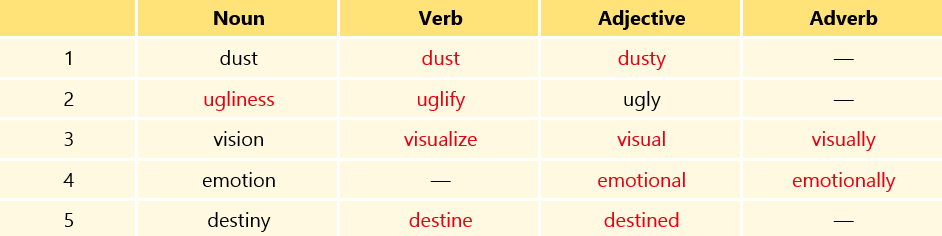
1. The dirt road dried and became dusty in the summer sun.
2. My cousin from the country was depressed by the ugliness of thecity.
3. The chair is visually attractive, but uncomfortable.
4. My best friend has always provided me with emotional support during difficult times.
5. Given how hard Ruth works, she seems destined for a successful career.
Task 7Collocations
Use collocations from the passage to complete the sentences below. Some of the words or phrases are given in the brackets. More than one answer may be possible. Example:
I can't come over tonight, because I need to get over this mountain of math homework.(mountain)
1. The store was crowded with customers due to the end of season sale that was on. (customer)
2. When I got into my friend's car, the radio was playing my favorite station.(station)
3. We decided to sit at a table next to the window and enjoy the view of the lake.(table)
4. I painted this picture for my mother's birthday when I was in kindergarten.(picture)
5. I cut the sleeves off my jacket, and turned it into a vest.(vest)
Task 8Reading in depth
There is a short passage with 10 blanks. You are required to select one word for each blank from a list of choices given in the box following the passage. Read the passage through carefully before making your choices. You may not use any of the words in the bank more than once.
For many years, 1. prehistoric cave art was thought to have 2. originated in Europe, where famous works have been found and dated in France and Spain. However, a recent discovery in Indonesia challenges that 3.theory. New research has shown that a cave painting in Borneo dates from at least 40, 000 years ago, making it the oldest known piece of 4. figurative art. The painting, which is believed to 5. depict a native species of wild bull, is only one of thousands of artworks discovered in the region. Among the other works are images of animals, boats, 6. geometric designs, stick-like human figures, as well as handstencils. In order to date the paintings, scientists employed a(n) 7. technique called uranium series dating. This involves examining layers of the mineral calcite that formed on top of the paintings over the years, and the material beneath them. They were able to 8. confirm that one of the paintings had been produced at least 40, 000 years ago, although it may actually be up to over 50, 000 years old. While Europe was thought to be the 9.birthplace of cave painting, it is now clear that the 10. practice also arose around the same time in other parts of the world.

Sentence Structures
Task 9Construct the sentences with the given words or phrases, following the model.
Model 1:
The floor is layered with dry splotches of paint, the walls plastered with sketches of tormented teenagers and fat puppies, the shelves crowded with clay pots.
【谓语并列句,第二句开始谓语系动词省略】
1. the kitchen sink, fill with dirty dishes, the floor, litter with food crumbs, the garbage can, stuff with rotting food
→ The kitchen sink is filled with dirty dishes, the floor littered with food crumbs, the garbage can stuffed with rotting food.
2. the skater's hair, pin with fancy hairpins, her face, paint with bright make-up, her outfit, decorate with sparkling rhinestones
→ The skater's hair was pinned with fancy hairpins, her face painted with bright make-up, her outfit decorated with sparkling rhinestones.
3. the abandoned house, cover with vines, its gutter, fill with leaves, its garden, congest with weeds
→ The abandoned house was covered with vines, its gutter filled with leaves, its garden congested with weeds.
Model 2:
Either Ivy has a great force field, or my laser vision isn't very strong, she won't look at me.
【either...or... 表示“或者…或者”】
1. speak too quietly, hard of hearing
→ Either youare speaking too quietly, or I am hard of hearing.
2. the exam, unusually difficult, not study for it well enough
→ Either the exam was unusually difficult, or I did not study for it well enough.
3. finish, all homework tonight, stay home tomorrow
→ Either you can finish all of your homework tonight, or you can stay home tomorrow and complete it.
Task10 Sentence translation
Translate the following sentences into English, using the words and phrases in the brackets.
五个穿戴着整洁的白衬衫和领带的人依次走进会议室并坐在长桌旁。 (file into)
Five men, neatly dressed in white shirts and ties, filed into the conference room and sat down at a long table.
2. 玛丽被悲惨童年的痛苦记忆所折磨,她想逃离家庭。 (torment,fleefrom)
Being tormented by the painful memories of her miserable childhood, Mary wanted to flee from her family.
3. 这位年老的乞丐掏出10元钱,捐献给地震受灾者。这一幕让很多人感动到落泪。(fish out, move...to tears)
The old beggar fished out a 10-yuan bill and donated it to the earthquake victims. Such a scene moved many to tears.
4. 它跳进了游泳池。 (plunge)
She plunged into the swimming pool.
5. 我试图弄清他的话的意思。 (figure out)
I am trying to figure out the meaning of his words.
Task11 Passage translation
Translate the following passage into English. Try to use the words and phrases from Passage A as many as possible.
都说我们这一代人学财务,是为了下一代能学艺术。当然,这只是一句玩笑,想要学艺术哪一代都可以开始,但它说明一个道理,玩艺术最好家里有点经济基础。不过, 这里说的学艺术不是学着玩,指的是考艺术院校,以后以艺术为职业。当然,不是每个人都能以艺术为职业,但是每个人都应该有点艺术细胞,如果人生中只做有实际价值的事情,那就太没有意思了,艺术看起来不会创造什么实际价值,但是却是让我们成为文明人的标志,即使对于普通人,艺术也是润滑剂(lubricant),让人生更有意义。
For your reference:
It’soften said that our generation got into finance in order for the next generation to be able to go into the arts. Of course, this is just a joke. Members of any generation can devote themselves to art if they have an interest in it. Nevertheless, the joke reveals a truth, that is, if you want to go into the arts, you'd bette rhave a well-off family supporting you. Here, by saying “gointo the arts”, we don't mean dabbling in art for fun, but enrolling in art schools and choosing art as a career for life. It is certain that not everyone is suited for a profession inthe arts. However, each of us should have some inclination towards art. Life would be dull if we did things with only practical value. Art may seem to produce nothing of real value, but it is the signature of any civilization. Art adds more meaning to life for all people, whether they are creative ornot.
Critical Thinking and Discussion
Task12 Work in a small group
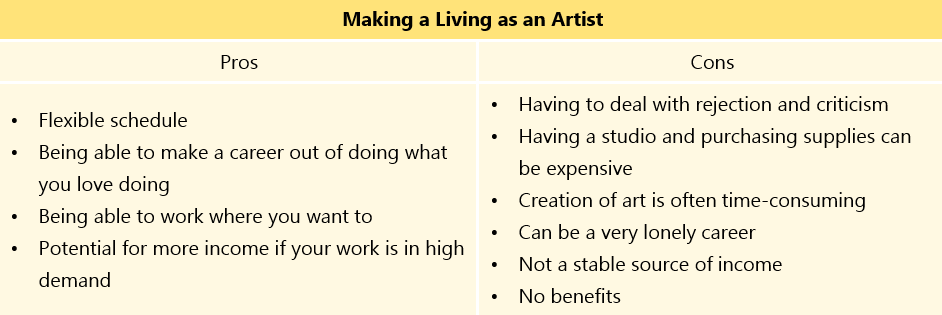
Discussthe question: What are the pros and cons of making a living as an artist? Write your supporting ideas in the chart. Use the words or phrases in the passage when discussing in your group.