
Writing a Bad News Letter
Have you ever had to write a letter to tell someone that they weren't doing a good job? Or received a letter that contained bad news? If you've been in either of these situations, you know that writing and receiving negative news is difficult. The writer must be sensitive to the audience, anticipate their reaction, and structure the message carefully to present the news in an acceptable way.
To deliver bad news should be carefully put together to minimize the negative reaction it may create. The following approaches are effective for this purpose.
Buffer the opening
In the opening, you should show that you care and are concerned about the news you are about to deliver. You may want to provide some background or make a statement that establishes some common ground between you and the receiver, which is intended to let the receiver see that you understand the negative effect the news is likely to have.
Present the reasons
Before stating the bad news, present the reasons for the decision. This will help the receiver understand (and hopefully accept) that the decision was carefully thought out and makes sense.
Cushion the bad news
The bad news itself should appear in the middle of the letter. You don't want to begin with it, since it might cause quite a shock. Nor do you want it to be the last thing the receiver reads. If you put it between the reason and a pleasant closing, the bad news may be received in a more positive light.
Close pleasantly
Close the letter with a statement that promotes goodwill. While you don't want to under play the bad news, you can use the closing to offer an alternative or express an interest in future endeavours. Be sincere and honest. However, if you don't want to encourage future correspondence, don't open the door to it.
The following is a sample of an email containing bad news.
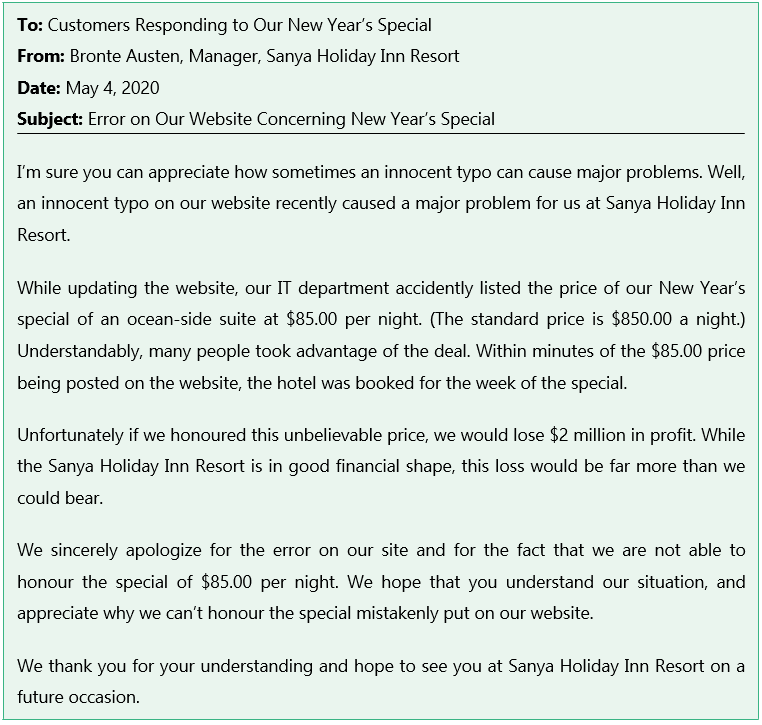
Now your turn:
Ms. Kang, a college English teacher, receives your letter encouraging her to purchase a set of dictionaries for her classroom. However, your publishing company, New World Press, did not get enough sales up front to publish the dictionaries. Consequently, your company will not be publishing the dictionaries this year, although it hopes to do so next year. You need to inform teachers who placed orders that the dictionaries will not be available this year, but may be published next year.

