-
1 Section A&nb...
-
2 Section B&nb...
-
3 Section C&nb...
Task 1Connecting with the topic
Check (√) your answers to these questions about community and responsibility.
1. How well do you know your neighbours?
A. Very well.
B. Somewhat well.
C. Not very well.
D. Not at all.
2. How important do you think it is to be connected to those in your community?
A. Very important.
B. Important.
C. Not very important.
D. Not important at all.
3. Do you agree or disagree with the statement that society is becoming less sensitive?
A. Strongly agree.
B. Somewhat agree.
C. Neither agree nor disagree.
D. Disagree.
Task 2Pair work
Compare your answers to Task 1 with a partner's. Do you both agree or disagree with the statement that society is becoming less sensitive? Talk with your partner.
Example:
A: I think that society is becoming less sensitive to the needs of others.
B: Do you? Why do you say that?
A: People are so focused ontheir own lives, and on their work, and on social media.
They do not take the time to talk to their own neighbours anymore.
B: I do not completely agree.
A: You do not?
B: I think that people aremore consumed with their own lives, but I think that they are
also still sensitive to the needs of others.
A: Why do you think this?
B: The Internet and social media allow users to make connections with thousands of
people. I have made friends online about whom I care very much, and who care about
me. So I do not think that we are less sensitive as a society.
Task 3Previewing the passage
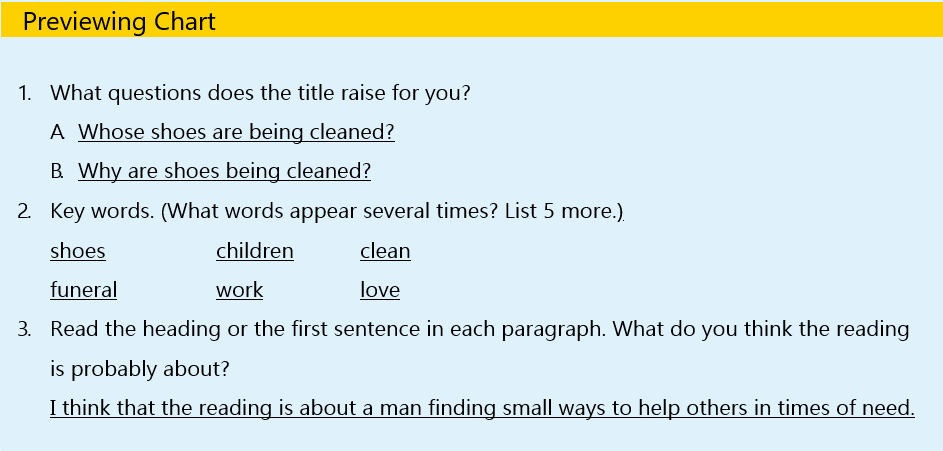
Scan Passage A to complete the Previewing Chart below.
Task 4Vocabulary skills
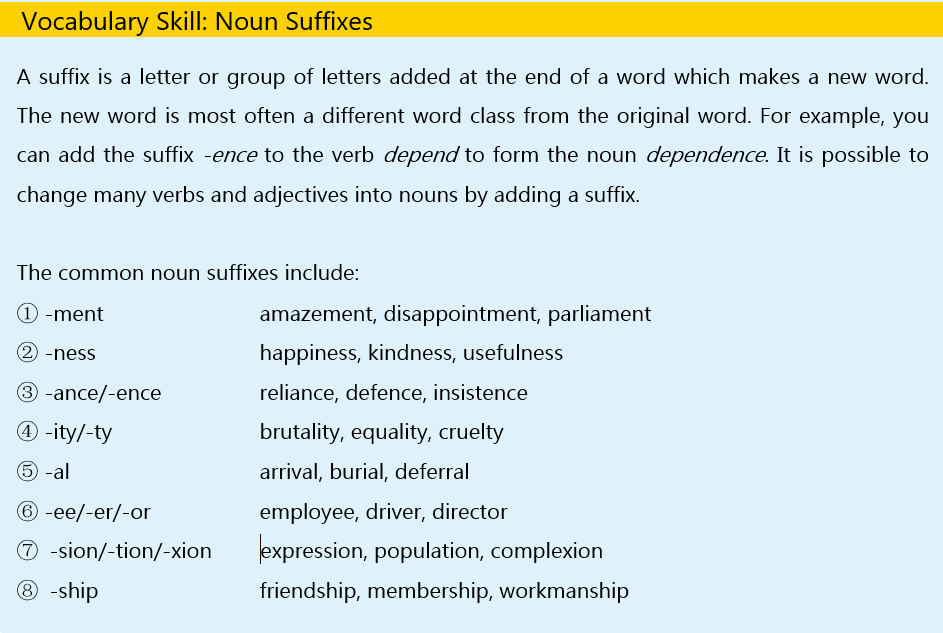
Learn noun suffixes. Use the noun form of the boldfaced verb or adjective in the
first sentence to complete the second sentence.
1. You can pay your bill online.
Payment of your bill can be made online.
2. Jimin felt happy when she read her report card.
Jimin felt happiness when she read her report card.
3. It is rare to see this bird so far south.
Seeing this bird so far south is a rarity.
4. I am going to see my little sister perform in her school play tonight.
I am going to see my little sister's performance in her school play tonight.
5. My parents are very proud of the high marks I managed to achieve this year.
My parents are very proud of my achievement of high marks this year.
Passage A
I’ve Come to Clean Your Shoes
In the face of tragedy, the smallest gestures can be the most valuable.
Madag Harrah
in the face of 面对着
tragedy n. a terrible incident 悲剧;灾难
e.g. For every tragedy, there is a possible happy ending.
对于每一场悲剧,都有一个可能的快乐结局。
Other countries responded immediately to the Nepal earthquake tragedy.
其他国家迅速对尼泊尔的地震悲剧做出回应。
gesture n. an act or a remark made as a formality or as a sign of intention or attitude 姿态 ; 手势 v. 作手势;用动作示意
e.g. As a gesture of goodwill, the hotel has prepared souvenirs for each guest.
为了表示友好,宾馆为每位客人准备了纪念品。
He covered his face in a gesture of despair.
他捂上脸,以示痛苦。
The teacher gestured for the student to enter his office.
老师示意学生进入他的办公室。
She gestured towards the bedroom and there the baby was sleeping.
她指着卧室,婴儿正在睡觉。
valuable a. precious, important 有价值的;贵重的
e.g. She thanked her supervisor for the valuable advice.
她感谢她的导师提出的宝贵意见。
Workers consider what they are doing is valuable.
工作者们认为他们所做的事情是有价值的。
(译文)我是来给你擦鞋的
在悲剧面前,最微小的举动也可能是最有价值的
1 In shock, I stumbled around the house trying to decide what to put into the suitcases. Earlier that evening, I'd received a call from my mother telling me that my brother and his wife, along with his sister-in-law and both of her children, had been killed in a car crash. “Come as soon as you can,” Mom begged.
In shock, I stumbled around the house trying to decide what to put into the suitcases.
Note: 该句中 “trying to...” 是现在分词结构做伴随状语。
suitcase n. 手提箱
...I'd received a call from my mother telling me that my brother and his wife...
Note: 该句中“telling me that...” 是现在分词结构做后置定语,修饰 “my mother”。
sister-in-law n. the sister of one’s husband or wife(夫或妻的姐妹)(大)小姑子;(大) 小姨子
car crash 车 祸
(译文)我沉浸在震惊之中,踉踉跄跄地在房子里走来走去,试图决定往手提箱里放些什么。那天晚上早些时候,我接到母亲的电话,她告诉我说,我的哥哥嫂子,还有哥哥的大姨子和大姨子的两个孩子,都死于车祸。“尽快赶过来吧!”妈妈恳求道。
2 That's what I wanted to do—to leave at once, to hurry to my parents in my Missouri hometown. But my husband, Larry, and I were in the midst of packing our belongings for an upcoming move from Ohio to New Mexico. Our house was in total disarray. Some of the clothes that Larry and I and our two young children, Eric and Meghan, would need were boxed up. Other clothes lay unwashed in a pile on the laundry roomfloor. Supper dishes sat on the kitchen table. Toys were strewn everywhere.
That's what I wanted to do...
Note: "what I wanted to do" 是 what 引导的名词性从句做表语。
in the midst of among, in the middle of 在…中间
e.g. Our teacher stood in the midst of us when the photograph was taken.
拍照时,我们的老师站在我们中间。
I was in the midst of writing a graduation thesis during the whole week.
整个星期我都在忙着写毕业论文。
pack v./n. to gather items and place them in a suitcase or bag 包装;捆扎
e.g. We are going to go on vacation tonight, but I haven't packed yet.
我们今晚就去度假,但我到现在还没打包行李。
Don't forget topack some of your favorite books in your suitcase wherever you go.
不管去哪儿,别忘了在你的行李箱内放几本喜欢的书。
A pack of cigarettes was found onthe desk after he left.
在他离开后,桌子上发现了一包香烟。
Please keep the goods in pack lest you return them.
请保持货物包装完整,以防您退货。
belongings n. one's movable possessions 所有物;行李
e.g. Don't forget to takeyour belongings when you arrive at the destination.
到达目的地时别忘了带走随身物品。
Don't bring too many belongings for such a short trip.
这样的短途旅行不要携带太多物品。
upcoming a. forthcoming, happening soon 即将来临的
e.g. She was worried aboutthe upcoming exam.
她为即将到来的考试担忧不已。
Tickets sell well for the singer's upcoming concert tour.
这位歌手即将举行的巡回演唱会门票畅销。
disarray n. a state of disorganization 无秩序;杂乱
e.g. During the war, every industry was in disarray.
在战争期间,每个行业都毫无秩序。
All the books and toys were in disarray when I arrived home.
我到家时,所有的书和玩具都杂乱不堪。
Other clothes lay unwashed...
Note:这里的 unwashed 为主语补足语。
laundry n. 洗衣房;洗衣店
strew v. to spread or scatter 撒满;散播
e.g. Rubbish are strewn everywhere after the party.
派对结束后到处都是垃圾。
Every spring,the farmers strew the seed into the soil.
每年春天,农民都会将种子撒入土壤中。
(译文)这就是我想做的——立刻启程,赶到我的家乡密苏里,到我父母那里去。但是我的丈夫拉里和我正在收拾行李,准备从俄亥俄州搬家到新墨西哥州。我们的房子一片混乱。拉里、我和我们两个年幼的孩子埃里克和梅根需要的一些衣服被装进箱子了。其他没洗过的衣服堆在洗衣房的
地板上。晚饭的盘子放在餐桌上。玩具到处都是。
3 While Larry made plane reservations for the following morning, I wandered about, aimlessly picking things up and putting them down. I couldn't focus. The words I'd heard on the phone echoed through my mind: "Bill is gone—Marilyn too.June—and both of the children..." It was as though the message had muffled my brain with cotton.
While Larry made plane reservations for the following morning, I wandered about, aimlessly picking things up and putting them down.
Note: 该句中 “picking things...” 是现在分词做伴随状语。
reservation n. a plan whereby something is booked for someone 预约,预订
e.g. The restaurant is very popular, so be sure to get a reservation before you go.
这家餐厅很受欢迎,所以去之前一定要预订位子。
Due to the emergent situation, she had to cancel her reservation.
由于突发情况,她不得不取消她的预订。
wander v. to walk in an aimless manner 徘徊;漫无目的闲逛
e.g. I spent the evening wandering around the neighborhood.
我整晚都在附近闲逛。
The little girl began to wander in the foreign land.
小女孩开始在这片陌生的国度漫步。
The words I'd heard on the phone echoed through my mind...
Note: 该句中 “I'd heard” 是省略了关系代词that 的定语从句,修饰 words。先行词在定语从
句中做宾语。
echo v./n. a series of sounds caused by the reflection of sound waves from a surface back to
the listener 回响,发出回声
e.g. It’s so quiet at that moment that I could hear the echo of his footsteps.
那一刻如此安静,我能够听到他脚步的回声。
The echo of their shout sounded in the valley for several seconds.
他们喊叫的回声在山谷里持续了几秒钟。
In the midnight,the building echoed with the sound of her scream.
在午夜时分,这个楼房里回荡着她的尖叫声。
It was as though the message had muffled my brain with cotton.
Note: 此处的 as though 引导的方式状语从句中使用了虚拟语气。as though ( 也可作 as if) 从
句在使用虚拟语气时主要有以下三种情况:
与现在情况相反,as if 从句中使用过去式。
与过去情况相反,as if 从句中使用“had+ 过去分词”。
与将来情况相反,as if 从句中使用“would/could/might+ 动词原形”。例句:
He answered amiably, as if the whole affair were a triviality.
他和蔼地回答,好像整件事情都是微不足道的。
He talks about Paris as if he had been there before.
他说起巴黎来好像他以前去过巴黎似的。
Alice opened her mouth as if she would say something.
爱丽丝张开嘴好像要说什么。
muffle v . to wrap or cover sb./sth. 裹住,蒙住
e.g. I was so sleepy that I muffled the alarm clock in my quilt.
我好困,就把闹钟蒙在被子里。
The children muffled their laughs in their sleeves at the pajama party.
在睡衣派对上,孩子们用袖子捂住笑声。
(译文)当拉里预订第二天早上的机票时,我走来走去,漫无目的地把东西拿起来又放下。我无法集中精神。我在电话里听到的话在脑海中回响 :“比尔走了——玛丽莲也走了。琼——两个孩子……”这仿佛像是用棉花把我的脑子裹住了。
4 After finalizing our travel arrangements, Larry phoned a few friends to tell them what had happened. Occasionally someone asked to speak with me. "If there's anything I can do, let me know," that person would offer kindly.
arrangement n. a plan or preparation that you make sothat something can happen 安排 ;布置
e.g. The secretary made all the arrangements for tonight’s cocktail party.
秘书为今晚的鸡尾酒会做了所有安排。
...to tell them what had happened.
Note: 该处 tell 后跟双宾语,其中 what had happened 是名词性从句做宾语。
occasionally ad. now and then; from time to time 偶然;偶尔
(译文)我们的行程安排好后,拉里打电话给几个朋友,告诉他们发生了什么事。偶尔有人请求和我通话。“如果有什么我能做的,请告诉我,”那个人会贴心地伸出援手。
5 “Thank you very much,” I'd reply. But I didn't know what to ask for. It was impossible to concentrate. I stared into space while Larry called Donna King, the woman with whom I taught a nursery class at church. Donna and I were casual friends, but we didn't see each other often. She and Emerson, her thin, quiet husband, were kept busy during the week by their own“nursery”— six children ranging in age from two to fifteen. I was glad Larry had thought to warn her that she'd be teaching alone on Sunday.
It was impossible to concentrate.
Note: 该句是形式主语的用法,真正的主语是不定式 “to concentrate”。
concentrate (on) v. focus 集中(注意力);聚精会神
e.g. He can concentrate onstudy for several hours.
他可以全神贯注地学习几个小时。
The new parents should concentrate all their energies on the growth of babies.
新手爸妈应该把精力都投入到宝宝的成长上。
stare (into) v . to look (into) intently n. long fixed look 盯着看;凝视
e.g. The bear stared at the hunter for seconds before fleeing away.
熊盯着猎人看了数秒后迅速逃跑了。
The teacher gave Tom such an angry stare that he immediately behaved himself.
老师很生气地瞪着汤姆看了一眼,他立刻就老实了。
...the woman with whom I taught a nursery class at church.
Note: 该句中 with whom 是“介词+ 关系代词”引导定语从句的用法。更多例子:
This is a book about which we have discussed a lot.
这是一本我们已经讨论很多的书。
This is the house in which ( 相当于 where) he lived.
这是他住过的房子。
nursery n. a place where young children are caredfor during the working day 托儿所
church n. 教堂;礼拜
casual a. informal 随便的,随意的
e.g. An interviewee may berejected for casual dress in the interview.
在面试中,受访者可能由于穿着随意而被拒绝。
Her greetings sounded casual, but I knew she was nervous.
她的问候听起来很随意,但我知道她很紧张。
(译文)“非常感谢,”我会回答。但我不知道请人帮什么。我无法集中精神。当拉里打电话给
唐娜·金时,我呆望着天空。我和唐娜·金在一所教堂里的保育班上课。唐娜和我只是泛泛之交,我们不常见面。每周的工作日,唐娜和她瘦削、文静的丈夫爱默生忙于他们自己的“托儿所”——6 个年龄从 2 岁到 15 岁不等的孩子。我很高兴拉里想到要提醒她,周日她得独自上课了。
6 Suddenly Meghan darted by, clutching a ball. Eric chased after her. They should be in bed, I thought.
Suddenly Meghan darted by, clutching a ball.
Note: “clutching a ball” 是现在分词做伴随状语。
dart v. to move quickly 向前冲,飞奔
e.g. The minute the class was over, the students darted towards the exit.
刚下课,学生们都涌向出口。
The little boy darted for the door when he heard the bell ring.
小男孩听到门铃声向门口跑去。
clutch v. to hold tightly 抓住;紧握
e.g. Feeling extremely scared, the girl clutched her mother’s hand.
女孩感到非常害怕,抓住了母亲的手。
The woman clutched her money to her chest in fear of being stolen.
因为怕钱被偷,这名女子将钱紧紧握在胸前。
chase (after) v. to follow in order to catch up with 追逐;追赶
e.g. The dog kept chasing after its own tail.
这只狗一直追逐自己的尾巴。
The hypocritical man was chasing fame all through his life.
这个虚伪的男人一生都在追名逐利。
(译文)突然,梅根抱着球飞跑而过。埃里克追着她。他们应该睡觉了,我想。
7 When the doorbell rang, I rose slowly and crept to the door. Emerson King was standing on the porch.
creep v./n. to move slowly to avoid being noticed 爬行;慢慢地移动
e.g. The spy crept into the crowd and then disappeared.
间谍混进了人群,然后消失了。
He had to creep into the party because he was not invited.
他没有被主人邀请,所以悄悄地溜进派对。
porchn. 门廊;走廊
(译文)门铃响了,我慢慢地站起来,挪动到了门口。爱默生·金站在门廊上。
8 “I've come to clean your shoes,” he said softly.
(译文)“我来给你擦鞋,”他轻声说。
9 Confused, I asked him to repeat.
confuse v. to cause someone to be bewildered 使困惑;使糊涂
e.g. His explanation ofthe theory confused the audience.
他对这一理论的解释使听众感到困惑。
I am confused by the sign which means the opposite in my country.
我对这个标志感到困惑,在我的国家它表示的意思正好相反。
(译文)我迷惑不解,让他重复一遍。
10 “Donna had to stay with the babies,” he said, “but we want to help. I remember when my father died, it took me hours to get the children’s shoes cleaned and shined for the funeral. So that's what I've come to do. Give me your shoes—not just your good shoes but all your shoes.”
...it took me hours to get the children’s shoes cleaned and shined for the funeral.
Note: 该句使用了形式主语,真正的主语是不定式结构 “to get...”。“get the children's shoes cleaned and shined” 中使用的是 “get sth. done” 结构,表示“让某事被做”。更多例子:
I'll get my haircut.
我要剪头发。
If you can't getthe article written within several weeks, you will be in trouble.
如果你几周之内写不出文章,就会有麻烦。
funeral n. 葬 礼
So that's what I've come to do.
Note: “what I've come to do” 是名词性从句做表语。
(译文)“唐娜得留在孩子身边,”他说,“但我们想帮忙。我记得我父亲去世的时候,我花了好几个小时才把孩子们的鞋子擦干净,去参加葬礼。这就是我过来要做的。把你的鞋给我——不仅是你的好鞋,而是你所有的鞋。”
11 I hadn't even thought about our shoes until he mentioned them. Now I remembered
that Eric had waded through mud in his good pair after church the previous Sunday. Not to be outdone, Meghan had kicked rocks, scuffing the toes of her shoes.
I hadn't even thought about our shoes until he mentioned them.
Note: 该句中使用了 “not...until...” 句型,表示“直到…才…”。
mention v./n. to refer to something briefly without going into detail 提到,谈到
e.g. My husband mentioned seeing his old friend this morning.
我丈夫提起今天早上见到了他的老朋友这件事。
She mentioned she was going to quit the job the next week.
她提到她下周将要辞职。
wade v. to walk through water or a soft substance 蹚( 水 ), 涉 ( 水 )
e.g. He waded into the water to save that girl.
他蹚进水中去救那个女孩。
The soldiers hadto wade through a swamp.
士兵们不得不穿过沼泽地。
mud n. 泥,烂泥
Not to be outdone, Meghan had kicked rocks, scuffing her toes.
Note: 该句中 “scuffing her toes” 是现在分词结构做结果状语。
not to be outdone not wanting someone else to do a better job than (someone) 不甘示弱
e.g. Not to be outdone, the rival company came up with a new marketing strategy.
竞争公司不甘示弱,拿出了新的营销策略。
The newspaper, not to be outdone, developed from print to digital.
这家报纸不甘示弱,从纸质印刷发展到数字化。
scuff v. to scrape or brush against the surface of 使磨损;用脚来回摩擦
e.g. I scuff my shoes on the grass to get rid of the mud.
我在草地上来回蹭鞋子擦掉泥土。
The leg bases of the furniture wear special pad to avoid scuffing the floor.
家具的腿部底座配有专用垫,以免刮伤地板。
(译文)直到他说起,我才想到我们的鞋子。现在我想起来了,上个星期天从教堂回来时,埃里克穿着他那双好鞋踩泥巴。梅根也不甘示弱,用鞋子踢石头,还磨坏了鞋头。
12 While Emerson spread newspapers on the kitchen floor, I gathered up the family's footwear. Emerson found a pan and filled it with soapy water. He got an old knife out of a drawer and retrieved a sponge from under the sink. Larry had to rummage through several cartons, but at last he located the shoe polish.
gather (up) v. to collect 收集;收割
e.g. People gather at thediscount store.
人们聚集在折扣店。
Kids like togather strawberries.
孩子们喜欢采草莓。
footwear n. outer coverings for the feet such asshoes, boots, or sandals 鞋,鞋类
soapy a. containing or covered with soap 含有肥皂的
drawer n. 抽 屉
retrieve v. to go and get (sth.) 收回,取回
e.g. The boy taught hisdog to retrieve a ball.
那个男孩教他的狗取球。
Computers can store and retrieve information efficiently and conveniently.
计算机可以高效方便地存储和检索信息。
sink n. 水槽;洗涤槽
rummage v. to search untidily through a mass 仔细搜查;翻找出
e.g. My granny rummagedthe drawer to find the old photo.
我的奶奶在抽屉里翻找那张旧照片。
I rummaged through the house, trying to find my certificate.
我翻遍屋子,想找到我的证书。
carton n. a light box or container 纸板箱
shoe polish 鞋 油
(译文)爱默生在厨房地板上铺开报纸,我把家里的鞋子都拿了出来。爱默生找到一只平底锅,往里面装满了肥皂水。他从抽屉里拿出一把旧的小刀,从水槽下面取出一块海绵。拉里翻遍好几个纸箱,终于找到了鞋油。
13 Emerson settled himself on the floor and got to work. Watching him concentrate on one task helped me pull my own thoughts into order. Laundry first, I told myself. As the washer chugged, Larry and I bathed the children and put them tobed.
settle v. to become comfortable 安定下来;定居;解决
e.g. After they got married, they settled in a small city in the western China.
结婚后,他们定居在中国西部的一个小城市。
It took the insurance company a long time to settle his claim.
保险公司花了很长时间来解决他的索赔。
Watching him concentrate on one task helped me pull my own thoughts into order.
Note: 该句中的 “watching him concentrate on one task” 是动名词做主语。
chug v. 发出轧轧声;稳步前进
e.g. The boat chugged into the distance.
船突突地开向了远处。The train chugs up the hill. 火车缓缓地开上了山坡。
bath v./n. 洗澡;沐浴
e.g. Taking a hot bath at the end of a day makes me feel relaxed.
一天结束后,泡个热水澡使我感到放松。
He takes a shower instead of a bath to save time.
为了节省时间,他冲了个澡而没有泡澡。
I bath my son every night in summer.
夏天,我每个晚上都给儿子洗澡。
The nurses bathed the baby two days after he was born.
护士在婴儿出生两天后给他洗澡。
(译文)爱默生坐在地板上开始工作。看着他专注于这项任务,我的思绪也逐渐清晰。我告诉自己,先洗衣服。洗衣机咔嗒咔嗒地响着,拉里和我给孩子们洗澡,把他们安置到床上。
14 While we cleared the supper dishes, Emerson continued to work, saying nothing. The love in the act released my tears, washing the fog from my mind. I could move. I could think. I could get on with the business ofliving.
Note: 该段中两处使用了现在分词结构做伴随状语,一是 “Emerson continued to work, saying
nothing. ” 二 是 “The love in the act released my tears, washing the fog frommy mind.”
The love in the act released my tears, washing the fog from my mind.
Paraphrase: Such a loving act moved me to tears, and my head became clearer.
releasev. to let go 释放;发表
e.g. Through playing basketball, he can release his energies.
通过打篮球,他可以释放精力。
The police havereleased a statement explaining the reasons for his arrest.
警方已发布一份声明,解释他被捕的原因。
fog n. 雾;迷惑
get on with to continue 继续干;与…友好相处
e.g. After drinking the coffee, he got on with decorating the house.
喝完咖啡后,他继续装饰房屋。
As a polite man, he gets on well with his colleagues.
他很有礼貌,与同事们相处得很好。
(译文)当我们清理晚餐的盘子时,爱默生继续工作,什么也没说。爱的行为释放了我的眼泪, 洗去了我心中的迷雾。我能动。我能思考。我又可以继续我的生活。
15 One by one, the jobs fell into place. I went into the laundry room tomove the load of washing into the dryer, returning to the kitchen to find out that Emerson had left. In a line against one wall stood all of our shoes, spotless.
fall into place to begin to make sense 落实;变得有条不紊
e.g. As long as you follow your plan, everything will fall into place.
只要你遵循你的计划,一切都将水到渠成。
After so much diligence, his career goals are beginning to fall into place.
经过如此多的努力,他的职业规划开始走上正轨。
load n. a heavy or bulky thing that is being carried 负载;大量
e.g. Recently, I have been busy with loads of work.
最近,我一直忙着做大量的工作。
The backpack is sturdy to carry a heavy load.
这个背包很牢固,可以承受重负荷。
dryer n. 烘干机;干燥机
...returning to the kitchen to find out that Emerson had left.
Note: 不定式结构 “to find out...” 是不定式结构做结果状语。更多例子:
He woke up to find that everyone was gone.
他醒来发现没人在。
He arrived late only to find the train had gone.
他迟到了,发现火车已经开走了。
In a line against one wall stood all of our shoes, spotless.
Note: 该句将介词短语 “In a line against one wall” 置于句首,主谓倒装。更多例子:
In the front of the house stands a girl.
房子前面站着一个女孩。
Along the road came a group of soldiers.
一群士兵沿着路走来。
另:spotless 为主语补足语。
spotless a. clean 一尘不染的,干干净净的
e.g. After two hours ofcleaning, the house was spotless.
经过两个小时的打扫,房子被收拾的一尘不染。
He has a spotless reputation so far.
到目前为止,他的声誉没有任何污点。
(译文)活儿一件一件都干完了。我走进洗衣房,把洗好的衣服放进烘干机,回到厨房却发现爱默生已经离开了。我们所有的鞋子都一尘不染地靠着墙排成一行。
16. Now when I hear of an acquaintance who has lost a loved one, I try to think of one task that suits that person's need, such as polishing the car, taking the dog to the boarding kennel or house-sitting during the funeral. And I always have the same answer if the person asks, “How did you know I needed that done?”
acquaintancen. a person one knows slightly, but who is not a close friend 相识的人,熟人
e.g. I bumped into achildhood acquaintance.
我碰到了一个儿时的熟人。
We gradually lost contact with many of our old acquaintances as we grew old.
随着年龄的增长,我们逐渐与许多熟人失去联系。
suit v. to meet the requirements of; fit 符合…的要求,适合
e.g. This young woman suits our requirements in the interview.
在面试中, 这位年轻女士符合我们的要求。
There is arange of dishes which suit all tastes.
有适合各种口位的菜肴。
boarding n. accommodation, lodge 寄 宿
kennel n . a small shelter for a dog 狗窝;犬舍
house-sit v. to live in and look after a house while its owner is away 代为照看房屋
e.g. The man was paid to house-sit for his neighbor.
他的邻居付钱请他照看房屋。
(译文)现在,当我听说一个熟人失去了心爱的人,我就会试着去想他可能会需要什么,比如擦车,带狗去寄养所或者在举行葬礼时帮忙看家。如果那人问我,“你怎么知道我的需要?”,我的回答总是一样的。
17 I reply, “It’s because a man once cleaned my shoes.”
(译文)我回答说 :“因为有个人曾经帮我擦过鞋。”
Understanding the Reading
Task 1 Identifying main ideas
Complete the summary with key information from the passage. More than one answer may be possible.
A car crash which 1. took the life of her brother forced the narrator to go to her hometown. With the house in disarray, she could not focus. Her husband decided to tell 2. several friends what happened, including Donna, with whom the narrator taught a nursery class. When Donna's husband came over, offering to 3. clean the family's shoes, the narrator was finally able to 4. focus on the chores she needed to do. Now, when the narrator hears that someone has lost a loved one, she offers to do a task to 5. suit that person's need.
Task 2 Reading for details
The following statements about the details in the passage are incorrect. Correct them on the lines according to your understanding.
1. The narrator and her family were in the midst ofbooking their tickets to take a train to New York when they received the terrible news.
The narrator and her family were in the midst of packing their belongings for their upcoming move to New Mexico when they received the terrible news.
2. The narrator was close friends with Donna, and the two saw each other every weekend.
The narrator was casual friends with Donna, and the two did not see each other often.
3. The narrator e-mailed Donna to inform her that she would have to go to the movies by herself on Sunday.
The narrator's husband phoned Donna to inform her that she would have to be teaching the nursery class alone on Sunday.
4. The narrator and her husband gave the children breakfast and got them ready for school.
The narrator and her husband bathed the children and put them to bed.
5. The narrator came to the living room from the laundry room to find that Donna had hung the cleaned curtains up.
The narrator came to the kitchen from the laundry room to find that Emerson had lined the cleaned shoes against the wall.
Task 3Note answers to the questions below. Discuss with a partner.
1. Why does the narrator's husband contact Donna?
Suggested answer:
The narrator's husband contacts Donna to tell her that she will be working alone on the weekend, because the narrator needs to go out of town to see her parents.
2. Why does Emerson come by himself?
Suggested answer:
Emerson comes by himself because his wife Donna needs to stay at home with their babies, but they still want to help the narrator and her family in any way they can.
3. What do you think that the main idea of this text is?
Suggested answer:
I think that the main idea of this text is that performing even the smallest kind gesture for people can make an important difference in their lives, especially for those facing difficulties.
Exploring Vocabulary
Task 4These sentences are about the passage. Complete them with the target
words and phrases in the box. Change the form when necessary.

1. Donna was a(n) acquaintance of the narrator’s.
2. Emerson's kindness allowed the narrator to release heremotions.
3. After hearing the bad news,the narrator began to wander around the house aimlessly.
4. The accident that took the life of the narrator's brother and his family was a(n) tragedy.
5. The dirty shoes were forgotten about until Emerson mentioned them.
6. The narrator was grateful for Emerson's kind and helpful gesture.
7. When the narrator's acquaintances lose loved ones, she offers to complete a task to suit their needs.
8. Meghan's brother Eric was chasing after her.
9. After receiving the news of her brother's death, the narrator could not concentrate on what she needed to do.
10. The narrator and her family were packing their belongings for a(n) upcoming move.
11. A small act of kindness in the face of a tragic event can be the most valuable.
12. The narrator describes Donna as a(n) casual friend.
13. Emerson settled himself down on the floor and got to work.
14. The narrator's daughter Meghanran by her, clutching aball.
15. The narrator was confused when Emerson told her why he had come over.
Task 5These sentences use the target words and phrases in new contexts. Complete them with the words and phrases in the box. Change the form when necessary.

1. Firefighters spent an hourworking to release the driver from the wreckage.
2. Tickets for the band's upcoming tour are soldout.
3. Tyler did not mention where he was going.
4. A(n) tragedy was narrowly avoided when the car almost crashed into the railing.
5. The casual remark was not meant to be taken seriously.
6. Please put away the valuable, breakable objects.
7. Jim raised his hands in a welcoming gesture.
8. This dress does not suit me at all.
9. Stop talking now and settle down.
10. Diane met a former college acquaintance at the trainstation.
11. The elderly man had to clutch a chair forsupport.
12. I found it difficult to concentrate while the radio wason.
13. I often confuse the twins because they look so similar.
14. Cats like to chase mice.
15. The cows are allowed to wander freely through the fields.
Task 6Word forms
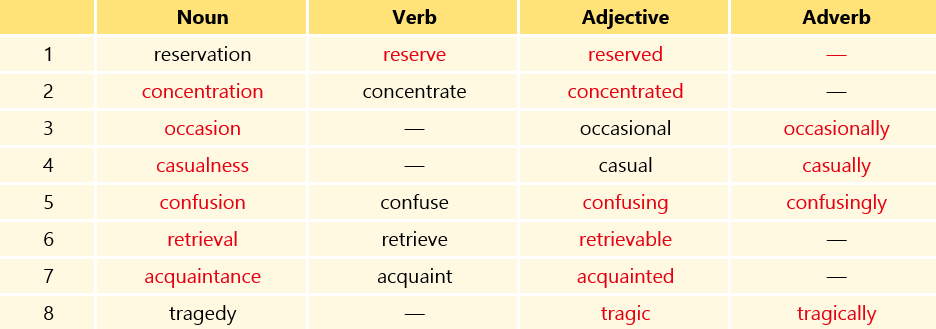
Look back over the passage, or consult your dictionary to find the missing word forms in the chart. After completing the chart, for each sentence below, look at the row in the chart with the same number, and choose the correct word form to complete the sentence.
1. We cannot sit at this table, because it is reserved for someone else.
2. This essay requires my full concentration.
3. We occasionally go running in the park.
4. Lee casually threw his keys on the table.
5. There was some confusion as to whether the player had scored or not.
6. Unfortunately, the files were deleted, and are not retrievable.
7. I am not personally acquainted with the man.
8. The accident resulted in a(n) tragic loss oflife.
Task 7Collocations
Use collocations from thepassage to complete the sentences below. Some of the words or phrases aregiven in the brackets. More than one answermay be possible. Example:
I can't come over tonight, because I need to get over this mountain of math homework. (mountain)
1. His tiredness caused him to stumble around the house.(stumble)
2. Our horses had to wade through the mud.(wade)
3. We gathered up the footwear we would take on the hiking trip.(footwear)
4. Clean your shoes before you come into the house, because they are covered with mud.(shoes)
5. Before I began to write my essay, I had to put my thoughts in order. (put,thoughts)
Task 8Reading in depth
There is a short passage with 10 blanks. You are required to selec tone word for each blank from a list of choices given in the box following the passage. Read the passage through carefully before making your choices. You may not use any of the words in the bank more than once.
Nonprofit organization sallow people to come together and unite their 1. resources in order to achieve goals that benefit the purpose for the organization's being. By doing so, the 2. funds generated by the organization are used for the betterment of the mission it seeks to fulfill. Nonprofit organizations are often organized in 3. response to social problems faced within communities. These problems are then acted upon by the creation of programs by the organization, which are run by people who 4. volunteer for the organization's cause. By volunteering for the cause, a number of goals for the 5. success of the cause are developed.
The purpose of a nonprofit organization depends on its goal. Some nonprofits serve to provide aid to people without access to various 6. necessities. An example of such nonprofits is a women's shelter, where women and children are given relief and shelter when seeking7. safety from abusive home situations. Other nonprofits are directed to share a particular 8.religious belief and work to do good in the name of that belief. Such organizations include those that provide charitable 9. services to their communities to meet the needs of people. Education nonprofits aim to 10.improve the conditions of those around them through advancements in education.

Sentence Structures
Task 9 Construct the sentences with the given words or phrases, following the model.
Model 1:
Watching him concentrate on one task helped me pull my own thoughts into order.
【v+ing,动词现在分词短语做主语】
1. watch, the documentary on pollution, allow, take protecting ourenvironment more seriously
→ Watching the documentary on pollution allowed meto take protecting our environment
more seriously.
2. run, errands, all morning, tireout, for the rest of the day
→ Running errands all morning tired me out for the rest of the day.
3. study art history, in college,teach, appreciate creativity
→ Studying art history when I was in college taught me to appreciate creativity.
Model 2:
This is what I wanted to do—to leave at once, to hurry to my parents in my Missouri
hometown.
【be + what (which, when,where, that, who, why, how),作表语从句】
1. studying, need to do to get a good mark on the test
→ Studying is what you need to do to get a good mark on the test.
2. this, never stand under a tree, during a thunderstorm
→ This is whyyou should never stand under a tree during a thunderstorm.
3. that, break my arm, last summer
→ That was howI broke my arm last summer.
Task10 Sentence translation
Translate the following sentences into English, using the words and phrases in the brackets.
1. 我在人群中找到了他。(inthe midst of )
I found him in the midst of the crowd.
2. 你应该为即将到来的旅行带一些药。(pack, upcoming)
You should pack some medicine for the upcoming trip.
3. 我不能专心工作。我总是神游他处。(concentrate on, wander)
I can't concentrate on my work. My mind is always wandering elsewhere.
4. 杰克许诺要跟凯瑟琳结婚,但他对婚姻漫不经心的态度让凯瑟琳很困惑。(casual, confuse)
Jack has promised to marry Catherine. But his casual attitude towards marriage really confuses Catherine.
5. 不管别人怎么说,我都会继续我的生活。(get on with)
No matter what others say, I will get on with my life.
Task11 Passage translation
Translate the following passage into English. Try to use the words and phrases from Passage A as many as possible.
什么是个人责任?它指的是要掌控你的生活,要掌控你对他人和事件的反应。不管
你喜欢与否,你都要对自己负责。为你的生活负责是有好处的。当你承认你对自己的生活负有全部责任时,你会立刻意识到你拥有多大的控制权。你想要实现的任何目标都在
你的控制范围之内。如果你在工作中承认错误,人们更可能相信你。这不仅仅是信任的问题。当你对自己的行为负责时,你也会赢得很多尊重。你如何为自己的生活负责?首先, 你需要自觉地作出决定(make a conscious decision)来为你的生活负责。当事情出了问题,公开承认它是你的错。人们都会犯错。你必须学会原谅自己和原谅别人的错误。对你的生活负责可能是一个非常有挑战性的过程。但如果你真的想快乐,这是必要的。
For your reference:
What is personal responsibility? It is taking control of your life, and taking control of your responses to others and events. You are responsible for yourself, whether you like it or not. There are benefits of taking responsibility for your life. When you admit that only you are responsible for your life, you immediately recognize how much control you have. Any goal that you want to achieve is within your control. If you admit to your mistakes in your work, people are more likely to trust you. Responsibility is not just a matter of trust. You also earn lots of respect when you take responsibility for your actions. How do you take responsibility for your own life? First, you need to make a conscious decision to take responsibility for your life. When something goes wrong, openly acknowledge it as your fault. People make mistakes. You must learn to forgive yourself and to forgive other people for mistakes. Taking responsibility for your life can be a very challenging process, but it is necessary if you want to truly be happy.
Critical Thinking and Discussion
Task12 Work in a small group
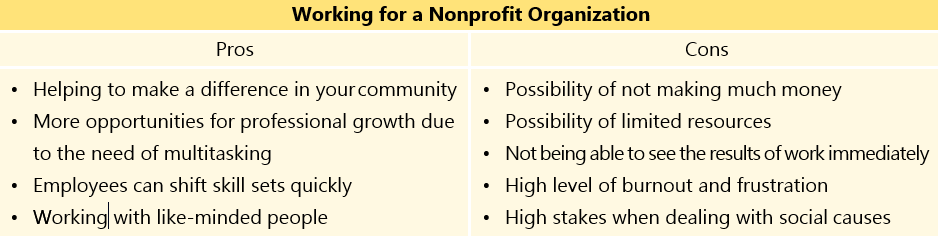
Discussthe question: What are the pros and cons of working for a nonprofit organization? Write your supporting ideas in the chart. Use the words or phrases in the passage when discussing in your group.