
3.2 Shearing
Cutting processes are thosein which a piece of sheet metal is separated by applying a great enough forceto cause the material to fail. The most common cutting processes are performedby applying a shearing force, and are therefore sometimes referred to asshearing processes. When a great enough shearing force is applied, the shearstress in the material will exceed the ultimate shear strength and the materialwill fail and separate at the cut location. Before a sheet-metal part is made,a blank of suitable dimensions first is removed from a large sheet (usuallyfrom a coil ) by shearing. This sheet is cut by subjecting it to shearstresses, generally using a punch and a die ( Fig.3-3 ). The typical featuresof the sheared edges of the sheet and of the slug are shown in Figs.3-5 and 3-6, respectively. Note thatthe edges are not smooth nor they perpendicular to the plane of the sheet.uced in presses is called a stamping. Stampingis carried out by dies and press, and has a high productivity. Mechanizationand automatization for stamping can be realized conveniently owing to its easyoperation. Because the stamping part is produced by dies, it can be used toproduce the complex part that may be manufactured with difficulty by otherprocesses. The stamping part can be used generally without further machining.Usually, stamping process can be done without heating. Therefore, not only doesit save material but also energy. Moreover, the stamping part has thecharacteristics of light weight and high rigidity.
Shearinggenerally starts with the formation of cracks on both the top and bottom edgesof the workpiece ( at points A and B, and C and D in Fig.3-3 ). These cracks eventually meet each other and complete separationoccurs. The rough fracture surfaces are due to these cracks; the smooth andshiny burnished surfaces on the hole and the slug are from the contact andrubbing of the sheared edge against the walls of the punch and die,respectively.
The majorprocessing parameters in shearing are
√ The shape of the punch and die
√ The speed of punching
√ Lubrication
√ The clearance,c, between the punch and the die
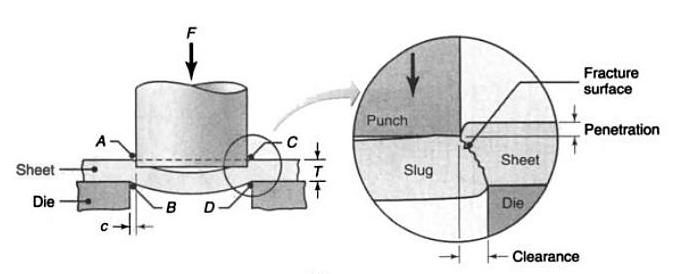
FIGURE 3-3 Schematic illustration of shearingwith a punch and die, indicating some of the process variables

