
目录

  • 1 课前导学
    • 1.1 自测
    • 1.2 慕课学习建议
  • 2 第2,3周 Chapter 1.  Introduction
    • 2.1 第一课时 1.1 What Is Manufacturing?
    • 2.2 第二课时 1.2 Selection of Materials
    • 2.3 第三课时 1.3 Selection of Manufacturing  Processes (1)
    • 2.4 第四课时 1.3 Selection of Manufacturing  Processes (2)
  • 3 第4,5周 Chapter 2. Metal-Forging Processes and Equipment
    • 3.1 第一课时 2.1 Introduction (1)
    • 3.2 第二课时 2.1 Introduction (2)
    • 3.3 第三课时 2.2 Open-die Forging (1)
    • 3.4 第四课时 2.2 Open-die Forging (2)
    • 3.5 线上直播 习题课+锻造1
  • 4 第6,7周 Chapter 2. Metal-Forging Processes and Equipment
    • 4.1 第一课时 2.2 Open-die Forging (3)
    • 4.2 第二课时 2.3 Impression-die and Closed-die Forging (1)
    • 4.3 第三课时 2.3 Impression-die and Closed-die Forging (2)
    • 4.4 第四课时 2.3 Impression-die and Closed-die Forging (3)
    • 4.5 线上直播 2022-4-22 Forging-2
  • 5 第8,9周 Chapter 2. Metal-Forging Processes and Equipment
    • 5.1 第一课时 2.3 Impression-die and Closed-die Forging (4)
    • 5.2 第二课时 2.4 Various Forging Operations
    • 5.3 第三课时 2.5 Die design, Die materials and Lubrication (1)
    • 5.4 第四课时 2.5 Die design, Die materials and Lubrication (2)
    • 5.5 线上直播 2022-4-29 Forging-3
  • 6 第10,11周 Chapter 3. Sheet-Metal Forming Processes and Equipment
    • 6.1 第一课时 3.1 Introduction (1)
    • 6.2 第二课时 3.1 Introduction (2)
    • 6.3 第三课时 3.1 Introduction (3)
    • 6.4 第四课时 3.2 Shearing (1)
  • 7 第12,13周 Chapter 3. Sheet-Metal Forming Processes and Equipment
    • 7.1 第一课时 3.2 Shearing (2)
    • 7.2 第二课时 3.2 Shearing (3)
    • 7.3 第三课时 3.2 Shearing (4)
    • 7.4 第四课时 3.2 Shearing (5)
    • 7.5 思维导图-优秀作业展示
  • 8 第14,15周 Chapter 3. Sheet-Metal Forming Processes and Equipment
    • 8.1 第一课时 3.3 Bending Sheets, Plates, and Tubes (1)
    • 8.2 第二课时 3.3 Bending Sheets, Plates, and Tubes (2)
    • 8.3 第三课时 3.4 Deep Drawing
    • 8.4 第四课时 3.5 Design Considerations in Sheet-Metal Forming (1)
  • 9 第16,17周
    • 9.1 第一课时 3.5 Design Considerations in Sheet-Metal Forming (2)
    • 9.2 第二课时 科技英语语法 (1)
    • 9.3 第三课时 科技英语语法 (2)
    • 9.4 第四课时 Plastics Injection Molding
第一课时 2.1 Introduction (1)

2.1 Introduction

Plastic forming operations arethose in which the shape of a metal piece is changed by plastic deformation; forexample, forging, rolling, extrusion, and drawing are common forming techniques (Fig.1.1). Of course, the deformation must be induced by anexternal force or stress, the magnitude of which must exceed the yield strengthof the material. Most metallic materials are especially amenable to theseprocedures, being at least moderately ductile and capable of some permanentdeformation without cracking or fracturing.
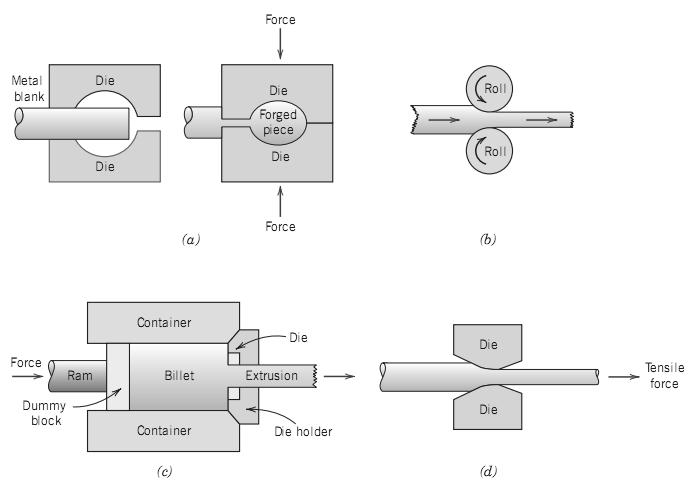
     

FIGURE.1-1  Some plastic forming operations: (a)forging; (b) rolling; (c) extrusion; (d) drawing.

When deformation is achieved at a temperature above that at which recrystallization occurs, the process is termed hot working; otherwise, it iscold working. With most of the forming techniques, both hot- and cold-working procedures are possible. For hot-working operations,largedeformations are possible, which may be successivelyrepeated because the metal remains soft and ductile. Also, deformation energyrequirements are less than for cold working. However, most metals experiencesome surface oxidation, which results in material loss and a poor final surfacefinish. Cold working produces an increase in strength with the attendantdecrease in ductility, since the metal strain hardens; advantagesover hot working include a higher quality surface finish, better mechanical properties and a greater variety of them, and closer dimensional control of the finished piece. On occasion,the total deformation is accomplished in a seriesof steps in which the piece is successively cold worked a small amount and thenprocess annealed; however, this is anexpensive and inconvenient procedure.