
-
1 Videos
-
2 Sentences
-
3 Dialogue
-
4 Text A
-
5 Text B
-
6 Text C
-
7 Text D
-
8 Further Reading
1、 The Zhuang Brocade, together with Song, Yun and Shu brocades, are four famous Chinese brocades.
壮锦,与宋锦、云锦、蜀锦一起,被誉为我国的四大名锦。
2、It is a traditional handicraft with more than 2,000 years of history.
它是一种传统手工艺,具有两千多年历史。
3、The Zhuang brocade is famous for its rich colors.
壮锦以其丰富的色彩而闻名于世。
4、Geometrical patterns such as squares and concentric circles are commonly seen in Zhuang brocades.
像方形和同心圆这样的几何图案在壮族织锦中很常见。
5、Phoenix, an auspicious symbol in China, often take a dominant role in the designs.
凤凰是中国吉祥的象征,在设计中往往占据主导地位。
6、Zhuang brocade is one of the outstanding cultural heritages in Zhuang nationality.
壮锦是壮族的优秀文化遗产之一。
Mr Wilson(Guest):I’ve heard about the Zhuang Brocade but I don’t know too much about it. What makes it so special?
我听说过壮锦,但是不太了解。为什么它如此独特呢?
Megan(Receptionist): The Zhuang Brocade, together with Song(Suzhou), Yun (Nanjing) and Shu (Chengdu) brocades, are four famous Chinese brocades. It is a traditional handicraft with more than 2,000 years of history.
壮锦,与宋锦(苏州)、云锦(南京)、蜀锦(成都)一起,被誉为我国的四大名锦。它是一种传统手工艺,具有两千多年历史。
Mr Wilson(Guest): It has a long history.
2000年?那壮锦有着悠久的历史了呢。
Megan(Receptionist): Yes. As early as Han Dynasty, the ancestors of Zhuang nationality brocaded "banbu", which was the predecessor of Zhuang brocade. Zhuang brocade was used as tributes in Ming Dynasty.
是的。早在汉代,壮族先民就织出了"斑布",那就是壮锦的前身,壮锦在明代被列为贡品。
Mr Wilson(Guest): How about the weaving techniques?
Megan(Receptionist): Actually there are two major techniques of weaving Zhuang brocade: using ordinary looms or using "pig cage" loom. Traditionally, Zhuang brocade is made on the “pig cage” loom.
实际上,壮锦的织造技术主要有两种:使用普通织机或使用“猪笼”织机。传统上,壮锦是在“猪笼”织机上制作的。
Mr Wilson(Guest):That is terrific. You must be so proud of it. I can’t wait to seeing it now.
Megan(Receptionist):That is right. Zhuang brocade is one of the outstanding cultural heritages in Zhuang nationality. It not only provides material for research on the weaving inventiveness of China’s ethnicgroups, but also stands as a towering landmark in the history of weaving.
壮锦是壮族的优秀文化遗产之一,不仅为研究中国各民族的织造发明提供了材料,而且是纺织史上的一座高耸的地标。
Guangxi Zhuang Autonomous Region
The State Council approved the establishment of the Guangxi Zhuang autonomous region on March 5, 1958.
Located in the southern part of the motherland, Guangxi Zhuang autonomous region connects Guangdong province in the east, neighbors Beibu Gulf in the south and faces Hainan province across the sea. It borders Yunnan province in the west, Hunan province in the northeast, Guizhou province in the northwest, and the Socialist Republic of Vietnam in the southwest. Guangxi covers an area of 237,600 square kilometers, and administers the Beibu Gulf area of approximately 40,000 square kilometers.
Forty percent of the total land area in Guangxi is a hilly basin landform. The plain mainly consists of alluvial river plains and an erosion plain. The largest Xunjiang River plain has an area of 630 square kilometers. The main peak of Maoer Mountain in the marginal mountains of the basin is 2,141 meters above sea level, the highest peak in South China. The karst landform is widely distributed in the southwest, northwest, central and northeast of Guangxi, accounting for 37.8 percent of the total land area. The extent of this formation is very rare in the world.
Guangxi is in the subtropical monsoon climate zone, with an average annual temperature of 17.5 to 23.5 C, average annual rainfall of 841.2 to 3,387.5 millimeters, and average annual sunshine of 1,213 to 2,135.2 hours. As a multi-ethnic inhabited region, there are 12 native ethnic groups namely Zhuang, Han, Yao, Miao, Dong, Mulam, Maonan, Hui, Jing, Yi and Shui and Gelao, and there are 44 other ethnic groups including Manchu, Mongolian, Korean, Tibet, Li and Tujia. Zhuang is the most populous minority in Guangxi and China. The Zhuang people mainly live in the cities of Nanning, Liuzhou, Chongzuo, Baise, Hechi and Laibin. Jingxi County has the highest proportion of Zhuang population, with a ratio of 99.7 percent. The Han people are distributed throughout the country, and in Guangxi live mainly on the south coast and in the east.
Guangxi has rich natural resources including minerals, marine life and animal and plant resources. There are large reserves of many minerals, especially aluminum, tin and other non-ferrous metals. Guangxi, with an area of about 100,000 hectares of mudflats, is one of the 10 key non-ferrous metal production regions in China. Its mangroves cover a total area of 5,654 square kilometers, accounting for 40 percent of the national total. Beibu Gulf is not only a famous fishing ground in China, but also a treasure house of the world's marine biological species. The world-famous Hepu Pearl is produced in this area. In addition, Guangxi has 149 rare and precious species under state protection, accounting for 45 percent of the national total. Guangxi also has 24 animal species under level 1 national protection, 27 percent of the national total.
Rich tourism resources and unique ethnic customs are also a major attraction of Guangxi. The main boutique scenic spots in Guangxi include Guilin Culture and Leisure Resort, Nanning Business Exhibition Lyudu Cultural and Tourism Area, Binhai Tourism Area based on Beihai Beach, Leye Dashiwei Tiankeng Group National Geopark, Detian Transnational Waterfall Tourism Area, Guidong Religious Scenic Site Historical and Cultural Tourism Area, Hezhou Shanshui Ancient Town Ecological Cultural Area, Zhuang-Yao-Miao-Dong-Ethnic Customs Eco-tourism Area in central Guangxi, "Three Sacred" Tourist Area in Laibing and Jinxiu and South China Border Customs Tourism Area with Pingxiang and Jingxi as the core. As of 2014, Guangxi had four national 5A-class tourist attractions and 112 4A-class tourist attractions in 14 prefecture-level cities. Guangxi also has three national-level scenic spots, namely Guilin Lijiang, Guiping Xishan Mountain and Ningming Huashan Mountain.
As the long-term host of the China-ASEAN Expo, Guangxi has important advantages. Other conferences such as the 9th Pan-Beibu Gulf Economic Cooperation Forum not only promote economic development in the region, but also help the world better understand Guangxi.
(转自http://en.gxzf.gov.cn/2020-07/10/c_263420.htm)
参考译文:
广西壮族自治区
1958年3月5日,国务院批准成立广西壮族自治区。
广西壮族自治区地处祖国南部,东接广东省,南邻北部湾,与海南省隔海相望。西临云南,东北与湖南接壤,西北与贵州省接壤,西南与越南社会主义共和国接壤。广西占地二十三万七千六百平方公里,管理北部湾面积约四万平方公里。
广西土地面积的40%为丘陵盆地地貌。平原主要由冲积河平原和冲蚀平原组成。最大的荀江平原面积630平方公里。盆地边缘山毛儿山的主峰为海拔2141米,是华南地区的最高峰。广西西南、西北、中部、东北地区岩溶地貌分布广泛,占总面积的37.8%。这种形成的程度在世界上是非常罕见的。
广西属亚热带季风气候带,年平均气温17.5~23.5℃,年平均降雨量841.2~3,387.5毫米,年平均日照1,213~2,135.2小时。作为一个多民族聚居区,有壮族、汉族、瑶族、苗族、侗族、木兰族、毛南族、回族、京族、彝族、水族、格劳族等12个民族,还有满族、蒙古族、朝鲜族、西藏族、黎族、土家族等44个民族。壮族是广西和中国人口最多的少数民族。壮族主要居住在南宁、柳州、崇左、百色、河池、莱滨等城市。荆溪县壮族人口比例最高,达99.7%。汉族分布在全国各地,广西主要分布在南部沿海和东部。
广西拥有丰富的自然资源,包括矿产资源、海洋生物资源和动植物资源。有大量的矿藏,特别是铝、锡和其他有色金属.广西是中国十大有色金属重点产区之一,占地面积约10万公顷。红树林总面积5654平方公里,占全国总面积的40%。北部湾不仅是中国著名的渔场,也是世界海洋生物资源的宝库。世界著名的合浦珍珠就是在这个地区生产的.此外,广西有国家重点保护的珍稀物种149种,占全国的45%。广西还有全国一级保护动物24种,占全国的27%。
丰富的旅游资源和独特的民族风情也是广西的主要景点。广西主要精品风景名胜区包括桂林文化休闲度假区、南宁商展柳都文化旅游区、北海海滨旅游区、乐业大石威天坑集团国家地质公园、德田跨国瀑布旅游区、桂东宗教风景区历史文化旅游区、河州山水古镇生态文化区、广西中部壮瑶苗族民俗生态旅游区、莱兵金秀“三圣”旅游区和以萍乡、景溪为核心的华南边境海关旅游区。截至2014年,广西有4个国家级5A级旅游景点和112个4A级旅游景点,分布在14个地级城市。广西还有桂林丽江、桂平西山和宁明华山三大国家级风景名胜区.
广西作为中国-东盟博览会的长期主办国,具有重要的优势。第九届泛北部湾经济合作论坛等会议不仅促进了该地区的经济发展,而且有助于世界更好地了解广西。
广西将继续发挥优势,促进经济繁荣、生态发展和人民生活水平的提高,在世界舞台上大放异彩。
Zhuang Brocade: State of the Weaving Art
With a population of over 16 million, Zhuang is the largest ethnic minority group in China. Over 90 percent of Zhuang people live in Guangxi Zhuang Autonomous Region in southwest China, and the rest reside in neighboring Yunnan, Guizhou and Hunan provinces. Throughout the centuries, the Zhuang people have been admired for their outstanding brocade weaving skills.
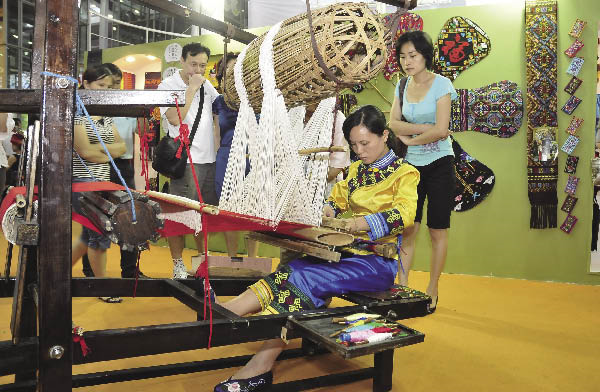
A Zhuang girl demonstrates brocade weaving on a traditional “pig cage” loom at the 5th China (Shenzhen) International Cultural Industries Fair.
Centuries-long Handicraft
Zhuang brocade has a long history. As early as the Han Dynasty (206 B.C-A.D 220), Zhuang people began to weave banbu, or streaky cloth, which is considered the predecessor of brocade. Several remnants of the cloth were discovered in a tomb from the Han Dynasty in Guangxi, proving the early existence of this weaving technique. As dyeing technology was improved later, the former monochromatic textile became richer in color.
During the period spanning the Tang (618-907) and the Song (960-1279) dynasties, this handicraft took on its defining characteristics, merging the strengths and beauty of silk, fiber and cotton.
Of brocade’s origin, a story handed down from the Song Dynasty tells of Danimei, a female weaver of the Zhuang ethnic group. According to the legend, she amused herself by designing new and fascinating patterns for her brocades. One morning, having spent the whole night sitting in her doorway thinking up new designs, Danimei suddenly noticed the dewdrops on a spider web, which in the morning light emitted all the colors of the rainbow. Danimei was instantly inspired by this amazing effect and moved her loom outside under the eaves. Watching the pattern of the dew-bejeweled web, Danimei began to weave a piece of brocade to mimic it, with multicolored silk threads.
With her deft hands flying up and down without stop, Danimei managed to weave the new design within just half a day.
Seeing the outstanding work, weavers from all around the region came to Danimei’s house to learn her skills. This technique thus spread quickly across places inhabited by the Zhuang population.
By the Ming and Qing dynasties (1368-1911), Zhuang brocade was woven with an even richer pallet of colorful floss and further elaborated in both style and technique. With its fantastic mix of textile strands and hues, richly embellished brocades became one of the special gifts offered by the local authority of Guangxi to royal courts, starting in the Ming Dynasty.
Zhuang Innovation
With a history of over 1,000 years, Zhuang brocades have stood out for their exquisite designs and durability. Their techniques have been adopted by people in other provinces to produce beautiful and long-lasting cloth.
Traditionally, Zhuang brocade is made on the “pig cage” loom, a device with a wood frame, basic gears and a bamboo-woven cage that threads run across to form raised patterns. The structure is not complicated, but shows the working principle behind a modern jacquard mechanism. Brocade produced by this kind of manual machine takes on the characteristic three-dimensional texture and permits many more varieties of pattern.
In order to make a perfect color match, people often use cotton or jute yarns for the warp and thrown silk for the woof. At the same time, one direction is normally done in primary hues and the opposite in brighter or lighter colors.
The Zhuang brocade is famous for its rich colors.Zhuang people like colorful objects, and often make clothes and embroidery with five-color floss. The tints are luxurious but not vulgar, primitive but conforming to aesthetic values.
Geometrical patterns such as squares and concentric circles are commonly seen in Zhuang brocades. Apart from these, there are also many traditional designs that incorporate clouds, flowers, plants, waves and animals, as well decorative patterns symbolizing bliss and contentment. Phoenix, an auspicious symbol in China, often take a dominant role in the designs. Perhaps the most famous pattern is “phoenixes flying in pairs.” Some patterns also embody Chinese themes and legends such as “two dragons playing with a pearl,” “carp leaping over the dragon gate,” “lions playing ball” and “butterflies courting flowers.”
In recent years, more patterns have emerged, reflecting new themes such as grain harvests and the unity of ethnic groups. Furthermore, the picturesque landscapes where Zhuang people reside also inspire them to recreate their beautiful mountains and rivers in their designs. All these patterns represent the life of the Zhuang people and serve to further enrich traditional brocades.
A gift Zhuang brocade is presented by Ma Biao (second left), chairman of Guangxi Zhuang Autonomous Region, to Mrs. Cecilia Koo, widow of Koo Chenfu, late chair of the Straits Exchange Foundation.
In 2007, a brocade was woven to depict Victoria Harbor for the 10th anniversary of Hong Kong’s return to China. The elaborate piece, 3.5 meters in length and 2.4 meters in width, is the largest Zhuang brocade in the world. This wonderous gift, carrying best wishes to Hong Kong and now preserved in a government building, remains much admired by the island’s residents.
Brocade weaving is a must-learn for Zhuang women. To the local people, a brocade quilt-cover is indispensable as a dowry. Therefore, a girl must begin to learn the weaving skill before reaching marriageable age. Zhuang brocade is not only the material traditionally selected for bedding, ethnic costumes and handbags, but is also found on contemporary catwalks, glimmering on models of various nationalities.
In the past two decades, new technologies have been adopted and put into the production of Zhuang brocade; modern factories have been set up, contributing to significant improvement in the variety and quality of the fabric. However, there are still a number of villages in Guangxi specializing in the production of hand-made brocades.
Perennially popular among Chinese and foreigners, the wide-range of designs, well-knit structures, vivid patterns and rich colors all reflect the wisdom and the optimistic character of the Zhuang.
Zhuang brocade not only provides material for research on the weaving inventiveness of China’s ethnic groups, but also stands as a towering landmark in the history of weaving.
(转自:http://www.chinatoday.com.cn/ctenglish/se/txt/201003/09/content_253159_2.htm)
参考译文:
壮锦:织造艺术的现状
壮族人口超过1600万,是中国最大的少数民族。90%以上的壮族居住在中国西南部的广西壮族自治区,其余的居住在邻近的云南、贵州和湖南。几百年来,壮族人民以其出色的织锦技巧而备受推崇。
在第五届中国(深圳)国际文化产业博览会上,一位壮族女孩在传统的“猪笼”织布机上展示织锦。
几百年的手工艺
壮锦有着悠久的历史。早在汉代(公元前206年至公元220年),壮族人就开始织布,即条纹布,被认为是织锦的前身。在广西汉代的一座墓穴中发现了一些布的残留物,证明了这种织布技术的早期存在。随着染色工艺的不断改进,原有的单色纺织品的颜色更加丰富。
在唐朝(618-907)和宋朝(960-1279)时期,这种手工艺呈现出鲜明的特点,融合了丝绸、纤维和棉花的力量和美。
关于锦缎的起源,有一个宋代流传下来的故事,讲的是壮族女织女丹美的故事。根据传说,她通过为她的胸针设计新的迷人的图案来娱乐自己。一天早晨,丹妮梅整晚坐在门口想出新的设计,突然注意到蜘蛛网上的露珠,它在早晨发出彩虹的所有颜色。丹妮梅立刻受到这一惊人效果的启发,把织机移到屋檐下。看着露珠织网的图案,丹妮梅开始用五颜六色的丝线编织一条织锦来模仿它。
丹妮梅灵巧的双手不停地飞来飞去,只花了半天时间就织出了新的图案。
看到这些杰出的作品,各地的织工来到丹妮梅家学习她的技艺。因此,这种技术在壮族人居住的地方迅速传播。
到了明清时期(1368-1911年),壮锦用一种更加丰富的彩绒托盘编织而成,在风格和技术上都得到了进一步的阐述。从明代开始,广西地方当局向皇室赠送的特别礼物之一是富有装饰色彩的罗布麻,它由纺织和色彩的完美结合而成,成为广西地方政府赠送给皇室的特别礼物之一。
壮族创新
壮族胸针有着一千多年的历史,以其精湛的设计和耐用性而脱颖而出。他们的技术已经被其他省份的人们所采用,以生产美丽而持久的布料。
传统上,庄锦是在“猪笼”织机上制作的,这是一种由木架、基本齿轮和竹子编织的笼组成的装置,这些线穿过织机形成凸起的图案。其结构不复杂,但体现了现代提花机构的工作原理。这种手工机器生产的织锦具有独特的三维纹理,允许更多的图案品种。
为了达到完美的配色,人们经常用纯棉或黄麻纱作经纱,用抛丝作经纱。同时,一个方向通常是原色,相反的是较亮或较浅的颜色。
壮锦以其丰富的色彩而闻名于世。壮族人喜欢五颜六色的物品,经常用五色牙线做衣服和刺绣.色彩豪华,但不粗俗,原始,但符合审美价值。
像方形和同心圆这样的几何图案在壮族织锦中很常见。除此之外,还有许多传统图案,包括云、花、植物、波浪和动物,以及象征幸福和满足的装饰图案。凤凰是中国吉祥的象征,在设计中往往占据主导地位。也许最著名的模式是“双双飞行的凤凰”。一些图案也体现了中国的主题和传说,如“两条龙玩珍珠”、“鲤鱼跳过龙门”、“狮子玩球”和“蝴蝶求花”。
近年来,出现了更多的格局,反映了粮食丰收和民族团结等新主题。此外,壮族居住的风景如画,也启发他们在设计中重新创造美丽的山川。这些图案代表了壮族人民的生活,进一步丰富了传统的花纹。
广西壮族自治区主席马飚(左二)向已故海峡交流基金会主席古琴福的遗孀古柏芝夫人赠送壮族锦。
2007年,为了纪念香港回归中国十周年,制作了一个织锦来描绘维多利亚港。这件精巧的作品长3.5米,宽2.4米,是世界上最大的壮锦。这份令人赞叹的礼物,带着对香港最美好的祝愿,现在保存在一座政府大楼里,至今仍深受岛上居民的喜爱。
织锦是壮族妇女的必修课.对当地人来说,织锦被套作为嫁妆是必不可少的.因此,一个女孩在达到结婚年龄之前必须开始学习编织技巧。壮锦不仅是传统上床上用品、民族服饰、手袋的选材,而且还出现在当代时装秀上,在各民族的模特身上闪现光芒。
近二十年来,壮锦生产采用了新技术,建立了现代化工厂,织物品种和质量有了显著提高。然而,广西仍有一些专门生产手工织锦的村庄.
长期以来深受中外欢迎,设计种类繁多,结构紧凑,图案生动,色彩丰富,都体现了壮族的智慧和乐观性格。
壮锦不仅为研究中国各民族的织造发明提供了材料,而且是纺织史上的一座高耸的地标。
Bronze Drums
Inspired by the shape of drum or bronze basin, bronze drums are percussion instrument of the ethnic groups in the southwest of China. Applied to sacrifice rites, the bronze drums were usually used to play music or accompany with dance. Popular in Yunnan, Guangxi, Guangdong, Sichuan and Hunan provinces in the south of China and spread to East Asian countries, the bronze drums were initiated in the Autumn and Spring Period (770-476BC). The bronze drums of the Han Dynasty (206BC-220AD) are among the most excellent ones.
Bronze drums were molded by clay or stone and cast by bronze alloy. The upper part is the drum face and the lower part is the drum body, which is hollow. One bronze drum is composed by five parts, namely the face, chest, waist foot and ear. The face of the drum is smooth with the center a little bulged, decorated with lines of the sun rays, and images of the toads, tortures, birds and knights were carved on the outer part of the rays. The drum chest is connected with the drum face in an arc form. The waist of the drum is like a tube, with the drum feet below it, which are smaller in the upper part and bigger in the lower part like a cone. Bronze drums later featured no obvious borderlines between the waist and the foot, and some even had no feet. There is always a pair of drum ears between the chest and waist symmetrically, with lines carved on as decoration.
In terms of region and design, bronze drums fall into two styles: Dian and Yue. Bronze drums of the Dian Style were popular in Yuannan, Guizhou, Sichuan and Hunan Provinces, among which, the central Yunnan Province and the west of Guangxi Province have the largest number. Bronze drums of the Dian Style are small in size; the diameter of the face is within one meter, which is smaller than the diameter of the body. Bronze drums of the Yue Style were popularized in the southeast of Guangxi Province and the southwest of Guangdong Province. Bronze drums of the Yue Style are large in size and finely cast, whose face is larger than the chest, as well as the waist.
参考译文:
青铜鼓
青铜鼓受鼓或铜盆形状的启发,是西南少数民族的打击乐器。铜鼓常用于祭祀仪式,用于演奏音乐或伴奏舞蹈。铜鼓流行于中国南方的云南、广西、广东、四川、湖南等省,流传到东亚各国,始建于秋春时期(公元前770-476年)。汉代铜鼓(公元前206年-220年)是最优秀的铜鼓之一。
铜鼓用粘土或石头铸成,用青铜合金铸造。上部是鼓面,下部是鼓体,是空心的。一个铜鼓由脸、胸、腰、脚、耳五部分组成。鼓面光滑,中间有一点凸起,装饰着太阳射线的线条,射线的外层雕刻着蟾蜍、酷刑、鸟类和骑士的形象。鼓箱以弧形与鼓面连接。鼓的腰部就像一根管子,鼓脚在它下面,在上半部分更小,在下部更大,就像一个圆锥体。铜鼓后来在腰部和脚之间没有明显的分界线,有些甚至没有脚。胸部和腰部之间总是有一对鼓耳对称地,上面刻有线条作为装饰。
就地域和设计而言,铜鼓分为两种风格:滇鼓和越鼓。滇式铜鼓流行于元南、贵州、四川、湖南等省,其中滇中、广西西部铜鼓数量最多。殿式铜鼓尺寸小,面直径在一米以内,比身体直径小。粤式铜鼓在桂东南和粤西南推广。越式铜鼓大而细,面比胸大,腰大。
Zuojiang Huashan Rock Art Cultural Landscape
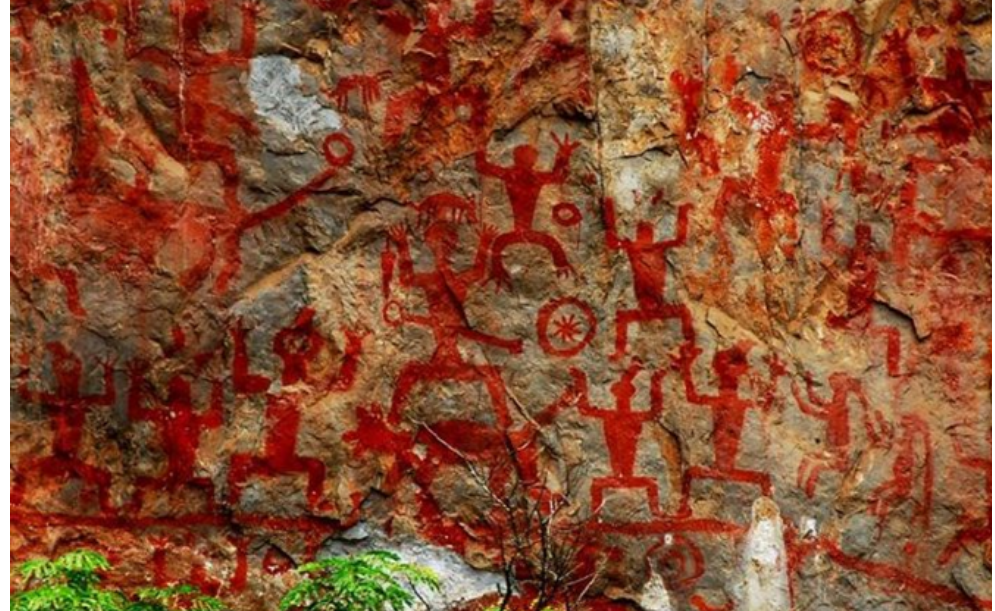
Located on the steep cliffs in the border regions of southwest China, these 38 sites of rock art illustrate the life and rituals of the Luoyue people. They date from the period around the 5th century BCE to the 2nd century CE. In a surrounding landscape of karst, rivers and plateaux, they depict ceremonies which have been interpreted as portraying the bronze drum culture once prevalent across southern China. This cultural landscape is the only remains of this culture today.
(转自http://blog.sina.com.cn/s/blog_57a711e30102wffy.html)
参考译文:
广西左江花山岩画
花山岩画位于中国西南边陲地区的陡峭岩壁上。这38处岩画展现的是骆越族人生活和宗教仪式的场景,这些绘制年代可追溯至公元前5世纪至公元2世纪的岩画与 其依存的喀斯特地貌、河流和台地一起,使人得以一窥过去在中国南方盛行一时的青铜鼓文化仪式的原貌。这一文化景观如今是这种文化曾经存在的唯一见证。
Zhuang Nationality
Population and Distribution:
With a population of about 16,178,811, Zhuang ethnic group is the largest minority group in China with a long history and glorious culture. Over 90 percent of the population live in Guangxi Zhuang Autonomous Region. The rest reside in Yunnan, Guangdong, Guizhou and Hunan Provinces.
Language and Character:
They have a language of its own that belongs to the Zhuang-Dai branch of Zhuang-Dong Austronesian (an austronesian belongs to the Sino-Tibetan family of languages). The language is divided into two dialects although they have few differences.
Chinese characters were used before 1955 for writing, however since 1957, a writing system based on the Latin alphabet has been created with the help of the Chinese government. The Latin alphabet has been adopted to publish many books. Since then, they have had their own language. In the year of 1982, the Zhuang language was revised and has been greatly used.
Belief:
Since the ancient times, they have had numerous kinds of beliefs. They believe in the propagation, the totem, and their ancestors. Now, most of them are polytheists, believing the power of many inanimate things in nature, such as giant trees, high mountains, cavity, the earth, the sun, water and so on. Sacrifice activities are usually held because of their beliefs of being blessed by the divinity and to prevent all kinds of disasters.
Food and Food Culture:
Their primary products are tropical and subtropical crops such as rice and corn due to the mild climate and abundant rainfall. The people eat all kinds of meat, including beef, mutton, pork and chicken, etc. The vegetables of their daily life are of various kinds. Poached and pickled vegetables are the favored ones.
They are so hospitable that any guests are honored by the whole village. Wine is a must when treating the guests. Guests are shown a unique way of drinking each others wine in the spoon by crossing each other's arms. The elder person is shown respect by nobody eating before him or her.
Clothes:
The style of clothing differs according to different areas. There is little difference for the men's wear, in comparison with the Han people's style. Women however, have numerous styles. For example, the women living in the northwest Guangxi usually wear the collarless, embroidered jackets buttoned to the left along with loose and wide trousers, or pleated skirts and embroidered belts. The women from the southwest Guangxi prefer collarless jackets buttoned to the left with black square headbands on the head and loose trousers. Most of them complement their outfits with silver ornaments.
Crafts:
Like some other ethnic group women, the Zhuang women are skilled at weaving and embroidering. These women have a great reputation for the distinctive designs of cotton woven yarn brocade they make in colorful velour. Zhuang brocade is renowned for its color, luster, durability and the wide range of use. Another skill such as dying with wax is also popular. You can appreciate the excellent skills used in handcrafting carpets, aprons, bed covers, waistbands, tablecloth and curtains as a beautiful purchase for homes all over the world. Now, Zhuang brocade is not only a wonderful handicraft favored by the people in China but also has won international fame and enjoys a large market both at home and abroad.
Festivals:
Besides sharing similar festivals with the Han, they have their unique ones including: the Devil Festival, the Ox Soul Festival, and the Singing Festival.
The Devil Festival, held on July 14th of the lunar month, is regarded as an occasion second to the Chinese New Year. The day before the Devil Festival, every family does a thorough house cleaning and makes special preparations of outfits used in the sacrifice. On that day, duck, pork and good wines along with some candies and fruits must be offered in order to show great respect to their ancestors.
The Ox Soul Festival held on April 8th of the lunar month is to celebrate the birthday of the king of oxen and to show their love and respect to the ox, therefore, each ox is relieved from their yokes and free from plowing. People give the ox a bath accompanied with beating drums. Parents of a family feed the ox with five-colored glutinous rice, while singing folksongs. It is a festival that represents their great hope for a good harvest.
The Singing Festival is a traditional occasion which was held before 1940 to visit graves of the ancestors. Now it has become a grand sentimental occasion using songs for their expression. On that day, after offering sacrifices to Sanjie Liu (a Zhuang minority girl good at singing), they will sing to each other to challenge each other not only the song itself but also wit. Lyrics are usually improvisational and humorous that makes every one burst into laughter. It is also a perfect day for the young men to express their love to the girls by singing, so it is also reputed as the Valentine's Day of the Zhuang ethnic minority.
Other Culture:
Other cultures such as frescoes and bronze drums are also of splendid fame.
The Zhuang minority's frescoes carved on the steep cliffs are of extreme Zhuang characteristics. Figures, beasts and some other patterns carved 2,000 years ago will make everyone appreciate the image of their ancestors and the superb technique.
The bronze drum used both in sacrifice and festivals, delivers a special culture of the Zhuang ethnic minority. On the top and sides of the drums, the sun, frogs, dragon, dancing women and other patterns are decorated. It is a great revelation of their worship to the sun and frog. Nowadays, the bronze drum has become an indispensable musical instrument for the festivals.
(转自https://www.travelchinaguide.com/intro/nationality/zhuang/)

