《西方财务会计》双语课程教学大纲
Western Financial Accounting (Bilingual) Teaching Syllabus
课程编号:131505047
学时:32(含课外学时)
学分:2
适用对象:会计学专业
先修课程:《大学英语》,《会计学基础》,《中级财务会计》
授课教师及联系方式:
姓名:熊玲
办公室:经管法学院(崇义南楼)会计系办公室A401
电话:13789375896
一、课程的性质和任务
This course is an introduction to the basic concepts, principles, and techniques of financial accounting, including analysis and recording of business transactions and preparation of worksheet. In addition to class lectures, there are a large number of original English books before and after class, and case reading is also very important for academic English proficiency. This is not only an important means for accumulating considerable professional vocabulary, but also an effective training for learners' thinking style.
二、教学目的与要求
To demonstrate a sound understanding of the basic accounting process ;
To describe and document the components of accounting cycle;
To measure a range of financial events, record business transactions and prepare financial reports;
On successful completion of this subject students will be able to enhance generic skills in group work, problem solving and information literacy and numeracy.
三、教学环节与学时分配
序号 | 教学内容 | 章节 | 课时安排 | Homework | Group-work |
1 | Accounting and the Business Environment | Chapter 1 | 4 | p33 review questions;s1-1~s1-5 E1-19;E1-22;E1-26;E1-29; | GROUP-WORK;P55-P59 Critical thinking: choose any one of them: |
E1-30~E1-33;P1-40A/P1-45A | |||||
2 | Recording Business Transactions | Chapter 2 | 2 | p100 review questions; s2-1~s2-7 E2-18,E2-19; | GROUP-WORK;P128 -129 Critical thinking: choose any one of them: Decision case; Ethical issue; Fraud case; Financial statement case; Team project) |
E2-25,E2-26;P2-30A;P2-33A | |||||
3
|
The Adjusting Process
|
Chapter 3
|
2
| p172 review questions;s3-1~s3-5;E3-18,19,20 | GROUP-WORK;P198-201 Critical thinking: choose any one of them: Decision case; Ethical issue; Fraud case; Financial statement case; Team project) |
s3-7~s3-12;E3-21,22,23 | |||||
s3-14~s3-15;E3-30;P3-36A | |||||
4
|
Completing the Accounting Cycle
|
Chapter 4
|
2
| P240 review questions; s4-7~4-10,E4-17;E4-20;E4-22 P4-31A;GROUP WORK P268-P270 | GROUP-WORK;P268 -270 Critical thinking: choose any one of them: Decision case; Ethical issue; Fraud case; Financial statement case; Team project) |
| 5 | Presentation Time | 2 | P254-P267 | Group work | |
6
|
Merchandising Operations |
Chapter 5
|
2
| review questions;s5-1~5-3;E5-15~E5-17 S5-4~S5-7;E5-18~5-20;P5-32A;P5-34A | |
7
|
Merchandise Inventory
|
Chapter 6
|
2
| P401 REVIEW QUESTIONS;S6-1~S6-8;E6-16,E6-17 P6-32A,P6-33A | |
8 | Internal Control and Cash | Chapter 8 | 2 | P462 review questions; S8-1~s8-8;E8-11~E8-20;P8-25A;P8-28B | |
| 9 | Receivables | Chapter 9 | 2 | P519 review questions; S9-3~s9-10;E9-14~E9-20;P9-29A | |
| 10 | Plant Assets, Natural Resources, and Intangibles | Chapter 10 | 2 | P583 review questions; S10-3~s10-14;E10-17~E10-22;P10-30A;P10-31A | |
| 11 | Current Liabilities | Chapter 11 | 2 | P630 review questions; S11-2~S11-12;E11-14~11-23;P11-27A,P11-31B | |
| 12 | Payroll | Chapter 11 | 2 | P630 review questions; S11-2~S11-12;E11-14~11-23;P11-27A,P11-31B | |
| 13 | Corporations | Chapter 13 | 2 | P684 review questions; S11-2~S13-11;E13-19~13-22;P13-35A,P11-36A | |
| 14 | Long-term Liabilities | Chapter 14 | 2 | P748 review questions; S14-1~S14-6;E14-17~18;P14-32A,P14-33A | |
| 15 | Review and Presentation | Chapter 1-14 | 2 | Answer questions about this semester and students can make the last presentation. | |
| 16 | TEXT | 2 | Written examination |
四、教材及主要参考书:
1、选用教材:
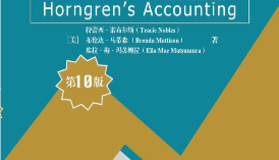
Horngren's Accounting, Tenth edition, Tracie Nobles;,Brenda Mattison, Ella Mae Matsumura, published by Pearson Education,2017
2、主要参考书:
Accounting,9th Edition, Charles T. Horngren, Walter T. Harrison Jr, Linda Smith Bamber,published by Pearson Education,2013
Principles of Accounting,23th Edition, , James M. Reeve , Carl S Warren ,published by 人民大学出版社(改编版),2010
葛家澍,林志军《现代西方会计理论》厦门大学出版社,2011
文硕《西方会计史-会计发展的五次浪潮》(上),经济科学出版社,2012
A History of Accountancy in the United States, G.J.Previts, B.D.Merino, published by 中国人民大学出版社(翻译),2009

