
-
1 Reading
-
2 Translation

“Because it’s there.” These famous words were spoken in 1922 by George Leigh Mallory, the greatest British mountain climber of his generation.
Mallory made the first serious attempt to climb the highest mountain in the world, Mount Qomolangma in the Himalayas, in 1922. This expedition failed but when Mallory returned to England he was determined to return to the mountain and try again. So he went on a lecture tour to try to raise money for the next attempt. Everywhere he went Mallory was asked the same questions: Was it cold? Where was Qomolangma? Why would you want to climb Qomolangma anyway? In answer to this last question Mallory replied quickly and impatiently, “Because it’s there.”
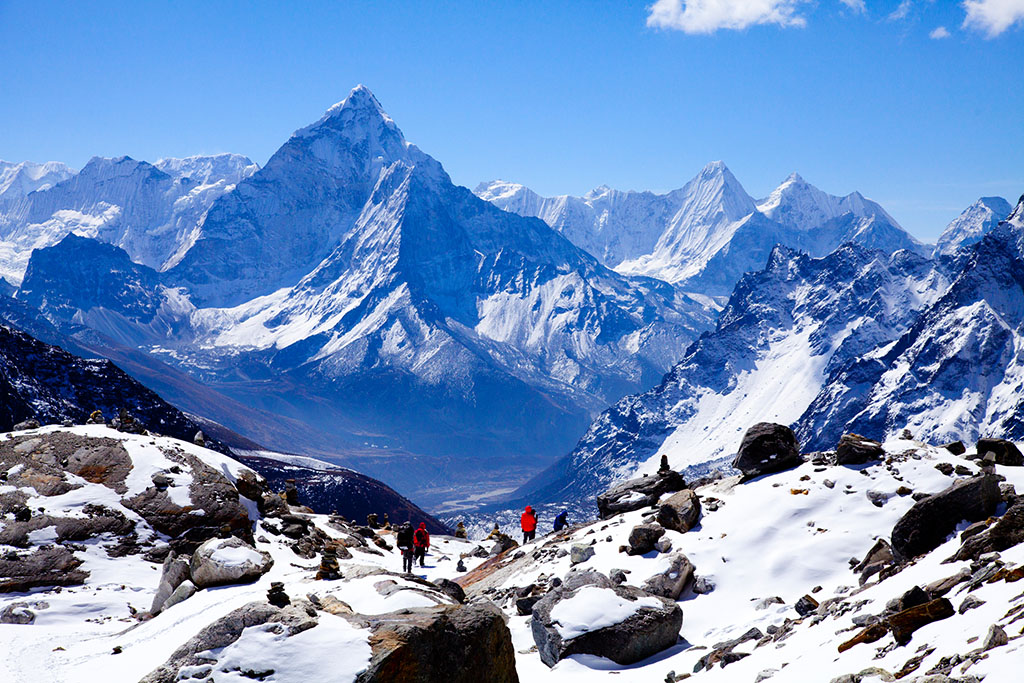
Mallory returned to Qomolangma in 1924 to lead a new expedition to try to conquer the world’s highest peak. Mallory went with a large team of climbers and local guides, called “sherpas”. They made their way slowly and carefully up the mountain until they reached a camp just a few hundred metres below the summit.
The next day, 8 June 1924 George Mallory and his companion Andrew Irvine set off along the north-east ridge to make for the top. The morning weather was clear and their colleagues could see them making good progress. However when the two men were just 300 metres below the summit, clouds came over the mountain and they were lost to sight. They were never seen again.
The disappearance of Mallory and Irvine in 1924 has led to a mystery that remains unsolved till today. Did they reach the summit, 30 years before Edmund Hillary and Tenzing Norgay, and then die on the descent?
Some clues were later found. In 1933, a British expedition discovered Irvine’s ice axe at a point high up on the north-east ridge. But had it been dropped there or fallen from higher up? No bodies were found there nor was there any sign of a camera, which might offer proof of the ascent.
Then in 1975 a Chinese climber found a body, which he described as “old English dead”. However, he himself died before he could reveal the exact location of the body.
In 1999, an American team led by veteran climber and Qomolangma conquerer, Eric Simonson, set out to find more evidence of Mallory and Irvine. They wanted to discover once and for all the true fate of the climbers who had disappeared 75 years before.
Simonson saw the expedition as a homage to great courage and leadership. “The achievement of George Mallory and Andrew Irvine is not fully appreciated. To get within a few hundred meters of the summit in 1924, wearing tweed clothing and using extremely heavy and primitive oxygen gear, was incredible.”
Joining Simonson on his team were historians, physicists and photographers as well as other climbers. They wanted to record what they discovered. In the spring of 1999 they set up camp on Qomolangma and began the climb towards the north-east ridge.
On 1 May they discovered a shiny white object lying on the rocks at just over 8,000 metres up the mountain. On closer inspection they discovered it to be the body of a man, with his skin bleached white by the sun and the wind. He was still wearing a few old clothes. The body’s head was missing. The team looked at the clothes and found a name still written there. They opened the pockets. They found letters, tobacco, matches and maps. They had discovered George Mallory’s body.
After a few hours of searching the area for other items, the American team said a few words of farewell and buried Mallory’s body.
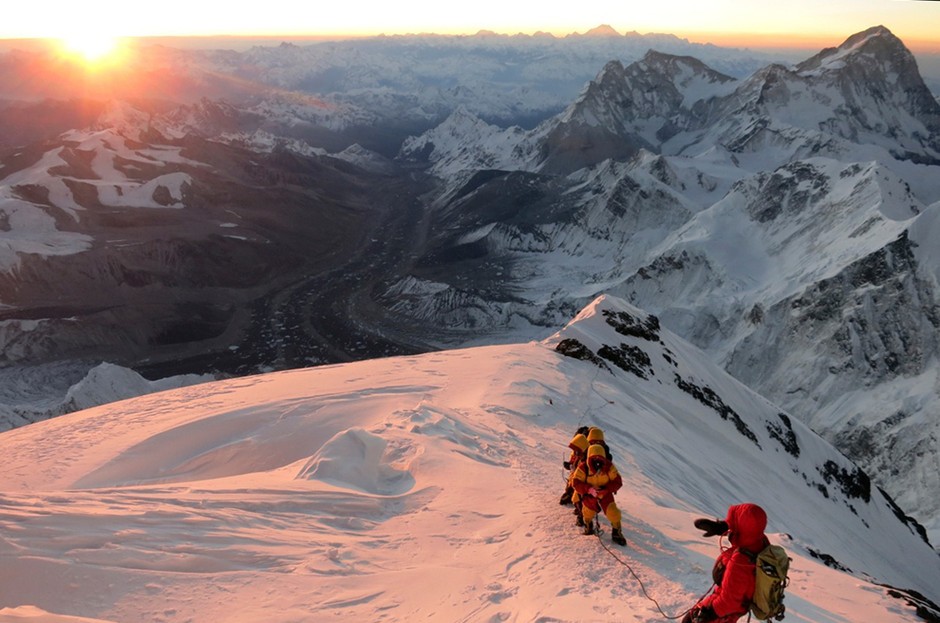
“This discovery is a huge achievement,” declared Simonson. “It is hard to convey our excitement over this discovery.” Unfortunately, the camera they found on Mallory’s body was empty and there was no other proof that he had reached the summit. However, his sunglasses were in his breast pocket and so it would appear that Mallory was coming down when he fell, with the sun behind him. But we will never know if he died after reaching the top or not. Of Irvine, no sign was found.
The heroic effort by the early mountaineers to climb Qomolangma exemplifies the human will to meet any challenge, however remote and however difficult. It shows that people are prepared to risk and suffer death to achieve what was previously seen as impossible.
Our thirst for knowledge is shown in the exploration of the deepest oceans and our landing on the Moon. We seek to understand the outer reaches of the universe and to unlock the secrets of the human genome. It is our human nature to want to learn more and do more than has ever been done before. Why? “Because it’s there.”
So in the end it does not really matter whether or not Mallory and Irvine climbed to the top of Qomolangma and died on the way down, or whether they tripped and fell before reaching the summit. Their achievement lies in gra sping the glorious challenge of the mountain and in risking all to tackle it. Mallory’s body, lying exposed for 75 years on the mountain and now buried on its slopes, is proof that the human spirit will never be defeated.