
Suspension
1 Overview of Suspension
The suspension covers the arangement used to connect the wheels to the body.The purpose is to prevent large shocks, caused by the wheels striking bumps in the road, being passed to the vehicle occupants and components: otherwise discomfort and damage would occur.
The deflection of a pneumatic tire takes much of the impact from a road bump but some form of springing is still needed to give a satisfactory ride. Unfortunately the release of the energy contained in a spring when it has been deflected by a road bump causes the vehicle to bounce, so to overeome this shock absorber is fitted
Types of oscillations are:
1) Bouncing: rectilinear oscillations along the vertical axis.
2) Lurching: rectilinear oscillations along the transverse axis
3) Pitching: rotary oscillations about the transverse axis
4) Rolling: rotary oscillations about the longitudinal axis.
5) Shimmying: rotary oscillations of the steering wheels about the steering knuckle pin
6) Skidding: yawing with several tires slipping on the road surface.
7) Surging: rectilinear oscillations along the longitudinal axis.
8) Tramping:rotary oscillations of rigid axles about the axis of rotation parallel to the longitudinal axIs
9) Yawing: rotary oscillations about the vertical axis.
The suspension system has two subsystems-the front suspension and the rear suspenstion.
2 Front Suspension
The front suspension is more complicated than the rear suspension. This is because the front wheels must move in several different directions. The wheels must move up and down with the suspension and turn left to right with the steering. Since the car goes in the direction in which the front wheels point, the alignment of the front wheels is important.The wheels must point in just the right direction for the car to move straight down the road and turn properly.
Modern cars use an independent front suspension. In this system, each wheel mounts separately to the frame and has its own individual spring and shock absorber.Thus, the wheels act independently of one another. When one wheel hits a bump or hole in the road, the other wheel does not deflect.
3 Front Wheel Alignment
As a car moves down the high-way, the suspension moves the front wheels up and down. At he same time, the steering mechanism moves the front wheels, sometimes to make turns and sometimes to make the car travel straight. The angular relationship between the wheels and suspension parts during this motion is the front-end geometry. Since the geometry can change, the alignment of the front wheels is adjustable. You can change the adjustment to compensate for spring sag.
The alignment of the front wheels affects the operation of a car.Poor alignment can make a car pull to one side and stop the front wheels from returning to the straight-ahead position after a turn.
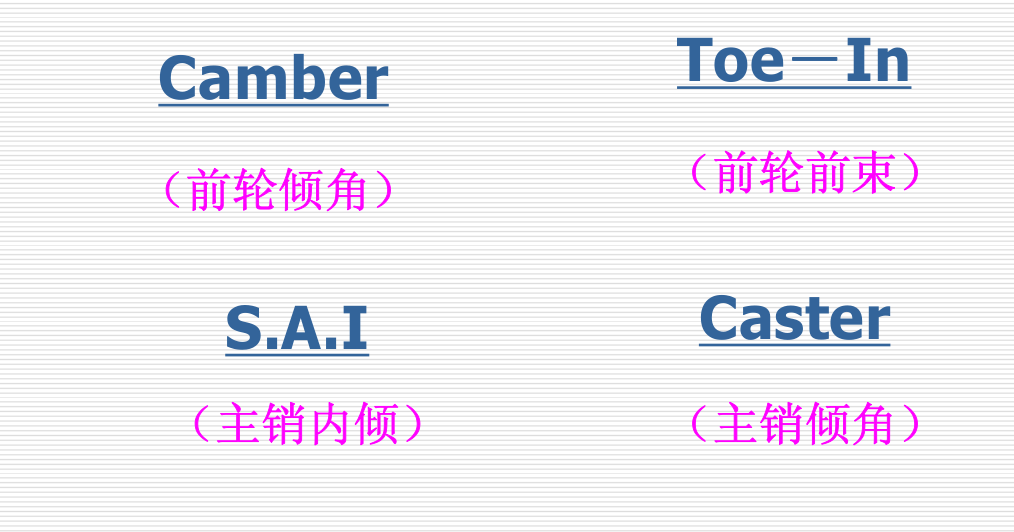
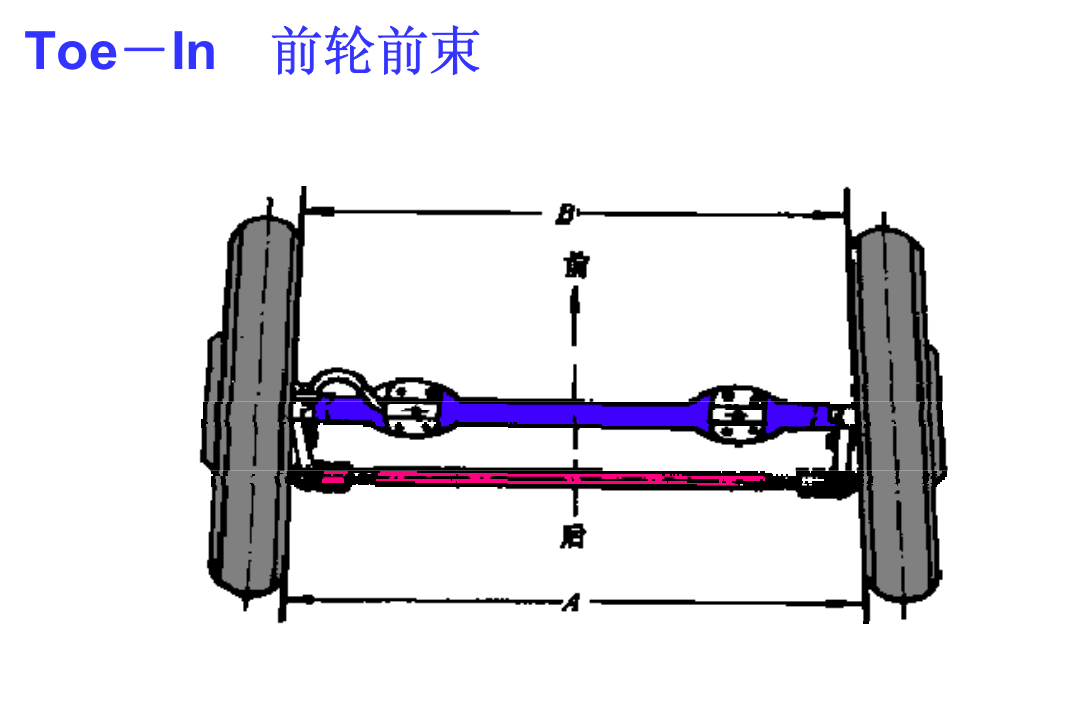
1 )Toe-in
Toe-in specifies the degree to which non-parallel front wheels are closer together at the front than at the rear; measured at the edges of the rims at the wheel center height.
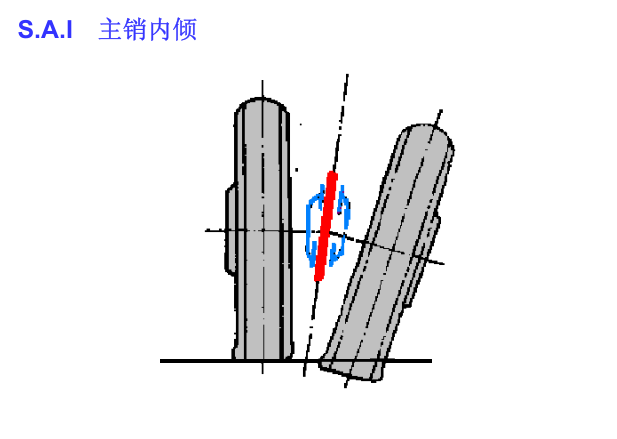
2) kingpin angle
The kingpin angle is the inclination of the steering axis (kingpin) relative to the longitudinal plane, measured in the transverse plane of the vehicle.
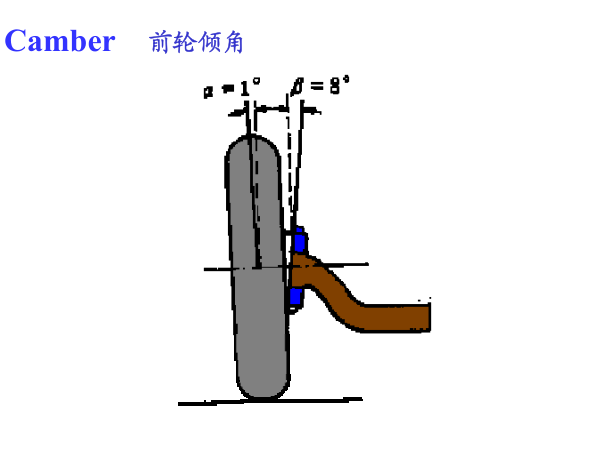
3) Camber
Camber is the inclination of the wheel relative to the longitudinal vehicle plane, measured in the transverse plane of the vehicle. Positive camber means that the wheels are tilted further out at the top than at the bottom.
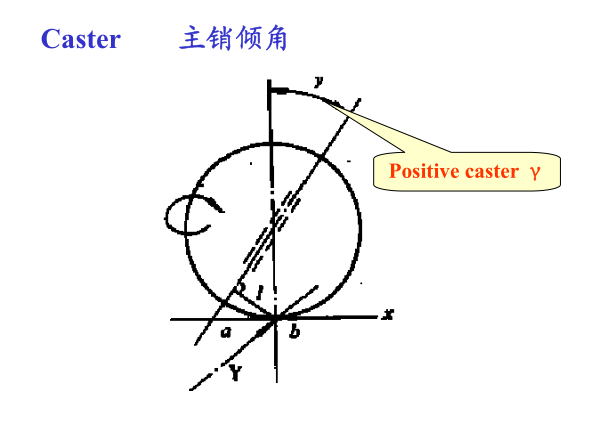
4) Caster
Caster is specified as the angle by which the steering axis ( kingpin line ) deviates from the vertical when viewed from the side, or as that distance on the road surface by which the wheel contact point trails the point at which an extension of the steering axis meets the road surface.
 4 Rear Suspension
The purpose of the rear suspension support the weight of the rear of the vehicle. As with the front suspension, this system contributes to the stability and ride of the vehicle. Rear suspensions may be of the solid axle or independent design. Many cars have solid axle rear suspension. Either design may have different kinds of springs, including torsion bars However, the coil spring and leaf spring types are most popular

