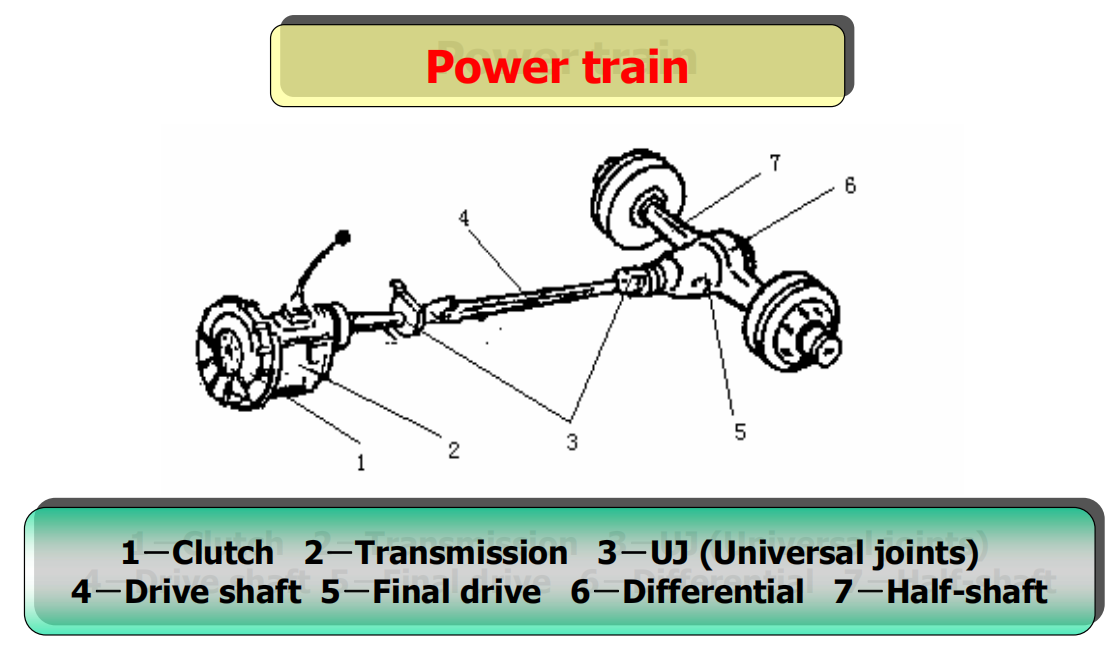
overview of power train
1 function
The function of the power train of an automobile is to provide the forces necessary for locomotion. The forces are produced by the conversion in the IC (Internal combustion) engine of the chemical energy in liquid fuels (or in the electric motor of electrical energy) into the energy of motion (kinetic energy).
Each driving machine operates within a given speed range , limited by the idle speed and the maximum speed . The characteristic data such as power and torque are subject to variation , with the maxima being available only in certain ranger . The transmission ratios in the power train ensure that the available torque and the respective tractive-power demand are matched to each other .

2 versions of power train
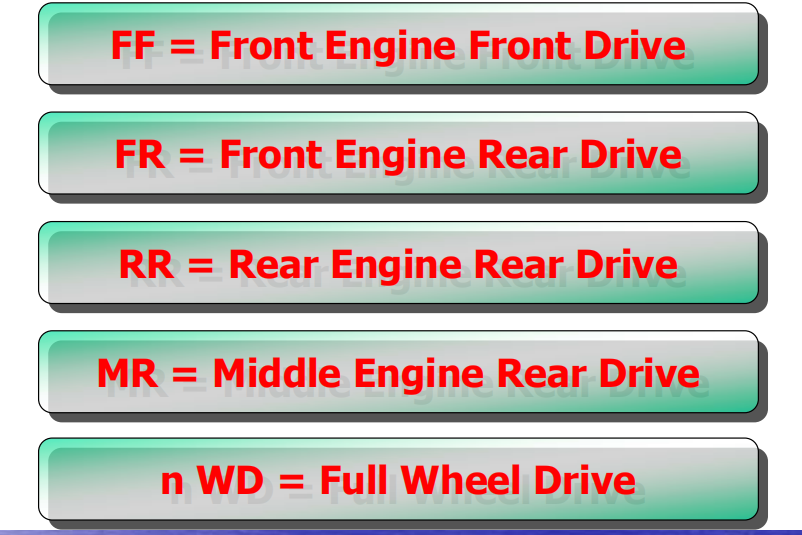
The power train in an automobile varies depending on the position of the engine (or electric motor) and the driven axle . Various engine and drive systems are used ; each one has advantages which are shown in the table .
Vehicles can be described by the number of axles . Most light vehicles only have two axles . The vehicle has four wheels but only two driving wheels . This vehicle has four driving wheels and is commonly called a four-wheel drive vehicle . On commercial vehicles , the load carried in a single axle in limited by law , so vehicles with extra axles are common . This layout has six wheels to support the vehicle but only two drive it . The extra axle at the rear is only used to support the weight of the vehicle . This extra axle is sometimes called a lazy axle . This is called a 6×2 (six by two) vehicle . If the lazy axle is changed axle , this becomes a 6×4 vehicle . Some heavy goods vehicles have an extra steering axle , which allows more weight to be carried .
The location of the driving axle determines whether the vehicle is classified as rear-wheel drive , front-wheel drive , four-wheel drive or all-wheel drive .
3 elements of the power train
The elements of the power train must meet the following requirements
1) enable driving away,
2) convert torque and speed ,
3) enable different directions of rotation for driving forward and backward ,
4) transmit tractive and pushing forces ,
5) permit different rotational speeds of the drive wheels when cornering
6) guarantee optimum operation of the engine (or electric motor ) in terms of fuel consumption and exhaust emissions .