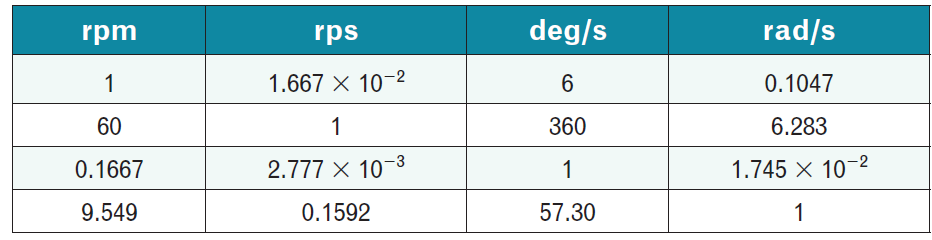
Conversion Factors between Various Units for Angular Velocity

After completer chapitre 7, you try to solve these problems:
An automobile travels at 30 mph, which is also the speed of the center C of the tire(Figure 1) . If the outer radius of the tire is 15 in., determine the rotational velocity of the tire in the units of rad/s, deg/s, rps, and rpm.
A small automobile engine produces 260 N ? m of torque at 2100 rpm. Determine the engine’s power output in the units of kW and hp.
A diesel engine for marine propulsion applications produces a maximum power of 900 hp and torque of 5300 N ? m. Determine the engine speed necessary for this production in rpm.
The radius of an input pinion is 3.8 cm, and the radius of an output gear is 11.4 cm. Calculate the velocity and torque ratios of the gearset.
The torque produced by a 2.5 L automobile engine operating at full throttle was measured over a range of speeds (Figure 2). By using this graph of torque as a function of the engine’s speed, prepare a second graph to show how the power output of the engine (in the units of hp) changes with speed (in rpm).
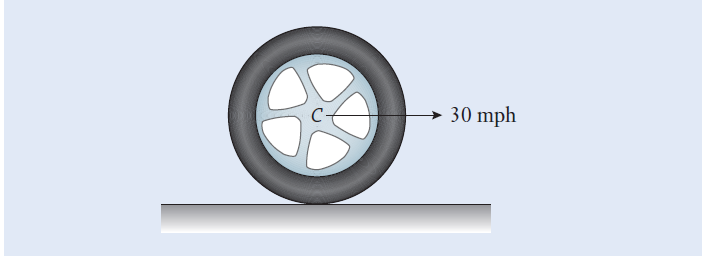
Figure 1: the tire
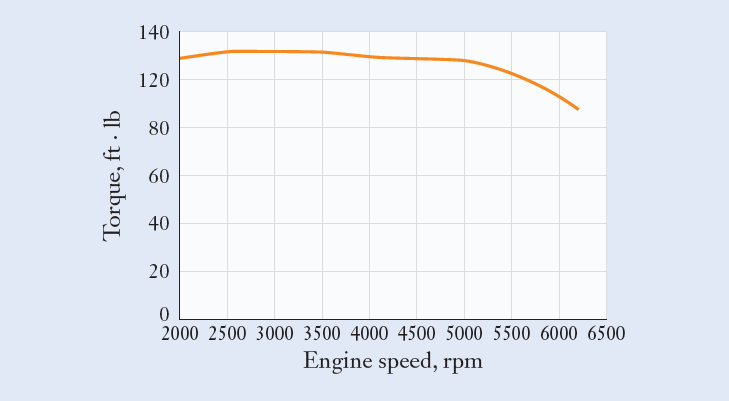
Figure 2 : graph of torque as a function of the engine's speed


