
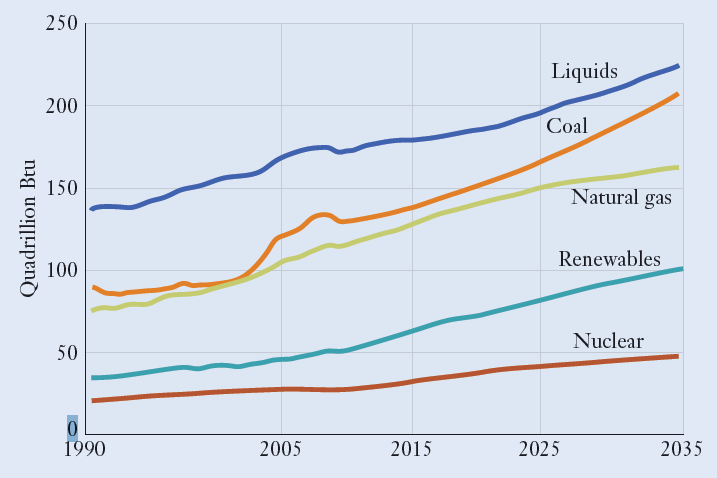
World energy use by fuel type.
Based on data from United States Energy Information Administration, International Energy Outlook 2014 report #.DOE/EIA-0383(2014).
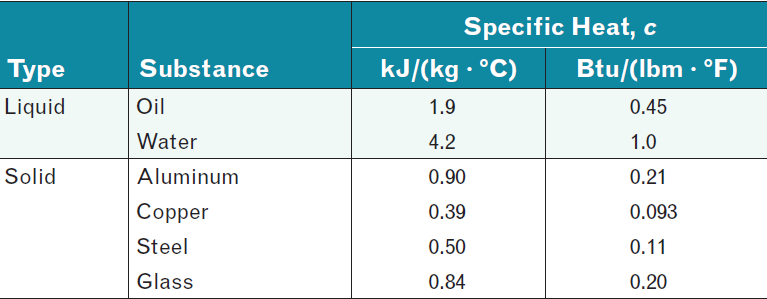
Specific Heat of Certain Materials

After completer chapitre 6, you try to solve these problems:
Give two examples each of engineering applications where heat would be transferred primarily through conduction, convection, and radiation.
A hollow square box is made from 1 ft2 sheets of a prototype insulating material that is 1 in. thick. Engineers are performing a test to measure the new material’s thermal conductivity. A 100 W electrical heater is placed inside the box. Over time, thermocouples attached to the box show that the interior and exterior surfaces of one face have reached the constant temperatures of 150 8F and 90 8F. What is the thermal conductivity? Express your result in both the SI and USCS.
Neglecting the presence of friction, air drag, and other inefficiencies, how much gasoline is consumed when a 1300 kg automobile accelerates from rest to 80 km/h? Express your answer in the units of mL. The density of gasoline is 2.9*10-4 kg/(m*s).
A brick wall 3 m high, 7.5 m wide, and 200 mm thick has a thermal conductivity of 0.7 W/(m ? 8C). The temperature on the inner face is 25 8C, and the temperature on the outer face is 0 8C. How much heat is lost per day through the wall?
For the plant in P7.33, 25,000 gal/s of water flow in the river adjacent to the power plant. The river is used as the source of cooling water for the condenser. Considering the heat transferred from the power plant to the river each second and the specific heat of water, by what amount does the temperature of the river rise as it passes the power plant? The density and specific heat of water are 1026 kg/m3 and 4.2 kJ/(kg*C).


