
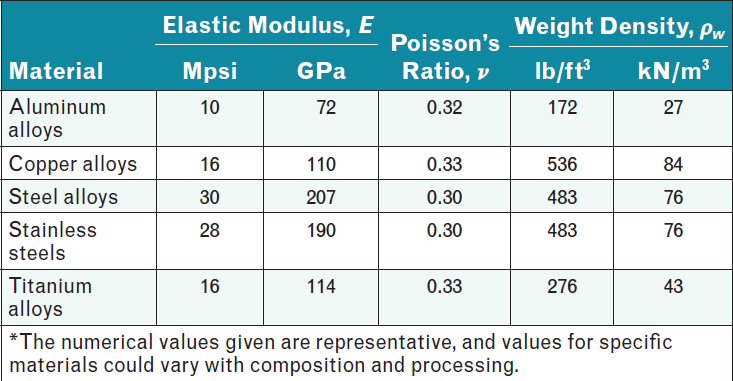
Elastic Modulus and Weight Density of Selected Metals
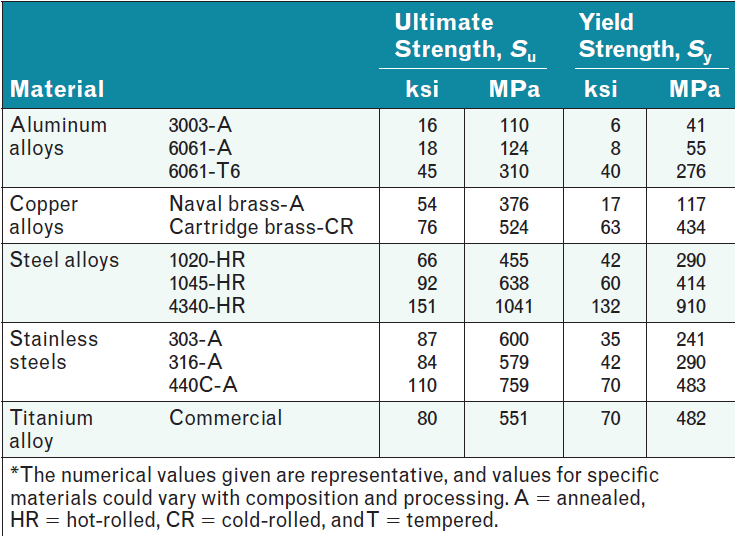
Ultimate and Yield Strengths of Selected Metals

After completer chapitre 5, you should answer these questions:
Sketch stress-strain curves for steel and aluminum.
What is the difference between elastic and plastic behavior?
Define the following terms: elastic modulus, proportional limit, elastic limit, yeild point, and ultimate point.
What are the approximate numerical values for the elastic modulus of steel and aluminum?
How is the yield strength found using the 0.2% offset method?
If a rod is stretched in tension, how does Poisson's ratio, v, relate the change in diameter to the change in length?
Discuss some of the differences in alloys, material properties, and applications for steel, aluminum, and other metals.
In waht ways do tensile and shear stresses differ?
How is the shear yield strength Sxy related to the yield strength Sy obtained from a tensile test?
What is meant by the term factor of safety?
Discuss the trade-off between a factor of safety being too large or too small.


