
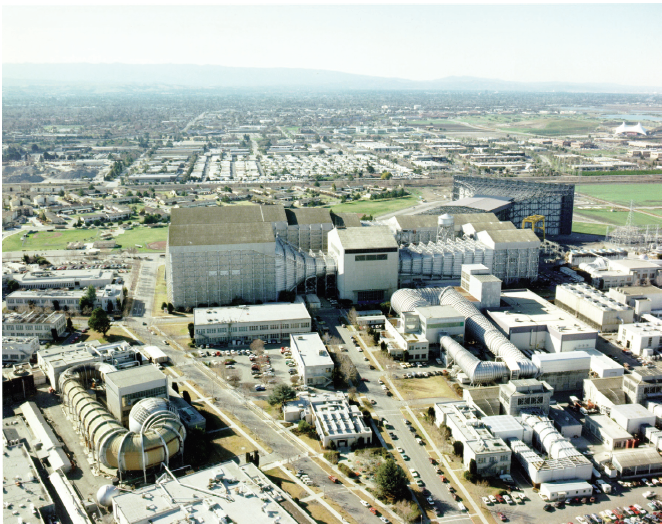
An aerial view of several wind tunnels that are used for aircraft and flight research. Courtesy of NASA.

After completer chapitre 4, you should answer these questions:
What are the units for force and moment in the USCS and SI?
How many newtons are equivalent to 1 pound?
How do you calculate the resultant of a force system by using the vector algebra and vector polygon methods? Give examples of instances where it would be more expedient to use one method over the other.
How do you calculate a moment by using the perpendicular lever arm and force components methods? Give examples of instances where it would be more expedient to use one method over the other.
Why is a sign convention used when calculating moments using the component method?
What are the equilibrium requirements for particules and rigid bodies?
What are the units for drawing a free body diagram?
What are the units for fluid density and viscosity in the USCS and SI?
Make sketches to illustrate the difference between laminar and turbulent fluid flow.
How is the Reynolds number defined?
Give examples of buoyancy, drag, and lift forces, and explain how they are calculated.
What are the coefficients of drag and lift?


