
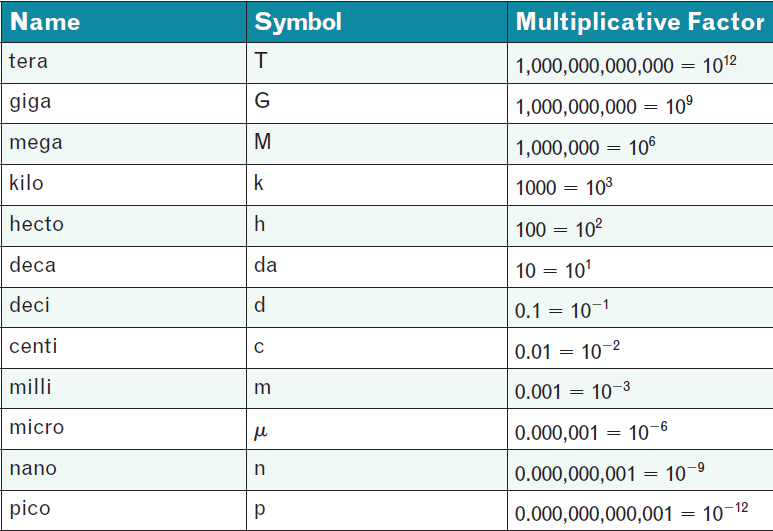
Order-of-Magnitude Prefixes in the SI

After completer chapitre 2, you try to solve these problems:
Express your weight in the units of pounds and newtons, and your mass in the units of slugs and kilograms.
Express your height in the units of inches, feet, and meters.
For a wind turbine that is used to produce electricity for a utility company, the power output per unit area swept by the blades is 2.4 kW/m2. Convert this quantity to the dimensions of hp/ft2.
A world-class runner can run half a mile in a time of 1 min and 45 s. What is the runner’s average speed in m/s?
One U.S. gallon is equivalent to 0.1337 ft3, 1 ft is equivalent to 0.3048 m, and 1000 L are equivalent to 1 m3. By using those definitions, determine the conversion factor between gallons and liters.
A passenger automobile is advertised as having a fuel economy rating of 29 mi/gal for highway driving. Express the rating in the units of km/L.
(a) How much horsepower does a 100 W household lightbulb consume?
(b) How much kW does a 5 hp lawn mower engine produce?
The estimates for the amount of oil spilled into the Gulf of Mexico during the 2010 Deepwater Horizon disaster were 120–180 million gal. Express this range in L, m3, and ft3.
In 1925, the Tri-State Tornado ripped a 219 mi path of destruction through Missouri, Illinois, and Indiana, killing a record 695 people. The maximum winds in the tornado were 318 mph. Express the wind speed in km/h and in ft/s.
Give numerical values for order-of-magnitude estimates for the following quantities. Explain and justify the reasonableness of the assumptions and approximations that you need to make.
(a) The number of cars that pass through an intersection of two busy streets during the evening commute on a typical workday
(b) The number of bricks that form the exterior of a large building on a
university campus
(c) The volume of concrete in the sidewalks on a university campusThe modulus of elasticity, modulus of rigidity, Poisson’s ratio, and the unit weight for various materials are shown below. The data is given as Material; Modulus of Elasticity, E (Mpsi & GPa); Modulus of Rigidity, G (Mpsi & GPa); Poisson’s Ratio; and Unit Weight (lb/in3, lb/ft3, kN/m3). Prepare a single table that captures this technical data in a professional and effective manner.
Aluminum alloys 10.3 71.0 3.8 26.2 0.334 0.098 169 26.6
Beryllium copper 18.0 124.0 7.0 48.3 0.285 0.297 513 80.6
Brass 15.4 106.0 5.82 40.1 0.324 0.309 534 83.8
Carbon steel 30.0 207.0 11.5 79.3 0.292 0.282 487 76.5
Cast iron, grey 14.5 100.0 6.0 41.4 0.211 0.260 450 70.6
Copper 17.2 119.0 6.49 44.7 0.326 0.322 556 87.3
Glass 6.7 46.2 2.7 18.6 0.245 0.094 162 25.4
Lead 5.3 36.5 1.9 13.1 0.425 0.411 710 111.5
Magnesium 6.5 44.8 2.4 16.5 0.350 0.065 112 17.6
Molybdenum 48.0 331.0 17.0 117.0 0.307 0.368 636 100.0
Nickel silver 18.5 127.0 7.0 48.3 0.322 0.316 546 85.8
Nickel steel 30.0 207.0 11.5 79.3 0.291 0.280 484 76.0
Phosphor bronze 16.1 111.0 6.0 41.4 0.349 0.295 510 80.1
Stainless steel 27.6 190.0 10.6 73.1 0.305 0.280 484 76.0


