
目录

  • 1 Unit1  New Environment
    • 1.1 The Etiquette of Meeting Strangers
    • 1.2 Five Ways to Break the Ice
    • 1.3 Chinese Campus vs Western Campus
    • 1.4 Oxford University
    • 1.5 Business Card
    • 1.6 Exchanging Business Cards
    • 1.7 The Origin of Seven Days in a Week
    • 1.8 Lucy’s College Life in a Week
    • 1.9 The Stories Behind English Letters
    • 1.10 Parts of Speech
  • 2 Unit2  Family and Friends
    • 2.1 The Etiquette of Meeting Acquaintances
    • 2.2 Topics for Daily Meeting
    • 2.3 Eight Types of Friends in a Lifetime
    • 2.4 How to Look like Marilyn Monroe
    • 2.5 Telephone Message
    • 2.6 Good Telephone Manners
    • 2.7 The Meaning of Family
    • 2.8 Family Types
    • 2.9 Monophthongs
    • 2.10 Five Basic Sentence Patterns
  • 3 Unit3  College Study
    • 3.1 Library Tour
    • 3.2 Borrowing Books in the Library
    • 3.3 British People Love Reading
    • 3.4 Alice’s Adventures in Wonderland
    • 3.5 Types of Notices
    • 3.6 Written Notice
    • 3.7 Teaching Forms in British Universities
    • 3.8 My Favorite Course
    • 3.9 Phonetics
      • 3.9.1 Closing Diphthongs
      • 3.9.2 Central Diphthongs
    • 3.10 English Tenses
  • 4 Unit4  Health and Disease
    • 4.1 Health Problems
    • 4.2 Seeing the Dentist
    • 4.3 Chinese Fitness vs Western Fitness
    • 4.4 Yoga
    • 4.5 National Health Service
    • 4.6 Absence Note
    • 4.7 What is a gym like?
    • 4.8 My Favorite Fitness Activity
    • 4.9 Nasals
    • 4.10 Nominal Clauses
  • 5 Unit5 Holidays and Festivals
    • 5.1 Different Festivals, Different Culture
    • 5.2 Holiday Greetings
    • 5.3 Chinese Festivals vs Western Festivals
    • 5.4 Thanksgiving Day
    • 5.5 Gift Giving Guidelines
    • 5.6 Greeting Card
    • 5.7 Five Popular Tourist Countries in Europe
    • 5.8 My Favorite Tourist Destination
    • 5.9 Semi-vowels
    • 5.10 Relative Clauses
  • 6 Unit6 Transportation
    • 6.1 Traffic Signs in London
    • 6.2 Travel by Public Transportation
    • 6.3 Car Logos
    • 6.4 Audi Q5
    • 6.5 How to Get Cheap Flights
    • 6.6 How to Book Flight Tickets Online
    • 6.7 Means of Transport in the UK
    • 6.8 My Favorite Way of Traveling
    • 6.9 Syllables
    • 6.10 Infinitive
  • 7 Unit7 Dining culture: Coffee VS  Tea
    • 7.1 Western Dining Etiquette
    • 7.2 In the Western Restaurant
    • 7.3 Ordering at a Western Restaurant
    • 7.4 Coffee Culture
    • 7.5 Tea culture:Green tea brewing
    • 7.6 Tea culture: Green tea processing
    • 7.7 Tea Culture: The Past and Present of Tea
    • 7.8 Types of Menus
    • 7.9 Designing a Menu
    • 7.10 Strong and Weak Forms
    • 7.11 Present Participle
  • 8 Unit8 Career Planning
    • 8.1 Job Interview Tips
    • 8.2 Job Interview
    • 8.3 Fun Jobs
    • 8.4 Working as a Food Critic
    • 8.5 Resume
    • 8.6 Application Letter
    • 8.7 Personality Type and Career Choice
    • 8.8 Career Planning
    • 8.9 Intonation
    • 8.10 Subjunctive Mood
  • 9 Unit 9 Essential Skills for the Workplace
    • 9.1 Customer Service Etiquette
    • 9.2 Handle Customer's Complaints
    • 9.3 Reply to a complaint Letter
Personality Type and Career Choice

内容简介

8.7 Personality Types and Career Choices 人格类型与职业选择

要点:

1. Personality Type Theory 人格类型理论

1913年国际精神分析大会上,荣格提出个性的两种态度类型:内倾和外倾。1921年他在《心理类型学》一书中又作了详细的阐述,并提出了四种功能类型,即理性功能的相互对立的两种类型──思维功能与情感功能;和非理性功能的相互对立的两种类型──感觉功能和直觉功能。美国心理学家布里格斯和迈尔斯母女在荣格的两种态度类型和四种功能类型的基础上,又增加了判断和知觉两种类型,由此组成了个性的四维八极特征,它们彼此结合就构成了十六种人格类型。

2. 16 Personality Types 16 种人格类型

人格类型理论认为一个人的个性可以从四个角度进行分析,用字母代表如下:

驱动力的来源:外向E---内向I

接受信息的方式:感觉S---直觉N

决策的方式:思维T---情感F

对待不确定性的态度:判断J---知觉P

其中两两组合,可以组合成16种人格类型。

3. Animal Personality Types 动物与人格类型

1. INTP: 猫头鹰;2. ESTP: 狐狸;3. ISFP: 树懒;4. ENTJ: 狮子;5. ISFJ: 鹿;6. INTJ: 章鱼;7. ISTP: 猫;8. ESFP: 水獭;9. INFJ: 狼;10. ENFP: 海豚;11. ESTJ: 蜜蜂;12. ISTJ: 海狸;13. ENFJ: 狗;14. INFP: 猫鼬;15. ENTP: 鹦鹉;16. ESFJ: 大象

4. Common careers for different personality types 人格类型与职业选择
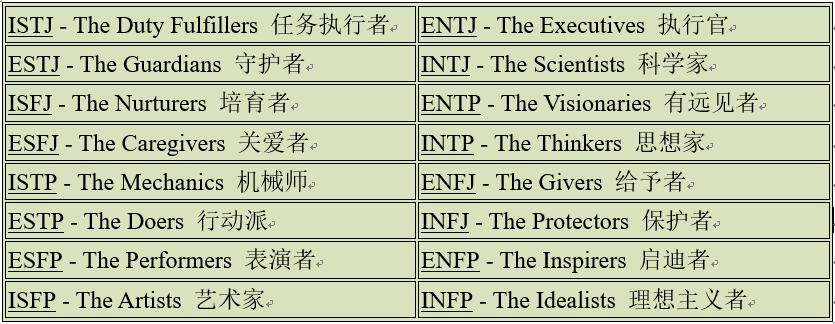
                                

5. Jung Typology Test 荣格性格类型测验

人格类型理论认为,不同人格类型的人适合从事的职业不尽相同。基于人格类型理论的人格测试有助于发现不同个体最适合从事的职业,从而给他们的职业选择提供重要参考。

双语台词