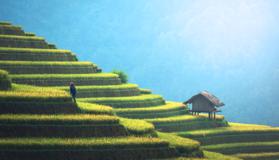
Unit Two Spring Sowing
I. Warming-up Activities
1.What would you do in a typical spring morning?
A good start in spring determines whatyou achieve in the year, and a good start at dawn determines what you achievein the day. 一年之计在于春,一日之计在于晨。
2. What hopes and worries do you have about your future life?
3. What do you know about farming? Do you know how spring sowing is done in ourcountry?
北方:翻地→施肥→播种→盖土;翻地→播种→施肥→盖土
南方:翻地→选种→上水→播种→施肥→插秧
4. What’s your opinion of being a farmer?
II. Background information
1. Liam O' Flaherty
Liam O' Flaherty is one of the most significant andimportant modern Anglo-Irish authors along with James Joyce. He was born in1896 on an lreland island, which must have had very big influence on hischaracter as well as on his writing. He once said, "1 was bom on astorm-swept rock and hate the soft growth of sun-baked lands where there is nofrost in men 's bones." Both his novels and his short stories defineAnglo-Irish literature in that his themes stem from his experiences growing upin a poverty-stricken society on the island of Aran; his naturalistic, mystical,romantic, and realistic styles were also defined by his experiences in hisnative Ireland.
Liam O’Flaherty became famous because of his novels,especially Famine and The Informer, but his literary reputationrests more heavily upon his short stories.
LiamO'Flaherty's Main Works
 Thy Neighbour's Wife(1924) —ashort story, first published creative work, thought to be one of his best.
“TheSniper“—appeared on January 12, 1923, in the British Socialist weekly The NewLeader (1923)
The Black Soul. One of the founders ofthe short-lived literary magazine To-Morrow (1924)
Spring Sowing (1924)
The Informer(1925), forwhich he had been awarded the 1925 James Tait Black Memorial Prize for fiction,and was made into a film of the same name by John Ford.
Civil War (1925)
The Assassin (1928)
Skerrett(1932)
Shamethe Devil (1934)
Famine(1937)
TheShort Stories of Liam O'Flaherty
Two Lovely Beasts and Other Stories (1948)
Insurrection (1950)
Duil [Desire], a collection of most of theshort stories which O'Flaherty hadwritten in Gaelic (1953)
The Stories of Liam O'Flaherty (1956)
Liam O'Flaherty was born in the village of Gort nagCapall, Inishmore, on 28 August 1896. Inishmore is the most northern of theAran Islands. Gort na gCapall means "The Field of the Horses" and istrue to its meaning. The entire area of Inishmore was bleak and harsh. Thetreeless, flat, rocky ground was almost too shallow for any crops to grow. Sucha harsh land affected O'Flaherty immensely:
I was born on a storm-swept rock and hate the softgrowth of sunbaked lands where there is no frost in men's bones. Swiftthoughts, and the swift flight of ravenous birds, and the squeal of terror ofhunted animals to me reality. I have seen the leaping salmon fly before thesalmon whale, and I have seen the sated buck horn his mate, and the wandererleave his wife in search of fresh bosoms with the fire of joy in his eye. Forme, that man is great who is his own God and the slave man is a harnessed loutwho jingles the coppers of his hire in the scales of mediocrity (Doyle 18).
The area of Inishmore was also quite povertystricken. Poverty, famine, and death were something that the people of Gort nagCapall dealt with every day (Sheeran 15). The people struggled with feedinglarge families on little or no food. Also, the people had little means ofearning money or removing themselves from the poverty. The common occupationsin Gort na gCapall were as landowners, such as Liam O'Flaherty's father, andfishermen. Another common practice was to haul sand from the shore in order tomix it with seaweed and silt in order to turn "bare rock into tillageland" (Sheeran 15). O'Flaherty had both an admiration and hatred for thepoor. They give him both a romantic quality in describing the plight of thecommon man but also "frequently fill him with misanthropy" (Doyle18). Among the people of Gort na gCapall were many orphans and widows. Becauseof the hard life, many people died early, either from starvation, disease, ordrowning in the ocean in an attempt to catch fish to feed the family.O‘Flaherty describes the life in such a harsh place as:
… terribly intense. There, not only extreme poverty,but the very position of the island foster in the human mind those devils ofsuspicion and resentment which make ingratitude seem man's strongest vice. Thesurrounding sea, constantly stirred into fury by storms that cut offcommunication with the mainland, always maintains in the mind of theinhabitants a restless anxiety, which has a strong bearing on character, sharpeningthe wits and heightening the energy, but at the same time producing a violentinstability of temperament (Doyle 17).
A somewhat different description of the Aran Islandswas given by John Millington Synge in The Aran Islands. This work isimportant in that it was a sore point for O'Flaherty. The description providedin The Aran Islands, written at intervals between 1898 and 1901, wasvery different than the life O'Flaherty actually led. The book provided aninspiration for O'Flaherty later on in life to give a proper description.
The mist and fog of Inishmore also proved to be adefining factor for the young O'Flaherty. As a youngster, he was fascinatedwith the mystical qualities present in the melancholy atmosphere of hishomeland. He was enthralled by the "mystical dreams and mysticalterrors" of the land (Doyle 18). He became preoccupied with ancient ruinsin the form of the "numerous prehistoric pagan and early Christianmonuments" of Aran (Doyle 18). O'Flaherty, through his mysticalfascination, became a brooding youngster who undertook "gloomymeditation" (Doyle 18). The enjoyment of the mystical pasts of Irelandalso furthered a naturalistic movement inside of O'Flaherty, which is quiteevident in his short stories.
O'Flaherty does not deal with the harsh life inInishmore for a great deal in his autobiographies because of a sense of familypride (Sheeran 22). His own upbringing is only a source of experiences on whichto create a greater imagination and draw a picture in his novels and short stories.
In 1908, a priest of the Holy Ghost order fromRockwell College in County Tipperary came to the Aran Islands in order torecruit some youngsters for the priesthood (Doyle 18). O'Flaherty was at thetop of his class and showed imagination in his unusual brooding manner. He wastherefore pointed out to the priest that further educational opportunitiesshould be given to him. His education at Rockwell College would be practicallyfree.
O'Flaherty still did well enough at Blackrock toreceive an entrance scholarship to University College, Dublin. He again,despite his retrospective aversion to the Church, contemplated the priesthoodonce again and was accepted at the Dublin Diocesan Seminary at Clonliffe. Theexperience at the University College was not a good one though.
O'Flaherty's life took an odd twist when he droppedout of University College and enlisted in the British Army in 1915. Threereasons exist as to why O'Flaherty made such a drastic move. First, O'Flahertywas rather disillusioned with the Republican cause because its leaders were notas violent and apt to rebel as O'Flaherty would have liked. He felt that theywere overly cautious with Republican actions (Doyle 20).
In 1920, O'Flaherty returned to Ireland. He becameactive in Communist activities. The Communist Party of Ireland was started bythe son of James Connolly, Roderic Connolly, who was the first president.O'Flaherty was active within the party (Cahalan 193). During the Irish CivilWar, O'Flaherty and a group of unemployed men gained control of the Rotunda inDublin and raised the Communist flag over the building (Doyle 21).
O'Flaherty soon joined the Irish Republican Army inan attempt to overthrow the Free State forces to no avail. On 6 December 1922,the Free State was officially established. O'Flaherty lost his spirit ofactivism and turned his efforts to writing (Cahalan 195).
Liam O'Flaherty is an often overlooked, though quiteprolific, Irish writer. His writings are hard to quantify. He vacillates fromthe romantic to the realistic to the naturalistic to the mystical. O'Flahertynever really found his place in society, which may have actually helped hiswritings. His abandonment led to imaginative insights. His rebellious natureled to a passion for his writings. The mythical history of Ireland and hisimpoverished upbringing affected O'Flaherty for the remainder of his life. Theunique author Liam O'Flaherty died in Dublin on 7 September 1984.
2. "Spring Sowing"
"Spring Sowing" is taken from the firstcollection of short stories, which bears tbe same title, published in 1924. Inlreland at that time, most people still depended on farming for a living, andthe main crop was potatoes. Modem science and technology had not yet caught upwith the land. There was little machinery. Practically everytbing was stilldone by hand. A typical farmer believed in traditional virtues: hard work,simple living, discipline, and above all, a strong sense of responsibility, responsibilityfor the happiness of his wife, parents, and children. ln spite of their almost primitiveliving and working conditions, however, they also had their joys- love andlongings for the future.

