2010 年英语(二)写作真题详解
Directions:
In this section, you are asked to write an essay based on the following table, in which you should
1) interpret the chart and
2) give your comments.
You should write at least 150 English words.
Write your essay neatly on the ANSWER SHEET.
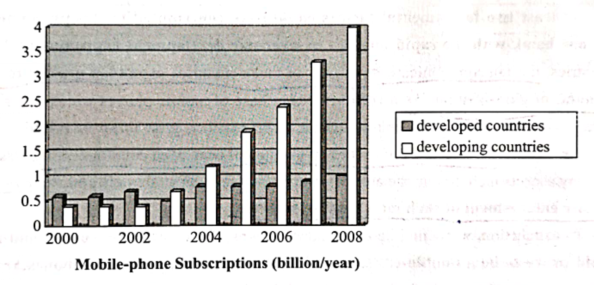
本文首先应总体描述图表,并指出发达国家手机人网的数据保持平稳。而发展中国家则急剧增加,然后具体描述数据细节:开头、结尾数据及最高、最低数据。论证部分最好分析数据变化的深层原因:发达国家趋于饱和,而发展中国家前途无量。最后可预测发展趋势或归纳结论。
经典范文
From the information given in the above column chart, we can see a striking contrast between developing and developed countries in mobile-phone subscriptions from 2000 to 2008. During this period, there has been a dramatic increase from 0.4 to 4 billion mobile phone subscriptions in developing countries, while that of developed countries remained steady at just under 1 billion.
At least two fundamental factors could have contributed to this phenomenon. On the one hand, with the rapid increase in economic development happening in developing countries, the telecommunication industry in those countries expanded greatly to meet the demand of globalization. As a result, the user base of mobile phones which can narrow the distance between people and link the whole world together, grew at an incredible speed. On the other hand, the extremely advanced civilization of developed countries means less potential in many aspects including in the area of private telecommunication tools and their demand for further enlargement of such tools tends to saturate.
In conclusion, while mobile-phone subscriptions, if used carelessly or without restraint, could prove to be a double-edged sword, the fact remains that such phones are already extremely prevalent in both developing and developed countries, and even today continue to rise in popularity. If people could imbue themselves with intelligence, prudence and discretion, I am sure that most of them would be able to sidestep the potential drawbacks of mobile phones while taking advantage of all the merits.
参考译文
根据以上柱状图提供的信息,我们可以看出,从2000年到2008年,发展中国家和发达国家在手机入网方面存在着惊人的对比。在此期间,发展中国家手机入网数从4亿急速增长到40亿,而发达国家的相关数据在10亿之下保持平稳。
至少有两点主要原因造成了这种现象。一方面,随着在发展中国家发生的快速经济增长,这些国家的电信产业必然会适应全球化的需求。因此,使用手机缩短人们之间的距离并与全世界联系的人数以惊人的速度增长。另一方面,发达国家极端先进的文明在私人电信工具等诸多领域意味着更少的发展潜力,他们对进一步开发此类工具的需求趋于饱和。
因此,如果不小心或没有节制,手机入网就是一把双刃剑。但事实上,手机入网在发展中国家和发达国家中均十分流行,这种趋势甚至今天还在继续扩大。假如人们多动脑、谨慎些、具有判断力,我确信大多数人都能克服手机的弊端,并且利用其优势。
2012年英语(二)写作真题详解
Directions: Write an essay based on the following table. In your writing you should
1) describe the table, and
2) give your comments.
You should write at least 150 words.
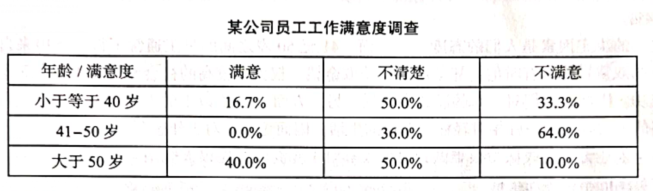
命题解析本文第一段应重点描述图表,首句总体描述:主题(工作满意度) +对象(某公司员工),第二至三句进行细节描述。次段应重点进行原因分析,首句使用过渡句,中间给出二至三点具体原因,重点分析为何40- -50岁的人满意度最低、大于50岁的人满意度最高,可从工作压力、家庭负担、职业倦怠、工作态度、职业规划等各方面进行分析。尾句可进行总结,归纳结论或提出建议措施均可,如公司需提高福利待遇并提供更多关怀、员工要端正工作态度等。
经典范文
The table clearly reflects the statistics of staff's job satisfaction in a certain company. According to the data given above, we can conclude that the percentage of people satisfied with their jobs is highest among those over 50 years old, at about 40%. In contrast, the percentage of the staff not satisfied with their jobs is about 64% among those in their forties, the highest among all the three age groups.
The major determinant of satisfaction lies in people' s attitudes. On the one hand, staff members in their forties usually have to undertake a lot of responsibilities from both their families and their career. Sometimes they are even under pressure to pursue money, power, high social status, and so on, which are all symbols of success. So, they have the least satisfaction in their job. On the other hand, people over 50 generally have shifted their life goals from achieving the ultimate success to a relatively easy and comfortable life, and therefore are inclined to be much more satisfied with their jobs.
In view of the above reasoning, I am convinced that it is difficult for everyone to be content with their jobs. And it is advisable that people should adjust their expectations for work, and that companies should pay more attention to the welfare of their staff.
参考译文
这张表格清楚地反映了某公司员工工作满意度的统计数据。根据给出的数据,我们可以看出50岁以上的人工作满意度最高,约为40%。相反,41至50岁之间的人在三个群体中不满意度最高,约为64%。
主要的决定因素是人们的态度。一方面,41 至50岁之间的员工通常不得不承担来自于家庭和事业的双重责任。有时他们甚至承受着获取金钱、权力、较高的社会地位等压力,而这些都象征着成功。因此,他们对工作的满意度最低。另一方面,50 岁以上的人通常已经将人生目标从实现最终的成功转变为一种相对轻松、舒适的生活,因而更容易对工作感到满意。
鉴于上述论证,我认为很难做到每个人都对工作满意。建议人们调整对工作的期望,而企业也应对员工的幸福多加重视。
2016年英语(二)写作真题详解
Directions:
Write an essay based on the following chart. In your writing, you should
1) interpret the chart, and
2) give your comments.
You should write about 150 words on the ANSWER SHEET.
命题解析
1.真题渊源
2016年英语(二)大作文继2015年之后连续第二年考查饼状图,同时,避开当年传统文化、
网上购物、环境保护等几大热门话题,继2005年MBA写作“十一黄金周”、 2011年英语(一)“旅程之‘余’”之后, 第三次考查“旅游”这一-次热门话题。体现了考研写作命题明显的反押题倾向,也表明了真题在考研写作命题中至高无上的地位!
2.写作方法
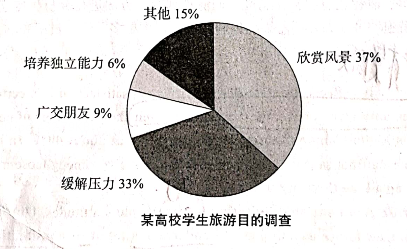
本文首段应该简要描述图表,首句进行总体描述:主题(旅游目的) +对象(某高校学生),接着进行细节描述,主要描述占比最大的两个目的(欣赏风景和缓解压力)。第二段进行因果论证,重点阐释两点原因:欣赏美景与缓解压力。尾段可进行预测趋势、归纳结论或提出建议措施。
经典范文
This pie chart clearly illustrates the purposes of touring for students in a certain university. As is reflected by the diagram, 37 percent of college students travel in order to appreciate the scenery. Next comes the aim of relieving pressure, accounting for 33% percent. By contrast, the percentages of students travelling aiming at other goals, making friends and cultivating independence account for 15%, 9% and 6% respectively.
Several primary factors could contribute to this phenomenon. In the first place, travel can offer us a wide range of experiences. In travelling, we may join tourists marveling at the incredible power of Niagara Falls, mingle with the happy throngs strolling in the Paris boulevards and experience the bitterness and joy of people on different lands and in different times. In the second place, college students, who have to juggle academic work, romantic relationships and a busy social calendar, are particularly susceptible to pressure. By touring, they can successfully manage and reduce stress.
Taking all these factors into consideration, we may predict that with the quickening pace and ever-increasing pressure of campus life, the number of university students touring will keep growing in the forthcoming decade.
参考译文
这幅饼状图清楚地揭示了某高校大学生的旅游目的。如图表所示,37%的大学生为了欣赏风景而旅游,接下来是为了缓解压力的目的,占了33%。相反,为了其他、广交朋友、培养独立能力旅游的大学生百分比分别各占15%、9%和6%。
一些主要原因可以解释这种现象。一方面,旅游能够充实我们的人生经历。在旅行中,我们可以和游客一起,赞叹尼亚加拉瀑布那雷霆万钧之势,和喜洋洋的人群一起穿过巴黎的林荫大道,还可以体验不同时代、不同国土上人们的酸甜苦辣。另一方面,大学生不得不应对学习、恋爱和繁忙的杜交日程,很容易感受到压力。通过旅游,他们可以成功地应对并缓解压力。
考虑到所有这些因素,我们可以预计,随者校园生活节奏的加快和日益增大的压力,旅游的大学生数最在未来几年将持续增加。
2018年英语(二)写作真题详解
Directions:
Write an essay based on the following chart. In your essay, you should
1) interpret the chart, and
2) give your comments.
You should write about 150 words neatly on the ANSWER SHEET.
命题解析
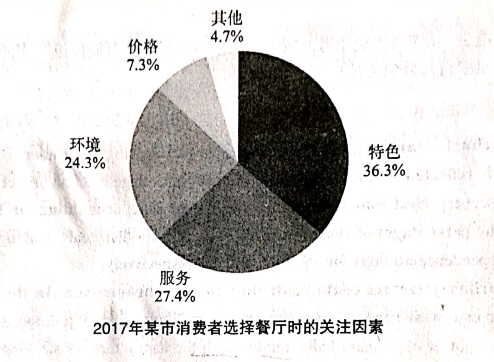
本题第一段图表描述段。首句进行总体描述,点出图表的主题(选择餐厅时的关注因素) +对象(某市消费者) +时间(2017年)。第二、三两句进行细节描述,第二句说明饼状图中数据较大的三个对象:特色、服务、环境及其所占百分比,第三句说明数据较小的两个对象:价格、其他及其所占百分比。
第二段可以进行原因列举,说明图表所反映的现象产生的原因。首句为主题句,承上启下进行过渡。其次进行具体论证,说明两至三点原因。最后一句可以进行小结,也可以不写。
图表作文第三段一般有三种写法: 第一种写法是预测趋势,正面继续、负面变化。本图为正面现象,这个趋势将会继续,在不远的将来某市消费者将继续关注特色、服务和环境,而不是价格或其他。第二种写法是归纳结论,对本文进行简单总结即可。
经典范文
The pie chart above clearly reveals the factors of consumers' concern on choosing restaurants in a certain city in 2017. Among all the five categories, the percentages of feature, service and environment are the highest, accounting for 36.3%, 27.4% and 24.3% respectively. On the contrary, the statistics of price and other factors take up merely 7.3% and 4.7% respectively, the lowest among the five groups.
Several primary causes that contribute to the above-mentioned phenomenon could be summarized as follows. In the first place, with the prosperity of economy in China and the increase of people's income in recent decades, a large number of people are paying more attention to the features of a restaurant instead of prices. In the second place, in a bid to develop interpersonal relationship and enjoy comfortable life, consumers in mounting numbers prefer service and environment to other factors.
With due consideration of all these contributors, we may predict that with the speedy development of our society, customers in expanding numbers will attach utmost significance to the feature, service as well as environment of a restaurant rather than prices or other factors.
参考译文
上述饼状图清晰揭示了2017年某市消费者选择餐厅时关注的因素。在所有五组数据中,特色、服务、环境的百分比是最高的,分别占36.3%, 274%和243%6。相反,价格和其他因素的数据只占7.3%和4.7%,在这五组中是最低的。
造成上述现象的主要原因可以概括如下。首先,随着中国经济的繁荣和近几十年来人们收入的增加,很多人越来越关注餐厅的特色,而不是价格。其次,为了拓展人际关系,享受舒适的生活,越来越多的消费者选择服务与环境而非其他。
考虑到所有这些因素,我们可以预计,随着社会的迅速发展,越来越多的消费者将更加重视餐厅的特色、服务、环境,而不是价格或其他因素。
教育文化类:大学扩招(2006年MBA真题)
经典范文
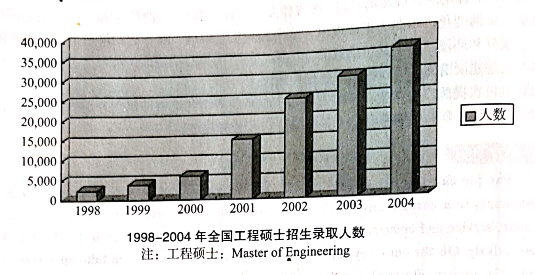
The diagram above clearly illustrates that a dramatic increase has occurred in the recruitment of Masters of Engineering (ME) in China during the past seven years. According to the statistics given above, we may conclude that the recruitment of MEs was on a steady rise from 1998 to 2004. In 1998, the number was at a low of only about 2,500. Surprisingly, it reached more than 35,000 in 2004, within no more than seven years.
Some driving factors that contribute to the above-mentioned change may be summarized as follows. First and foremost, China has become particularly active in manufacturing, which has led to an increased demand for qualified engineers. In addition, the development of the job market on the whole cannot keep pace with the expansion of college graduates, which has obliged a large number of students to stay on campus for another three years to get better prepared for their careers. Last but not least, working pressure is another reason. Taking all these factors into account, we may predict that with the speedy development of our society, the recruitment of MEs will keep growing in the forthcoming decade.
On the other side of the coin, however, this tendency may bring about a good many problems, such as the waste of talent. It is necessary for us to take effective measures to ensure this situation doesn’t get out of hand, and encourage students to choose majors for which both theoretical knowledge and practical skills will be demanded in the job market.
参考译文
上述图表清楚地揭示了过去七年中国的工程硕士招生录取人数急剧增长。根据上面给出的数据,我们可以得出结论:从1998到200年,工程硕土招生录取人数稳步增长。1998 年,招生人数较少,只有大约2500人。令人惊讶的是,到2004年招生人数在不到七年的时间里达到3.5万人以上。
促成上述变化的一些主要原因可以概括如下。首先,中国在制造业方面变得异常活跃,这使得对高素质工程师的需求增长。此外,就业市场的总体发展无法跟上大学毕业生人数的增加,这促使很多学生在校园里再待三年时间,为就业做更好的准备。最后,工作压力是另外一个原因。考虑到所有这些因素,我们可以预计,随着社会的迅速发展,工程硕士的招生人数在未来十年将会继续增加。
然而,问题的另一方面,这种趋势可能带来很多问题,例如人才的浪费。我们必须采取有效措施确保这一状况不会失控,同时鼓励学生选择那些就业市场上需要的既有理论知识又有实践技能的专业。
教育文化类:读书(2017年英语(一)真题改革版
经典范文
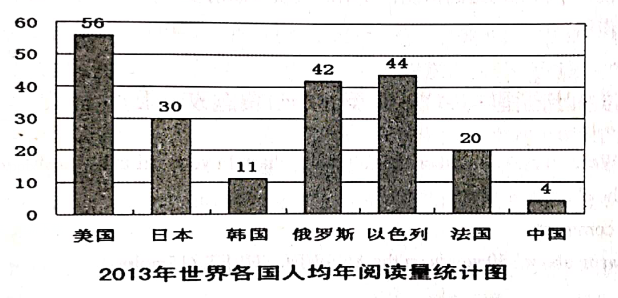
The column chart above reveals clearly the statistics of reading quantity per person in seven countries in 2013. Based upon the data, the reading volumes in the U.S, Israel and Russia are highest among the seven nations, accounting for 56, 44 and 42 books per person respectively. On the contrary, those in Korea and China are lowest, taking up merely 11 and 4 books.
This tendency is rather disturbing, for reading extensively is no less necessary to,one's mental life than fresh air is to one's physical life. From reading extensively, we can derive companionship, experience and instruction. First and foremost, a good book is our faithful friend. It can increase our contentment when we are cheerful and happy, and lessen our pain when we are sad or lonely. Furthermore, reading extensively can also offer us a wide range of experiences. Few of us can travel far from home or live long over one hundred, but all of us can live many different lives through the pages of books. Last but not least, reading extensively can increase our intellectual ability, broaden our minds and make us wise.
Though with the advent of TV, cellphone and the Internet, books are n0 longer read as extensively as they once were, nothing can replace the role that reading extensively plays in our lives.
参考译文
上述柱状图清晰地揭示了2013年七个国家人均阅读量的统计结果。根据这一统计数据, 美国、以色列和俄罗斯的阅读量在七个国家中最高,分别为56本,44本和42本。相反,韩国和中国的阅读量最低,只有11本和4本。
这种倾向相当令人担忧,因为我们应该知道,多读书对人的精神生活而言,犹如新鲜空气对人的身体,同样是十分必需的。从读书中我们可以收获友谊,获得经验,受到教益。首要的是,一本好书就是我们忠实的朋友。当我们开心和快乐时,书能增加我们的满足感;当我们伤心或孤独时,书能减轻我们的痛苦。而且,读书还能为我们提供各种经历。我们中很少有人能到离家很远的地方去旅行,或者活过一百岁,但是通过读书我们都能经历很多种不同的生活。最后但同样重要的是,读书能增加我们的知识技能,开阔我们的眼界,使我们变得有智慧。
虽然随着电视、手机和网络的出现,读书的人没有以前多了,但没有什么东西可以取代读书在我们生活中的作用。
教育文化类:出国留学(2013年英语(一)真题改革版)

经典范文
The chart above clearly reflects the amount of people studying abroad and the growth rate between 2005 and 2015 in China. According to the survey, the number of people studying overseas has been on a steady rise from 118,000 to 523,000. However, its growth rate fluctuated dramatically between a approximately 5% and nearly 30%.
Several major factors contribute to the aforementioned changes. On the one hand, for the majority of people, living and studying in a foreign country provides an excellent opportunity to expand their knowledge. In order to become truly proficient in a foreign language, it is vital to learn its culture, including social interaction, customs and conventions, and so on. On the other hand, overseas studies also provide us with a valuable chance to learn how to be more open-minded and independent. It takes a person with strong willpower and an independent spirit to live alone and fully adapt to the culture of a foreign land.
To sum up, by studying abroad, people are able to augment their linguistic knowledge and deepen their cultural understanding, to the benefit of their future careers. In the meanwhile, those equipped with the qualities of open-mindedness and independence will be able to contribute more effectively to, and be more competitive in, the modern-day workplace.
参考译文
上述图表清晰地反映了从2005年到2015年中国出国留学人数及其增长率的数据。根据调查,出国留学人数从11.8万稳步增长到了52.3 万。然而,其增长率在大约5%至将近30%之间急剧波动。
几个主要的因素造成了上述变化。一方面,对大多数人来说,能在外国生活和学习,将会给他们提供一个扩大知识面的绝佳机会。要想真正精通一门外语,了解这个国家的文化极其重要,包括其社会交往、风俗习惯等等。另- -方面,海外留学也会给人们提供一次宝贵的机会,来学习如何让自己心胸更加开阔,个性更加独立。这需要一个人凭借顽强的毅力和独立的精神独自生活并且充分适应异国文化。
总之,在国外留学,人们可以充实自己的语言知识,加深对文化的理解,从而对以后的职业生涯大有裨益。同时,那些心胸开阔、个性独立的人能更有效、更有竞争力地参与到当今的工作中来。
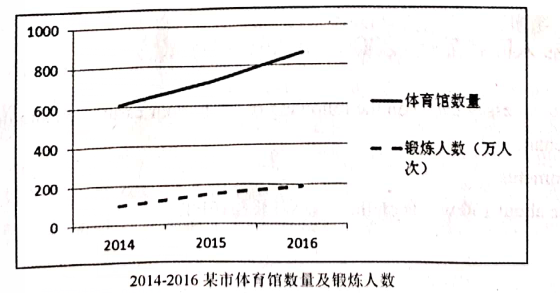
The line chart above illustrates clearly the amount gymnasiums and people doing exercises in a certain city between 2014 and 2016. As is revealed in the graph, the statistics of people doing exercises has been on a steady rise, from one million to nearly two million, while the number of gyms has increased considerably from 600 to about 860, a rise of about 260.
Several factors could contribute to this tendency. In the first place, with the quickening pace and ever-increasing pressure of urban life, people in growing numbers are suffering either physical or mental problems. Thus, gymnasiums in mounting numbers have been built by concerned departments. In the second place, the desire for health is universal. Accordingly, people variously choose jogging, playing basketball, swimming, skating, climbing or riding as their regular exercise because exercise never fails to make them stronger and more energetic.
As far as I am concerned, I have a peculiar interest in yoga as a form of exercise. An hours’ exercise every day usually makes me feel healthier and more vigorous. Besides, I never touch cigarettes or wine, nor do I stay up late. Instead, I keep a balanced diet and go to bed before11 o'clock at night, because I believe burning the midnight oil is harmful to health. More importantly, an optimistic attitude toward life makes me confident and persistent. To sum up, all these practices guarantee a healthy body and a happy life.
参考译文
上述线状图清晰地显示了某市2014年至2016年体育馆的数量和锻炼人数。如该图所示,锻炼人数从一百万人稳步增加到近两百万人,同时,体育馆数量从600座急剧增加到约860座,增长了约260座。
几个因素促成了这一趋势。首先,随着都市生活节奏的加快和压力的不断增加,越来越多的人开始面临生理或心理问题。因此,相关部门建造了越来越多的体育馆。其次,对于健康的渴望很普遍。因此,人们各自选择慢跑、打篮球、游泳、滑冰、爬山或骑车作为日常锻炼方式,因为这些运动总是使他们更强壮和更加精力充沛。
就我而言,我对瑜伽这种锻炼形式有特殊的兴趣。每天一小时的锻炼通常使我感到更健康而且更有活力。此外,我从不吸烟喝酒,也不熬夜。相反,我保持均衡饮食,而且晚上11点之前上床睡觉,因为我相信熬夜对健康有害。更为重要的是,对生活乐观的态度使我充满自信而且坚持不懈。总之,所有这些锻炼可以保证我有健康的体魄和快乐的生活
经典范文
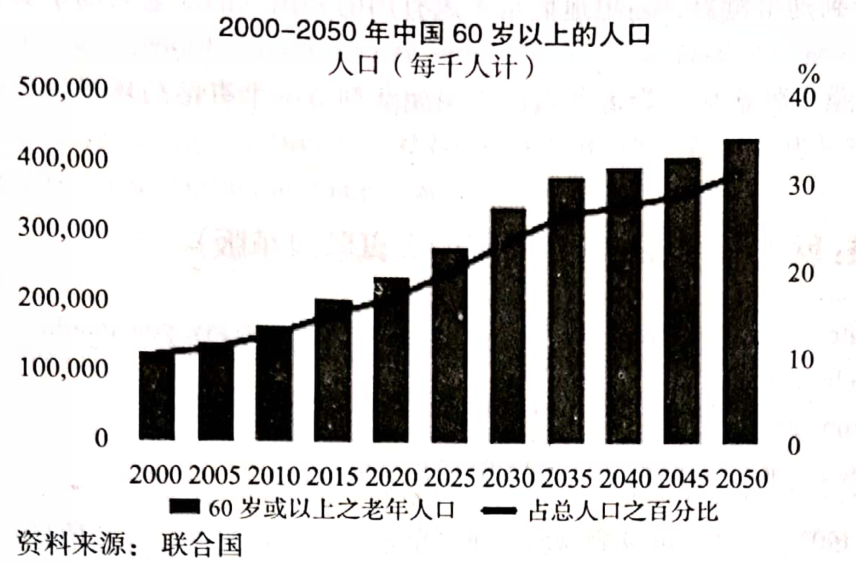
As can be seen from the mixed chart above, the population over 60 years old in China has increased markedly from 2000 and will continue to grow in the coming decades. From the statistics given in the diagram, we can estimate that there were 120 million aged people in 2000, accounting for about 10% of the total population, while the number will shoot up to 450 million in 2050, approximately 35% of the total.
From my point of view, the government, society and the children of the old should all care for the old together. Only one or two parties’ involvement will not be enough. How well we handle this social issue reflects the degree of civilization of our country. To begin with, all citizens with income pay taxes to the government, so the authority is obliged to ensure a stable and happy life for its people. In addition, society, including companies, associations and organizations, should play a positive role in helping the aged people, both financially and spiritually. Last but not least, the children of the elderly should be responsible for their parents, because their parents have not only brought them into the world, but also raised them to be useful citizens.
In conclusion, I suggest that the entire society should create an environment conducive to the happy life of the elderly. No one can escape the obligation.
参考译文
如上述混合图表所示,中国60岁以上的人口从2000年起已经显著增多,在未来几十年内仍将呈上升趋势。根据图表中给出的数据我们可以估计,2000年,60 岁以上的人口是1.2亿,约占总人口的10%,而到2050年,老年人的数量将猛增到4.5亿,约占总人口的35%。
在我看来,政府、社会和子女应该共同照顾老年人,只有一方或两方的参与是不够的。我们如何处理这一社会问题反映了我们国家的文明程度。首先,所有有收入的市民都给政府交税,因此政府必须确保其人民拥有稳定幸福的生活。其次,包括各个公司、协会、组织在内的整个社会都应该从物质和精神上在帮助老年人方面发挥积极作用。最后但同样重要的是,由于考研父母不仅把子女带到这个世界,还把他们培养成有用的公民,因此老人的子女应该对其父母负责。
总之,我认为整个社会应该为老年人的幸福生活创造一个有益的环境。没有人能够逃避责任。
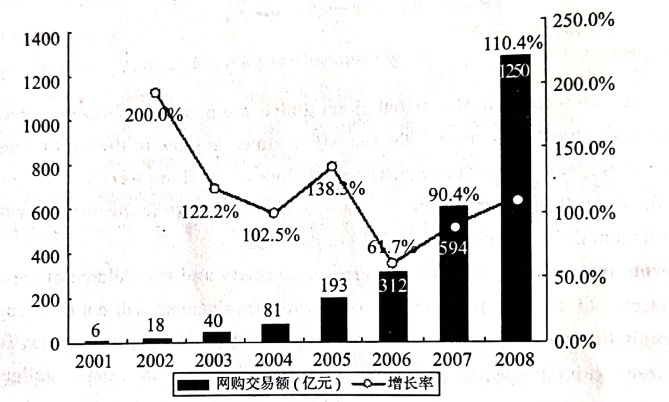
经典范文
The column chart above illustrates the turnover in online shopping and its growth rate in China from 2001 to 2008. During this period, there was a dramatic increase from 0.6 billion in 2001 to 125 billion in 2008 in turnover. Meanwhile, the growth rate decreased from 200% to 110.4%, a decline of about 90 percentage points.
While online shopping is not without its risks, it offers people an excellent alternative to the traditional way of shopping. The first reason that e-shopping is so appealing is its relative ease and convenience. For conscientious students with hectic schedules, purchasing items on eBay or Taobao.com, among other websites, is an excellent way to free up valuable time for their studies. The second advantage of online shopping is that it is available 7 days per week, 24 hours per day. Being able to shop at any and all hours of the day is conducive to the late nights associated with the modem lifestyle; at the same time, it means that people no longer have to plan their activities around stores' opening hours.
Despite the advantages to people of making purchases online, there are also a few suggestions that young people should bear in mind. Firstly, the speediness and convenience of e-shopping may encourage impulsive or unnecessary spending by inducing people to buy more than they had initially wanted. Secondly, there is a chance that those people who are already introverted may become even more alienated from the outside world.
参考译文
上述柱状图揭示了2001至2008年间中国网上购物的交易额及其增长率。在这段时期,网购交易额从2001年的6亿元急剧增长到2008年的1250亿元。同时,增长率从200%下降到110.4%,大约下降了90个百分点。
尽管网上购物并非零风险,但相对于传统的购物方式,它为人们提供了一个极好的选择。网上购物如此吸引人们的第-一个原因就是,它相对来说比较容易和方便。学习比较认真的同学们都有着繁忙的时间表,在易趣、淘宝等网站上购物是一个非常好的方式,可以省出宝贵的学习时间。网购的第二个好处就是购物没有任何时间限制。人们在一天中的任何时候都可以买东西,这与现代生活方式中习惯晚睡的作息时间相符,与此同时这也意味着人们不再必须按照商店的营业时间来计划自己的活动了。
尽管在网上购物有很多好处,但年轻人也应该记住几点忠告。首先,网购的快速和便捷可能会诱导人们很轻率地购买比最初预想多得多的、原本不需要的东西。其次,那些本来就内向的人们可能会变得与外面的世界更加疏远。