Unit 1 Human Anatomy
Keyto the Exercises
ı.preparation
Enjoy a video clip. You may watch it twice to achieve a good understanding. After watching,please fill in each of the following blanks with one word.
1 ) Cardiac
2 ) conscious
3 ) unstriated
4) elongated, striated, voluntary
Script
I tell you, working in a place like this,you can sure learn a lot about muscles. Hah. I
mean sure there are three different typesof muscles cardiac, smooth, and skeletal. And
skeletal is the only type you can see butwhat you can't see? Pretty impressive. Hey,
thanks, Rex.
There are three fundamental types of muscle tissue cardiac, smooth and skeletal.
Cardiac muscle forms the walls of the heartand contracts to propel blood through the blood vessels of the body. Cardiac musclesare involuntary. Involuntary muscles are muscles we have no conscious control over.Cardiac muscles are striated, which means the muscle tissue has obvious stripes orstriations. Smooth muscle forms the walls of hollowstructures like the digestive tract. It's
also responsible for changing the diameterof these tubes to move stuff like food through
them. Smooth muscle is controlled by the autonomicnervous system. Basically that
means the smooth muscle works without anyconscious help from us. It's on autopilot.
smooth muscles are unstriated. That meansthey don’t have the stripes that cardiac and skeletal muscles have, but likecardiac muscles, smooth muscles are involuntary. We can’t control themconsciously.
Skeletal muscles, the final division, aretypically attached to the skeletal system,
hence the cover name-skeletal muscles.
The skeletal muscles are also responsiblefor body movements and facial
expressions. Throwing balls, running fromthe police, frowning in disgust, all these
skeletal muscle cells are elongated,striated and under voluntary control.
So when you think skeletal muscles, thinkstriated and voluntary. Apart from movement, skeletal muscles have a number ofother responsibilities. Skeletal muscles
help you stand. They maintain posture byresisting the pull of gravity.
Nothing can resist the downward pull ofgravity. Just watch ! Hah ! It's impossible,
I tell you.
II.Reading
TextA
ComprehensionCheck
Pairwork Discuss and answer the following questions. Try not to look back at thetext.
1 ) The ability to change shape has becomethe most important property of muscle cells.
(Para. 2)
2) The prefixes myo-and sarco-arefrequently used in naming structures associated with muscle. (Para. 3)
3) Striated muscle is composed of regular,repeating elements which give the cells a finely cross-striated appearance whenthey are viewed microscopically. Smooth muscle, in contrast, lacks suchrepeating elements and thus has no striations. (Para. 3)
4) The advantage of skeletal muscle is thatit is capable of powerful contractions (about 100 watts per kilogram) becauseof the regular organization of its contractile proteins. Its disadvantage isthat its contractile range is limited wherever a larger range of movement isrequired, it is achieved through the amplification provided by the lever systemsof the skeleton to which the muscle is attached (hence the name skeletal muscle).(Para. 5)
5) Because skeletal muscle is involved inmany movements, such as breathing, blinking, Swallowing, and the actions of themuscles of the perineum and in the middle earl which are usually or exclusivelydriven at an unconscious level. (Para. 6)
6) Because cardiac muscle is provided witha continuous supply of energy by numerous blood vessels around the fibers, andabundant mitochondria within them. (Para. 7)
7) Smooth muscle is found in all systems ofthe body, in the walls of the viscera : including most of the gastrointestinal,respiratory, urinary and reproductive tracts, in the tunica media of blood vesselsin the dermis (as the arrector pili muscles), in the intrinsic muscles of theeye, and the dartos muscular layer of the scrotum. In some places, smoothmuscle fasciculi are associated with those of skeletal muscle, e. g. The sphinctersof the anus and the urinary bladder, the tarsal muscles of the upper and lowereyelids, the suspensory muscle of the duodenum, a transitional zone in the esophagus,and fasciae and ligaments on the pelvic aspect of the pelvic diaphragm. (Para.8)
8) These features are well illustrated bythe role of smooth muscle in the walls of tubes and sacs, where its actionregulates the size of the enclosed lumen and, in some cases, the consequentmovement of luminal contents. (Para. 9)
LanguagePractice
1.Read the text carefully and then fill out the missing information in thefollowing short
passage.The beginning letter of each missing word has been given.
1) mechanical 2) inflate 3) pump 4) tissue 5)mass 6) cardiac 7) Cardiac 8) bulk
9) striated 10) involuntary 11) viscera 12)unstriated 13) skeleton 14) voluntary 15) contract
2. Paraphrasethe following sentences. Pay special attention to the underlined parts.
1) The proteins called molecular motors areable to make cells become shorter or longer much more quickly.
2) In addition, the filaments of actin andmyosin arrange themselves mainly in the same direction. Under this condition,the whole cell contracts linearly as a result of interactions between themolecules within the cell.
3) The lengthened cells of unstriatedmuscle are smaller than the cells of striated muscle, and they gradually becomenarrower towards the ends.
4) A smooth muscle cell may be stimulatedto react or increase its activity in several ways.
3.Identify the expression from each of the following sentences which correspondsin meaning to one of the Chinese expressions given below. (These sentences arewell written. It is suggested that you read them aloud and learn them byheart.)
1)a variety of各种各样的
2)(be)referred to as被称作
3)convert...Into将······转化/转变为·····。
4)attach...To把······固定/附(着)在······上
5)exclusively专门地仅仅
6)branching network分支网络
7)(be) resistant to对······有抵抗力的耐······的
8)differ fro癿.,In在······方面不同于·····。
9) (be) associated with 与 · · · · · · 相关
10)(be)well illustrated by被······很好地阐明
4.Translate the following sentences into English with some expressions you haveidentified in exercise 3.
1) Certain symptoms are associated withwithdrawal from specific drugs.
2) Muscles are composed of individual cell,often referredto as fibers because they are so long and threadlike.
3) A stem cell has the capacity to developinto any of a variety of different cell types.
4) Of all flu samples tested this year, 4.6% have been resistant to antiviral medications.
5) Found exclusively in animalcells, lysosomes are responsible for degrading certain components that havebecome obsolete for the cell or organism.
6) The branching network ofmyofilaments is stabilized by cross-linking proteins.
7) The accessory organs of digestion areillustrated in Figure 12-4.
8) Mitochondria can convert energy fromnutrients into ATP.
9) Racial groups differ from oneanother in gene frequency.
10) Tendons attach muscles to bonesto produce movement at the joints.
TextB
ComprehensionCheck
Answerthe following questions.
1) The diaphragm is the major muscle ofinspiration, responsible for approximately two-thirds of quiet breathing inhealthy humans. (para. 1 )
2) The primary role of the intercostalmuscles is to stiffen the chest wall, preventing paradoxical motion duringdescent of the diaphragm in inspiration. (para. 5)
3) The abdomen is relaxed/in relaxation,when the diaphragm contracts during normal breathing. (Para. 7)
4) The medial aspect of the rib is elevatedand this increases the transverse dimension of the chest in the same manner asa bucket handle swinging outwards (Fig. 2A). This effect is most evident in thelower ribs. Movements at the costovertebral joints cause elevation of theanterior ends of the ribs that push the body of the sternum and the upper ribsforwards. This 'pump handle’ movement is most evident in the superior ribs andincreases the anteroposterior dimension of the thorax (Fig. 2B). (para. 2)
LanguagePractice
1.Translate the following sentences into Chinese.
膈肌是主要吸气肌,负责健康人约三分之二的平静呼吸。
肋间外肌是吸气运动中最活跃的肌肉,而肋1司内肌(不如肋间外肌强壮)在呼气运与
中最为活跃。
增加胸廓的上下径、左右径和前后径可以使胸膜腔的容积增大,导致胸膜腔内压降
低,从而使空气进入肺。
4 )因位于肝脏上方的右侧膈穹窿比位于胃上方的左侧膈穹窿遇到的阻力更大,故膈肌
右脚和右侧纤维比左边的更加结实。
5)参与通气的肌肉在睡眠过程中也必须保持工作状态,当咽肌松弛时,上气道的阻力
增加。
2.paraphrase the following sentences. Pay special attention to the underlinedparts.
1) Breathing is a process in which theabdomen and thorax work together well.
2) After its movement is stopped by theabdominal viscera, the central tendon is fastened and serves as a startingpoint from which the fibers of the diaphragm go on to contract.
Translationof the Texts
Text A
大多数细胞都具有能伸长或缩短的细胞骨架元件,使得细胞具有改变形状的能力。这种“变形”能力对于实现细胞的多种功能(例如运动、吞噬、有丝分裂和细胞突起的伸展等)是非常重要的。通过利用5'-腺苷三磷酸水解产生的能量,被称作分子马达的蛋白质能比依赖聚合 - 解聚机制(指肌动蛋白,微管蛋白)的系统更为迅速地引发长度改变。在这些依赖ATP的系统当中,最普遍的一种是基于肌动蛋白和肌球蛋白的相互作用的系统。
在肌细胞中,由肌动蛋白、肌球蛋白及相关蛋白组成的肌丝极为丰富,几乎充斥了细胞内部。此外,肌丝的排列大体是沿着同一方向的。因此,分子水平的相互作用将转化为整个细胞的线性收缩。这些特化细胞所拥有的“变形”能力便成为其最重要的特征。肌肉,即有收缩性的肌细胞的集合,是将化学能转化成机械功的机器。由此产生的力量用于驱动肢体、扩张肺、泵血、开闭管道等。肌肉组织占人体体重的40–50%。
肌肉细胞(肌纤维)也称为肌细胞(前缀myo-和sarco-经常被用于命名与肌肉相关的结构)。他们会通过三种主要途径之一,分化成为骨骼肌、心肌或平滑肌。骨骼肌和心肌可以称为横纹肌,因为他们的肌球蛋白和肌动蛋白丝排列呈有序重复,在显微镜下可见周期性横纹。相反,平滑肌由于缺乏这样的有序重复元素而没有横纹。
其他有收缩性的细胞(包括肌成纤维细胞和肌上皮细胞)在特性和发育起源上则与此不同。他们含有平滑肌样的收缩蛋白,并以单个细胞或小群落存在。
骨骼肌由平行的长条多核纤维束组成,构成机体肌肉组织的主体。因为其收缩蛋白的有规律构建,这种类型的肌肉具有强大的收缩能力(每公斤约100瓦)。然而,此种构造方式所付出的代价是收缩范围的局限性:无论机体的哪个部位需要更大范围的运动,机体都是通过肌肉附着的骨骼(骨骼肌由此得名)所构成的杠杆系统的放大作用来实现的(见下文)。
骨骼肌由躯体运动神经支配。因为它参与的运动通常是在有意识的控制下发动的,有时它被称为随意肌。不过,这一术语会误导我们:骨骼肌参与的许多动作(如呼吸、眨眼、吞咽、会阴部以及中耳内肌肉的运动)通常或完全是在无意识的驱动下完成的。
心肌仅存在于心脏和大静脉汇入心脏处的管壁内,由各单细胞借助电或机械联系成为一个功能单位,形成网络。心肌的收缩能力没有骨骼肌强大(心肌的收缩力为每公斤3—5瓦),但抗疲劳性却比骨骼肌强得多。围绕心肌纤维的数目众多的血管以及细胞内丰富的线粒体能够持续为心肌提供能量。就结构和功能而言,心肌与骨骼肌有许多重要的不同之处。例如,心肌具有自动节律性收缩的能力。不过,其收缩率和收缩强度能对体内激素和自主神经的控制产生应答。
平滑肌存在于人体的所有系统。它分布在内脏壁(包括大部分的胃肠道、呼吸道、泌尿生殖道)、血管中膜、真皮(如立毛肌),以及眼和阴囊肉膜肌层。在某些部位,平滑肌纤维束与骨骼肌纤维束具有相关性,例如:肛门和膀胱括约肌、上下眼睑的睑板肌、十二指肠悬肌、食管移行带,以及盆膈骨盆面的筋膜和韧带。
平滑肌含有肌动蛋白和肌球蛋白,但他们却没有形成重复单位,因此,其在显微镜下的形态平滑,没有横纹。比横纹肌相比,这种拉长的细胞更小,其末端更尖。它们能够缓慢但持久性收缩,并且虽然这类肌肉的力量没有横纹肌那么强大,但其缩短量要比后者大得多。平滑肌的这些功能属性的极好例证是其在管(囊)壁发挥的功能:通过平滑肌的作用,这些封闭腔的大小得到调节,并且在某些情况下,会随之产生管腔内容物的运动。
几种不同的途径均可用于激活平滑肌细胞,最常见的是通过自主神经纤维,血源性神经激素,或来自邻近的平滑肌细胞的信号传导。由于这些途径都不是在有意识的控制下进行的,平滑肌有时也被称为非随意肌。
Text B
呼吸运动的解剖学
呼吸运动是一个腹部与胸部高度协调的过程。膈肌是主要吸气肌,在健康人,负责约三分之二的平静呼吸。肋间外肌是吸气运动中最活跃的肌肉。肋间内肌则不如肋间外肌强壮,充当着呼气运动中最活跃的肌肉。增加胸廓的上下径、左右径和前后径可以使胸膜腔的容积增大,导致胸膜腔内压降低,从而使空气进入肺。在呼气运动中,膈肌舒张,向上移动。气体从肺中排出,肺的弹性回缩使得肺内气体压力低于外界大气压。这就使胸腔的左右径、前后径恢复正常(De Troyer Estenne 1988, Celli 1998)。
在吸气过程中,最低的肋骨是固定不动的,而膈肌的收缩使得中心腱下移。在这个运动过程中,膈肌的弯曲程度几乎是不变的。膈肌的弧形顶部下移且稍稍前移,位置几乎与初始位置相平行。腹壁的伸展性使得腹腔内的脏器也会随着膈肌的下移而发生下移。但腹壁的伸展性很快就会达到极限。中心腱的运动被腹腔内的脏器所阻止,而停在一个固定的位置。从这个位置开始,膈肌纤维又开始继续收缩。这个过程使得第二肋到第十肋抬高,而由于压力直接向周围传递,使得肋下的区域变得向外突出(图1)。肋骨的中间区域抬高,从而增加了胸腔的左右径。这种运动类似于桶柄的外弯(图2A)。而这种效应在较低的肋骨处(第七肋至第十肋)最为明显。肋椎关节的运动引起了肋骨前端的上抬,推动人体的胸骨体和上部的肋骨向前移动。这种“泵柄”运动在上部的肋骨处(第二至第六肋)最为明显,增加了胸腔的前后径(图2B)。因位于肝脏上方的右侧膈穹窿比位于胃上方的左侧膈穹窿遇到的阻力更大,故膈肌右脚和右侧纤维比左边的更加结实。膈肌的下降,腹壁的向外突出(腹式呼吸),肋骨的上抬(胸式呼吸)这三者之间的平衡会随着个体的不同和通气的深度而改变。胸廓因素在女性更为显著,但在深吸气的时候,无论男女都会增加。
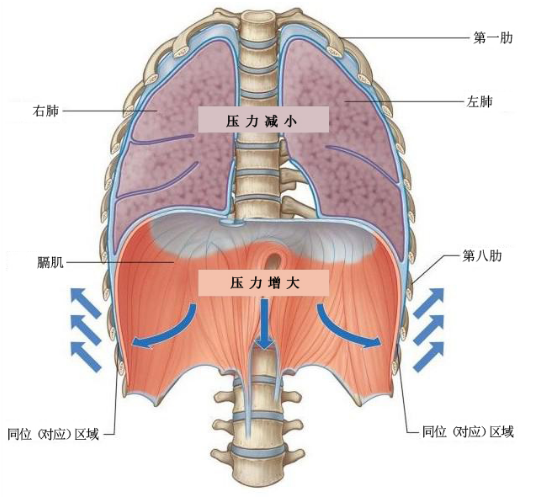
图 1 吸气运动:在吸气过程中的压力改变 (改编自 Drake, Vogl and Mitchell 2005)
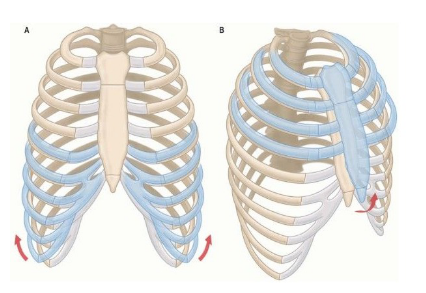
图2 在吸气过程中肋骨的运动(A) “桶柄”运动增加了胸廓的左右径;(B)“泵柄”运动增加了胸廓的前后径。
在平静呼吸的过程中,膈移动通常为1.5厘米。当深度通气时,膈肌最大的移动范围可以达到6到10厘米。在用力吸气后,例如在呼吸局部受阻的情况下,膈穹窿右侧可以下降至约第十一胸椎的位置,而穹窿左侧可以达到第十二胸椎的位置。在用力呼气后,膈穹窿右侧前面与第四肋软骨等高,侧面与第五、六、七肋齐平,后面与第八肋齐平。而膈穹窿左侧的位置则稍低一些。
膈肌的水平位置受通气的阶段和深度、呼吸的深度,胃和肠的膨胀程度,肝脏的大小等因素影响。X光照片表明膈肌的在胸腔中的高度会随着体位发生很大的改变。它在人体仰卧位时是最高的,在这个位置进行正常的呼吸运动时,膈肌产生最大的通气位移。而当人体垂直站立时,膈肌的位置变低,通气运动也减弱了。而当人体处于坐立位时,膈肌的位置变得更低。此时,它的通气运动是最弱的。当人体侧卧位时,两侧的膈肌表现不一致。最高的半边膈肌下降到一个较低的位置,比坐立位时的位置更低。此时膈肌的位置随通气运动改变不大。较低的半边膈肌在胸腔中的位置升高,甚至比仰卧位时更高,这部分膈肌此时发生的通气位移显著增大。随着体位改变产生的膈肌水平位置的改变很好的解释了为什么当病人发生严重呼吸困难时,坐起来最舒服,呼吸最不急促。
肋间肌最原始的作用是绷紧胸壁,当膈肌在吸气运动中下降时防止反常运动。这一点在刚发生高位脊髓损伤之后体现得最为明显。此时整个躯干处于迟缓性瘫痪状态,只有膈肌仍然发挥着功能。一个健康成年人的肺活量为4.5L时,其中3L是由于膈肌移动而产生的。刚发生高位脊髓损伤之后,即便膈肌进行最大程度的运动,肺活量也会下降到只有约300 mL。这是由于膈肌下降时,柔软胸壁的反常运动导致肺活量的丧失约2.7L。在一段时间(通常是几周)以后,(肋间肌)瘫痪转变成为痉挛,增加了腹壁的强度。肺活量也会逐渐增加至约3 L,达到膈肌所允许的极限。
同样,高位脊髓损伤展示了腹部在吸气和呼气过程中的作用。腹部肌群在人的主动呼气中发挥着主要作用。在脊髓损伤高位瘫痪的弛缓阶段,仅有的使松弛的膈肌在呼气状态回复到胸腔内的机制是肺和胸壁的被动回缩以及腹腔内脏器的重量。而后面的原因是最重要的,只有当病人躺下的时候才能起效。当病人坐立或者站起来的时候,他们就无法呼气。此时在腹部捆扎一条有弹性的腹带就能很好地帮助这些病人。相反,当膈肌麻痹变成痉挛(状态)后,僵直的腹壁便会对抗吸气运动。
腹部在呼吸过程中发挥的作用往往被人们低估。例如,如果前外侧的腹壁是由钢铁构成的并且僵硬地从骨盆边缘连接到肋缘,吸气运动将无法完成。膈肌不可能下降(因为腹腔的内容物是不可压缩的),肋骨也无法上升(因为它与骨盆的连接是伸展不了的)。在正常的呼吸过程中,当膈肌收缩的时候,腹壁松弛。我们采用绷紧腹部的方法是有可能阻止这种运动的,如同运用“沙滩椅体位”来扩大胸腔的容积。在这种情况下,腹部的内容物可以使膈肌的中心腱固定,以至于当膈肌收缩时,它可以使胸廓上升。但是,在这种运动状态下,肋骨与骨盆缘之间的缝隙变宽了。
参与通气的肌肉在睡眠过程中也必须保持工作状态,当咽肌松弛时,上气道的阻力增加。目前认为,在一部分人中,尤其是那些肥胖人士,咽肌的松弛能够导致睡眠状态下间歇性的呼吸暂停或者显著缺氧。这表明咽肌在人清醒状态下发挥着重要通气功能。现在也已明确,尽管在日常生活中参与通气的肌肉很少疲劳,但在异常的压力负荷下,例如在慢性阻塞性肺部疾病中,它们也会疲劳。
在通气过程中,肺部不同区域并非做均等运动。在平静换气中,邻近肺门区域几乎不运动,而肺的中央区域也只做轻微的运动。肺的浅表部分扩张得最厉害,而肺的纵隔面,后缘以及肺尖运动得较少,因为它们与可动性较小的结构相连接。膈肌和肋纵隔区域扩张程度最大。通气过程中的最大容积改变发生在肺泡。

