TheVitruvian Man
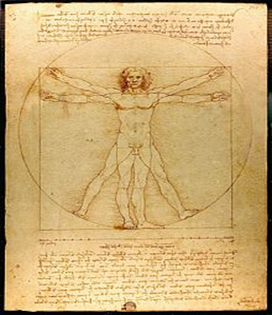
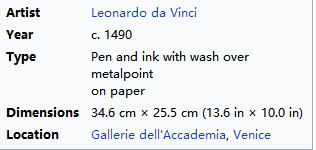
The Vitruvian Man, created by Leonardo da Vinci in 1487,is a portrayal of the perfect proportions of the human body and is commonlyassociated with the science of PHYSIOLOGY.
Vitruvian Man
维特鲁威人(画名根据古罗马建筑家维特鲁威Vitruvius的名字所取,他在著作《建筑十书》中盛赞人体比例和黄金分割); Vitruvian [vi'tru:viən] adj. (古罗马建筑师)维特鲁威风格的
Leonardo da Vinci
[li:ə,nα:dəu də 'vinʧi] 
列奥纳多•达•芬奇
portrayal
[pɔ:'treiəl]
n. [C, U] the act of showing or describing sb/sth in a picture, play, book, etc. 描绘;描写
This image demonstrates the blend of mathematics and art during the Renaissance and demonstrates Leonardo's deep understanding of proportion. In addition, this picture represents a cornerstone of Leonardo's attempts to relate man to nature. Encyclopædia Britannica online states, "Leonardo envisaged the great picture chart of the human body he had produced through his anatomical drawings and Vitruvian Man as a cosmografia del minor mondo(cosmography of the microcosm). He believed the workings of the human body to be an analogy for the workings of the universe."[4]
According to Leonardo's preview in the accompanying text, written in mirror writing, it was made as a study of the proportions of the (male) human body as described in Vitruvius. The text is in two parts, above[a] and below[b] the image.
The first paragraph of the upper part reports Vitruvius: "Vetruvio, architect, puts in his work on architecture that the measurements of man are in nature distributed in this manner, that is:
a palm is four fingers
a foot is four palms
a cubit is six palms
four cubits make a man
a pace is four cubits
a man is 24 palms
and these measurements are in his buildings". The second paragraph reads: "if you open your legs enough that your head is lowered by one-fourteenth of your height and raise your hands enough that your extended fingers touch the line of the top of your head, know that the centre of the extended limbs will be the navel, and the space between the legs will be an equilateral triangle".
The lower section of text gives these proportions:
the length of the outspread arms is equal to the height of a man
from the hairline to the bottom of the chin is one-tenth of the height of a man
from below the chin to the top of the head is one-eighth of the height of a man
from above the chest to the top of the head is one-sixth of the height of a man
from above the chest to the hairline is one-seventh of the height of a man.
the maximum width of the shoulders is a quarter of the height of a man.
from the breasts to the top of the head is a quarter of the height of a man.
the distance from the elbow to the tip of the hand is a quarter of the height of a man.
the distance from the elbow to the armpit is one-eighth of the height of a man.
the length of the hand is one-tenth of the height of a man.
the root of the penis is at half the height of a man.
the foot is one-seventh of the height of a man.
from below the foot to below the knee is a quarter of the height of a man.
from below the knee to the root of the penis is a quarter of the height of a man.
the distances from below the chin to the nose and the eyebrows and the hairline are equal to the ears and to one-third of the face.
The points determining these proportions are marked with lines on the drawing. Below the drawing itself is a single line equal to a side of the square and divided into four cubits, of which the outer two are divided into six palms each, two of which have the mirror-text annotation "palmi"; the outermost two palms are divided into four fingers each, and are each annotated "diti".
Leonardo is clearly illustrating Vitruvius' De architectura 3.1.2-3 which reads:
For the human body is so designed by nature that the face, from the chin to the top of the forehead and the lowest roots of the hair, is a tenth part of the whole height; the open hand from the wrist to the tip of the middle finger is just the same; the head from the chin to the crown is an eighth, and with the neck and shoulder from the top of the breast to the lowest roots of the hair is a sixth; from the middle of the breast to the summit of the crown is a fourth. If we take the height of the face itself, the distance from the bottom of the chin to the under side of the nostrils is one third of it; the nose from the under side of the nostrils to a line between the eyebrows is the same; from there to the lowest roots of the hair is also a third, comprising the forehead. The length of the foot is one sixth of the height of the body; of the forearm, one fourth; and the breadth of the breast is also one fourth. The other members, too, have their own symmetrical proportions, and it was by employing them that the famous painters and sculptors of antiquity attained to great and endless renown.
Similarly, in the members of a temple there ought to be the greatest harmony in the symmetrical relations of the different parts to the general magnitude of the whole. Then again, in the human body the central point is naturally the navel. For if a man be placed flat on his back, with his hands and feet extended, and a pair of compasses centred at his navel, the fingers and toes of his two hands and feet will touch the circumference of a circle described therefrom. And just as the human body yields a circular outline, so too a square figure may be found from it. For if we measure the distance from the soles of the feet to the top of the head, and then apply that measure to the outstretched arms, the breadth will be found to be the same as the height, as in the case of plane surfaces which are perfectly square.[5]
Article Link: https://en.wikipedia.org/wiki/Vitruvian_Man
Fast Reading
--Read the short passage in “Lead-In”within 2 minutes and answer the following questions.
Physiology is the study of how living organisms work. As applied to human beings, it includes the study of individual molecules—for example, how a particular protein's shape and electrical properties allow it to function as a channel for sodium ions to move into or out of a cell. At the other end, it is concerned with complex processes that depend on the interplay of many widely separated organs in the body. For example, how the brain, heart, and several glands all work together to cause the excretion of more sodium in the urine when a person has eaten salty food. Physiologists are interested in function and integration—how parts of the body work together at various levels of organisms. Thus, even when physiologists study parts of organisms, all the way down to individual molecules, the intention is ultimately to apply the information they gain to the function of the whole body.
Notes
sodium ion
[,səudiəm 'aiən]
钠离子
interplay
['intəplei]
n. [U, sing.] the way in which two or more things or people affect each other 相互影响(或作用)
gland
[ɡlænd]
n. [C] an organ in an animal or human body that secretes substances for use in the body 腺,腺体
excretion
[ik'skri:ʃ(ə)n]
n. [U] the act of passing waste matter, e.g. feces, urine or sweat, out of the body 排泄
urine
['juərin]
n. [U] a yellowish liquid, containing water and waste products, mainly salt and urea, which is excreted by the kidneys and passed out of the body through the ureters, bladder and urethra尿;小便