


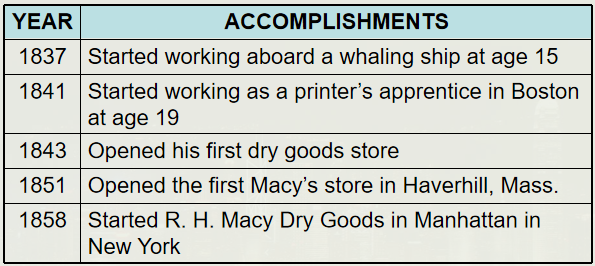
1) Speak about Rowland Hussey Macy drawing on information from the table below and from the text you have read. Close your comments based on his obituary.
Rowland Hussey Macy
2) Say the following expressions out in class one by one.
— Junk it.
— Get rid of it.
— Finish it off.
— Toss it out.
— Throw it away.
— We’re on our way.
— Pull the plug on it.
— Wipe it off the map.
— Where do we begin?
— Put it out of its misery.
— Who will be in charge?
— Well, it’s back to basics.
— We’re off to a good start.
— Let’s organize a task force.
— We’re off on the right foot.
— Back to the drawing board.
— What’s first on the agenda?
— Well, it’s back to square one.
— Time to start over from scratch.
— We’re headed in the right direction.
— How should we go about doing this?
— We’ve already made a (good) dent in it(有初步进展).
3) Play the roles of James and Victoria in the following dialogue, paying attention to the underlined expressions.
James: I say, wipe it off the map. For good.
Victoria: What? You’ve got to be kidding? After such a good start? We’ve already made a good dent in it.
James: It’s harder than it looks. I tell you, it won’t work. I can see the writing on the wall(不祥之兆).
Victoria: Come on. Give it a chance. Honestly, I think we’re headed in the right direction. You’re giving up without even trying.
James: I don’t need to waste a drop more of my energy on this. I can see where it’s heading. I warn you, you’re throwing away valuable time. Pull the plug on it.
Victoria: What a letdown! We’re on our way. It’s stupid to give up now. That’s ridiculous.
James: I just don’t get the point: why waste all your efforts, and everyone else’s too?
Victoria: First of all, I’m not — I honestly believe we’re on to something here. Second of all, even if you’re right and somehow the whole thing is off-base(离谱的), well… when life gives you lemons, make lemonade!
James: Fine words, but easier said than done. Nothing wrong with calling it quits when the outcome is crystal clear. I say time to start over from scratch.
Victoria: And I say that we’re off on the right foot. I’m ready for all, no matter what gets thrown at us.
James: You’re really something. Talk about being stubborn(固执的)! You sure take the cake(名列第一)!
Victoria: Oh yeah? Well, as for stubbornness, you should know: I learned it from a master — you!

Give a short oral presentation on the following title, using the text below as an example.
When Life Gives You Lemons
Life can be difficult, full of frustrations on campus and off campus. You can’t be telling the truth if you say that you haven’t experienced any frustrations. It’s hard to imagine what our lives would be like without them.
When life brings discomfort(不安,不适), add a little humorous wisdom to the bitter brew(饮料). In other words, “When life gives you lemons, make lemonade.” This means keep a positive attitude towards life, no matter what the world throws at you. Get rid of negative thinking.
Be constructive. You can learn and gain from your frustrations, defeats, losses, failures and other unfortunate experiences.
It’s important to cultivate a positive mindset(心态). Here’s one key way of doing that: Take time to focus on what’s been going well in your life. If you regularly see and count those blessings(幸事), negative thoughts will be out of sight, out of mind.

