目录

  • 1 UK-General Survey
    • 1.1 Introduction to the Course
    • 1.2 Official Name & Other Names
    • 1.3 Component Parts
    • 1.4 Capital City
    • 1.5 Language
    • 1.6 Currency
    • 1.7 Religion
    • 1.8 National Flag
    • 1.9 National Anthem
    • 1.10 National Emblem
    • 1.11 Quiz
    • 1.12 quiz
    • 1.13 checklist
  • 2 UK - Geography
    • 2.1 Position
    • 2.2 The Land
    • 2.3 Geographical Features of the Components
    • 2.4 Major Cites
    • 2.5 Climate
    • 2.6 checklist
  • 3 History
    • 3.1 The Founding of the Nation
    • 3.2 Transition to the Modern Age
    • 3.3 The Rise and Fall of the British Empire
    • 3.4 The History of the English Language
    • 3.5 checklist
  • 4 UK-Politics
    • 4.1 Political System
    • 4.2 Constitutional Monarchy
      • 4.2.1 The Constitution
      • 4.2.2 The Monarch
        • 4.2.2.1 Functions of the Monarch
        • 4.2.2.2 Present Monarch
      • 4.2.3 Quiz
    • 4.3 Separation of Powers
      • 4.3.1 Legislature – Parliament
        • 4.3.1.1 House of Lords
        • 4.3.1.2 House of Commons
          • 4.3.1.2.1 General Election
          • 4.3.1.2.2 Two-party System
      • 4.3.2 Executive – Government
        • 4.3.2.1 Prime Minister
        • 4.3.2.2 The Cabinet
      • 4.3.3 Judiciary - Court
      • 4.3.4 Quiz
    • 4.4 checklist
  • 5 UK-People and Their Lives
    • 5.1 Social Class
    • 5.2 General Characters of Britons
    • 5.3 Ways of Life
      • 5.3.1 Marriage and Family
      • 5.3.2 Housing
      • 5.3.3 Transportation
      • 5.3.4 Clothing
      • 5.3.5 Eating
      • 5.3.6 Working
      • 5.3.7 Sports
      • 5.3.8 Media
    • 5.4 Welfare System
    • 5.5 Social Problems
    • 5.6 checklist
    • 5.7 quiz 2A
    • 5.8 quiz 2B
  • 6 UK-Celebrities
    • 6.1 Who are they?
    • 6.2 Famous Britons
    • 6.3 Checklist
  • 7 UK & US -Major Holidays
    • 7.1 Intro
    • 7.2 New Year (UK&US)
    • 7.3 Birthday of Martin Luther King Jr. (US)
    • 7.4 Valentine's Day (UK&US)
    • 7.5 Easter (UK&US)
    • 7.6 April Fool's Day (UK&US)
    • 7.7 Queen's Birthday (UK)
    • 7.8 Independence Day (US)
    • 7.9 Labor Day (US)
    • 7.10 Columbus Day (US)
    • 7.11 Halloween (UK&US)
    • 7.12 Bonfire Night (UK)
    • 7.13 Rememberance Day (UK) / Veterans Day (US)
    • 7.14 Thanksgiving (US)
    • 7.15 Christmas (UK&US)
    • 7.16 Boxing Day (UK)
    • 7.17 Holiday Types
    • 7.18 Checklist
  • 8 Chapter 8 US-General Survey
    • 8.1 Country Name
    • 8.2 Capital City
    • 8.3 Language
    • 8.4 Religion
    • 8.5 Currency
    • 8.6 National Flag
    • 8.7 National Anthem
    • 8.8 National Bird
    • 8.9 Great Seal
    • 8.10 Population
    • 8.11 Checklist
    • 8.12 QUIZ
      • 8.12.1 QUIZ 3A
      • 8.12.2 QUIZ 3B
  • 9 Chapter 9 US-Geography
    • 9.1 Position
    • 9.2 Territory
    • 9.3 Time Zone
    • 9.4 State Region
    • 9.5 Geographical Features
    • 9.6 Waters
    • 9.7 Major Cities
    • 9.8 Climate
    • 9.9 Natural Disasters
    • 9.10 Quiz
    • 9.11 Checklist
  • 10 Chapter 10 US-History
    • 10.1 First Inhabitants
    • 10.2 Colonial Period
    • 10.3 War of Independence
    • 10.4 Westward Expansion
    • 10.5 American Civil War
    • 10.6 US in the 20th Century
    • 10.7 US in the 21st Century
    • 10.8 Resource for this chapter
      • 10.8.1 movie
    • 10.9 Quiz
    • 10.10 Checklist
  • 11 Chapter 11 US-Politics
    • 11.1 Government Principles
    • 11.2 Constitution
    • 11.3 Branches of Power
      • 11.3.1 Legislative
      • 11.3.2 Executive
      • 11.3.3 Judicial
      • 11.3.4 Checks and Balances
    • 11.4 Major Parties
    • 11.5 Election
    • 11.6 Quiz
    • 11.7 Checklist
  • 12 Chapter 12 US-People and Their Lives
    • 12.1 Basic Values
    • 12.2 Cultural Groups
      • 12.2.1 Caucasians
      • 12.2.2 Hispanics
      • 12.2.3 African Americans
      • 12.2.4 Native Americans
      • 12.2.5 Jewish Americans
      • 12.2.6 Asian Americans
    • 12.3 Social Welfare
    • 12.4 Tourism
    • 12.5 Life Style
      • 12.5.1 Family Structure
      • 12.5.2 Housing
      • 12.5.3 Commuting
      • 12.5.4 Food and Cuisine
      • 12.5.5 Fashion and Dress
      • 12.5.6 Transportation
      • 12.5.7 Media
      • 12.5.8 Sports
    • 12.6 Quiz 3
      • 12.6.1 Quiz 3A
      • 12.6.2 Quiz 3B
    • 12.7 Checklist
  • 13 Chapter 13 US-Celebrities
    • 13.1 Who are they?
    • 13.2 Influential Americans
  • 14 Chapter 14 UK & US-Education
    • 14.1 Education in the UK
      • 14.1.1 Education Policy
      • 14.1.2 Education System
        • 14.1.2.1 Primary Eduction
        • 14.1.2.2 Secondary Education
        • 14.1.2.3 Higher Education
    • 14.2 Education in the US
      • 14.2.1 Education Policy
      • 14.2.2 Education System
        • 14.2.2.1 Elementary & Secondary Education
        • 14.2.2.2 Higher Education
Waters


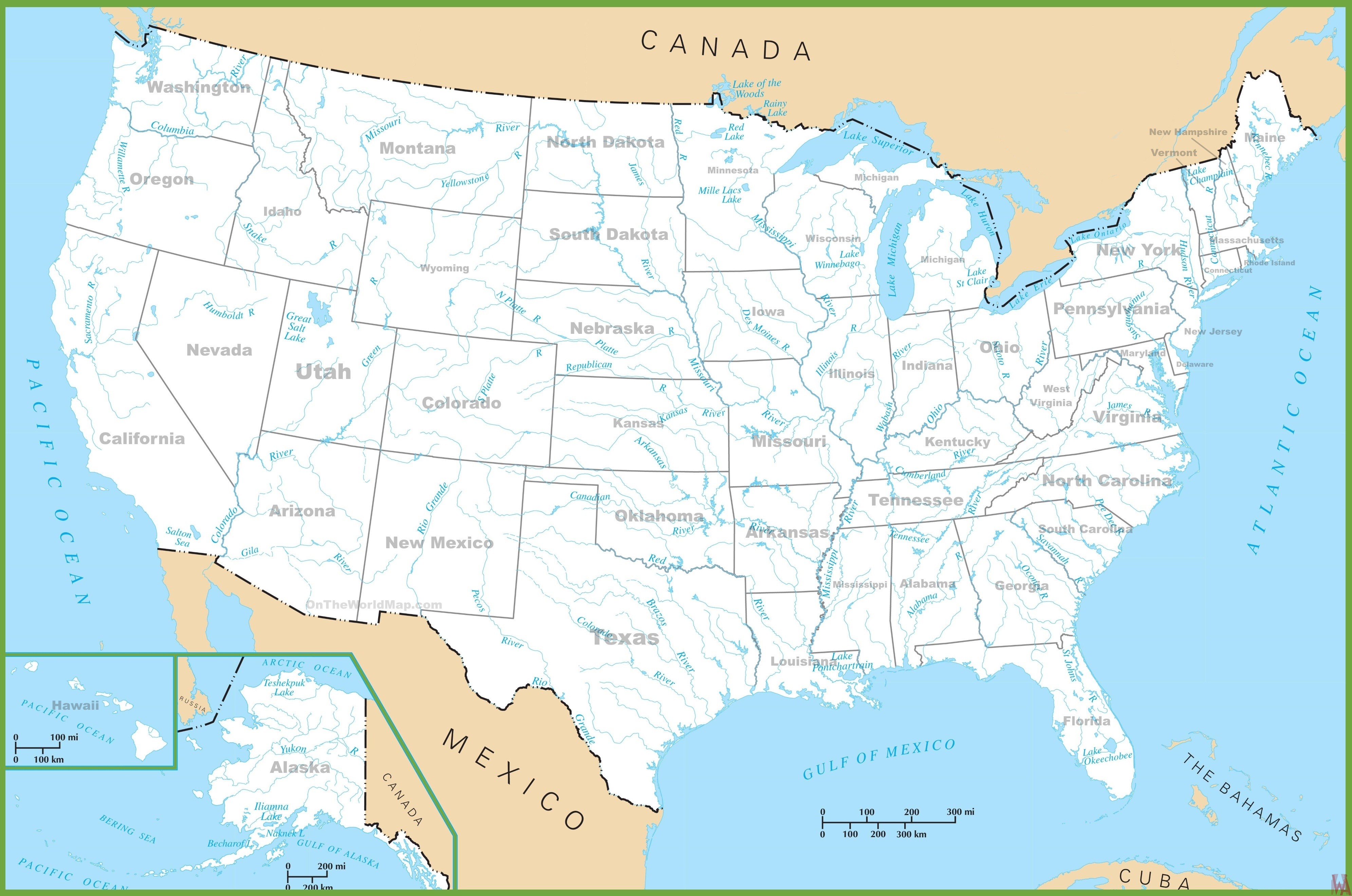
The United States enjoys abundant fresh water. Except for some dry areas in the west, the country for the most part receives more than enough rainfall for agriculture. In this part, we will see some of the important waters in the US.

                    i.           Mississippi River (密西西比河)

The Mississippi River is the most important river of the largestdrainage system(水系网)in North America. It flows 3,730 km from northern Minnesota to itsmouth in the Gulf of Mexico. The Mississippi ranks as the 4thlongest and 5th largest river in the world. It’s known to NativeAmerican Indians as the “Father of Waters”.

The Mississippi is the largest river system in North America. That means it carries a greater volume of water than any other rivers. With its tributaries(支流), the Mississippi passes through all or parts of 31 states between Rocky and Appalachian Mountains. However, the Mississippi river is not thelongest one in the United States. That honor goes to the Missouri River. But if Mississippi is measured from the source of its main branch – the Missouri River, it’s over 6,000 km with more than 40 tributaries.

                  ii.           Missouri River(密苏里河)

The longest river in this country, the Missouri River, flows east and south for about 3,800 km before entering the Mississippi at St. Louis, Missouri. On its way to the Mississippi, the Missouri forms part of the borderof 7 states. The river was once nicknamed “The Big Muddy” as it has a great deal of mud in it. Nowadays, some ecosystem restoration projects have beencarried out so as to improve water quality and protect endangered species.

                 iii.           St. Lawrence River(圣劳伦斯河)

The St. Lawrence River forms part of the boundary between Canada andthe United States. It’s the main outlet of the Great Lakes, flowing northeastfrom Lake Ontario(安大略湖)to the Gulf of St. Lawrence on the North Atlantic Ocean. It serves as a major water route to the interior of the US and Canada, linking the Great Lakes with the Atlantic Ocean.

                 iv.           Colorado River(科罗拉多河)

On the Pacific side, the Colorado River begins in the Rocky Mountain, which flows southwest for 2,300 km andempties into the Gulf of California. The Colorado drains an enormous area. All the farms and cities in the southwestern United States depend on its water.Many dams have been built in the Colorado River system. Hoover Dam(胡佛水坝) is the largest of the dams located on this area.

                  v.           Potomac River (波托马克河)

The Potomac River is famous, not only because Washington D.C. is located on its band but also because it’s the dividing line between the South and the North.

                 vi.           Hudson River (哈德森河)

The Hudson River is famous because New York City stands at the river mouth. Linked by canals with the five Great Lakes, the Hudson River serves as an important route for island waterway traffic.

                    vii.           Great Lakes

Along the US-Canadian border lies the world’s largest group of freshwater lakes – the five Grate Lakes. From the largest size to the smallest,it includes Lake Superior(苏必利尔湖), Lake Huron(休伦湖), Lake Michigan(密歇根湖), Lake Erie(伊利湖), and Lake Ontario(安大略湖). The lakes are a part of both countries and are shared by both. Only Lake Michigan lies entirely within the United States.

The lakes hold about one fifth of the fresh water on the Earth’s surface. These lakes are connected to the Atlantic Ocean by the St. Lawrence River. And they are joined together by canals and linked to the Mississippi andits tributaries. Some largest cities, such as Chicago and Detroit, are locatedon the edge of the Great Lakes.

                  ii.           Niagara Falls (尼亚加拉大瀑布)

Niagara Falls is the most spectacular falls in the United Statesbecause of its great beauty and immense size. It’s part of the Niagara River,which connects Lake Erie and Lake Ontario. About halfway between the two lakes,a sharp drop in the river makes Niagara Falls.

      The falls contain two giant waterfalls and a smaller one. The bigger waterfall is in Canada and is known as the Canadian Falls. It also called the Horseshoe Fall because of its shape. The one located in the US side is called American Falls. Even though they have the similar height, the Canadian Falls is twice as wide as the American Falls, and the former carries nine times more water than the latter. As a great tourist attraction, Niagara Falls makes and enormous roar and a huge cloud of water mist. You can always see rainbows shining through the mist here. At night, the falls are lit with colored lights, creating a brilliant display.