目录

  • 1 UK-General Survey
    • 1.1 Introduction to the Course
    • 1.2 Official Name & Other Names
    • 1.3 Component Parts
    • 1.4 Capital City
    • 1.5 Language
    • 1.6 Currency
    • 1.7 Religion
    • 1.8 National Flag
    • 1.9 National Anthem
    • 1.10 National Emblem
    • 1.11 Quiz
    • 1.12 quiz
    • 1.13 checklist
  • 2 UK - Geography
    • 2.1 Position
    • 2.2 The Land
    • 2.3 Geographical Features of the Components
    • 2.4 Major Cites
    • 2.5 Climate
    • 2.6 checklist
  • 3 History
    • 3.1 The Founding of the Nation
    • 3.2 Transition to the Modern Age
    • 3.3 The Rise and Fall of the British Empire
    • 3.4 The History of the English Language
    • 3.5 checklist
  • 4 UK-Politics
    • 4.1 Political System
    • 4.2 Constitutional Monarchy
      • 4.2.1 The Constitution
      • 4.2.2 The Monarch
        • 4.2.2.1 Functions of the Monarch
        • 4.2.2.2 Present Monarch
      • 4.2.3 Quiz
    • 4.3 Separation of Powers
      • 4.3.1 Legislature – Parliament
        • 4.3.1.1 House of Lords
        • 4.3.1.2 House of Commons
          • 4.3.1.2.1 General Election
          • 4.3.1.2.2 Two-party System
      • 4.3.2 Executive – Government
        • 4.3.2.1 Prime Minister
        • 4.3.2.2 The Cabinet
      • 4.3.3 Judiciary - Court
      • 4.3.4 Quiz
    • 4.4 checklist
  • 5 UK-People and Their Lives
    • 5.1 Social Class
    • 5.2 General Characters of Britons
    • 5.3 Ways of Life
      • 5.3.1 Marriage and Family
      • 5.3.2 Housing
      • 5.3.3 Transportation
      • 5.3.4 Clothing
      • 5.3.5 Eating
      • 5.3.6 Working
      • 5.3.7 Sports
      • 5.3.8 Media
    • 5.4 Welfare System
    • 5.5 Social Problems
    • 5.6 checklist
    • 5.7 quiz 2A
    • 5.8 quiz 2B
  • 6 UK-Celebrities
    • 6.1 Who are they?
    • 6.2 Famous Britons
    • 6.3 Checklist
  • 7 UK & US -Major Holidays
    • 7.1 Intro
    • 7.2 New Year (UK&US)
    • 7.3 Birthday of Martin Luther King Jr. (US)
    • 7.4 Valentine's Day (UK&US)
    • 7.5 Easter (UK&US)
    • 7.6 April Fool's Day (UK&US)
    • 7.7 Queen's Birthday (UK)
    • 7.8 Independence Day (US)
    • 7.9 Labor Day (US)
    • 7.10 Columbus Day (US)
    • 7.11 Halloween (UK&US)
    • 7.12 Bonfire Night (UK)
    • 7.13 Rememberance Day (UK) / Veterans Day (US)
    • 7.14 Thanksgiving (US)
    • 7.15 Christmas (UK&US)
    • 7.16 Boxing Day (UK)
    • 7.17 Holiday Types
    • 7.18 Checklist
  • 8 Chapter 8 US-General Survey
    • 8.1 Country Name
    • 8.2 Capital City
    • 8.3 Language
    • 8.4 Religion
    • 8.5 Currency
    • 8.6 National Flag
    • 8.7 National Anthem
    • 8.8 National Bird
    • 8.9 Great Seal
    • 8.10 Population
    • 8.11 Checklist
    • 8.12 QUIZ
      • 8.12.1 QUIZ 3A
      • 8.12.2 QUIZ 3B
  • 9 Chapter 9 US-Geography
    • 9.1 Position
    • 9.2 Territory
    • 9.3 Time Zone
    • 9.4 State Region
    • 9.5 Geographical Features
    • 9.6 Waters
    • 9.7 Major Cities
    • 9.8 Climate
    • 9.9 Natural Disasters
    • 9.10 Quiz
    • 9.11 Checklist
  • 10 Chapter 10 US-History
    • 10.1 First Inhabitants
    • 10.2 Colonial Period
    • 10.3 War of Independence
    • 10.4 Westward Expansion
    • 10.5 American Civil War
    • 10.6 US in the 20th Century
    • 10.7 US in the 21st Century
    • 10.8 Resource for this chapter
      • 10.8.1 movie
    • 10.9 Quiz
    • 10.10 Checklist
  • 11 Chapter 11 US-Politics
    • 11.1 Government Principles
    • 11.2 Constitution
    • 11.3 Branches of Power
      • 11.3.1 Legislative
      • 11.3.2 Executive
      • 11.3.3 Judicial
      • 11.3.4 Checks and Balances
    • 11.4 Major Parties
    • 11.5 Election
    • 11.6 Quiz
    • 11.7 Checklist
  • 12 Chapter 12 US-People and Their Lives
    • 12.1 Basic Values
    • 12.2 Cultural Groups
      • 12.2.1 Caucasians
      • 12.2.2 Hispanics
      • 12.2.3 African Americans
      • 12.2.4 Native Americans
      • 12.2.5 Jewish Americans
      • 12.2.6 Asian Americans
    • 12.3 Social Welfare
    • 12.4 Tourism
    • 12.5 Life Style
      • 12.5.1 Family Structure
      • 12.5.2 Housing
      • 12.5.3 Commuting
      • 12.5.4 Food and Cuisine
      • 12.5.5 Fashion and Dress
      • 12.5.6 Transportation
      • 12.5.7 Media
      • 12.5.8 Sports
    • 12.6 Quiz 3
      • 12.6.1 Quiz 3A
      • 12.6.2 Quiz 3B
    • 12.7 Checklist
  • 13 Chapter 13 US-Celebrities
    • 13.1 Who are they?
    • 13.2 Influential Americans
  • 14 Chapter 14 UK & US-Education
    • 14.1 Education in the UK
      • 14.1.1 Education Policy
      • 14.1.2 Education System
        • 14.1.2.1 Primary Eduction
        • 14.1.2.2 Secondary Education
        • 14.1.2.3 Higher Education
    • 14.2 Education in the US
      • 14.2.1 Education Policy
      • 14.2.2 Education System
        • 14.2.2.1 Elementary & Secondary Education
        • 14.2.2.2 Higher Education
Holiday Types


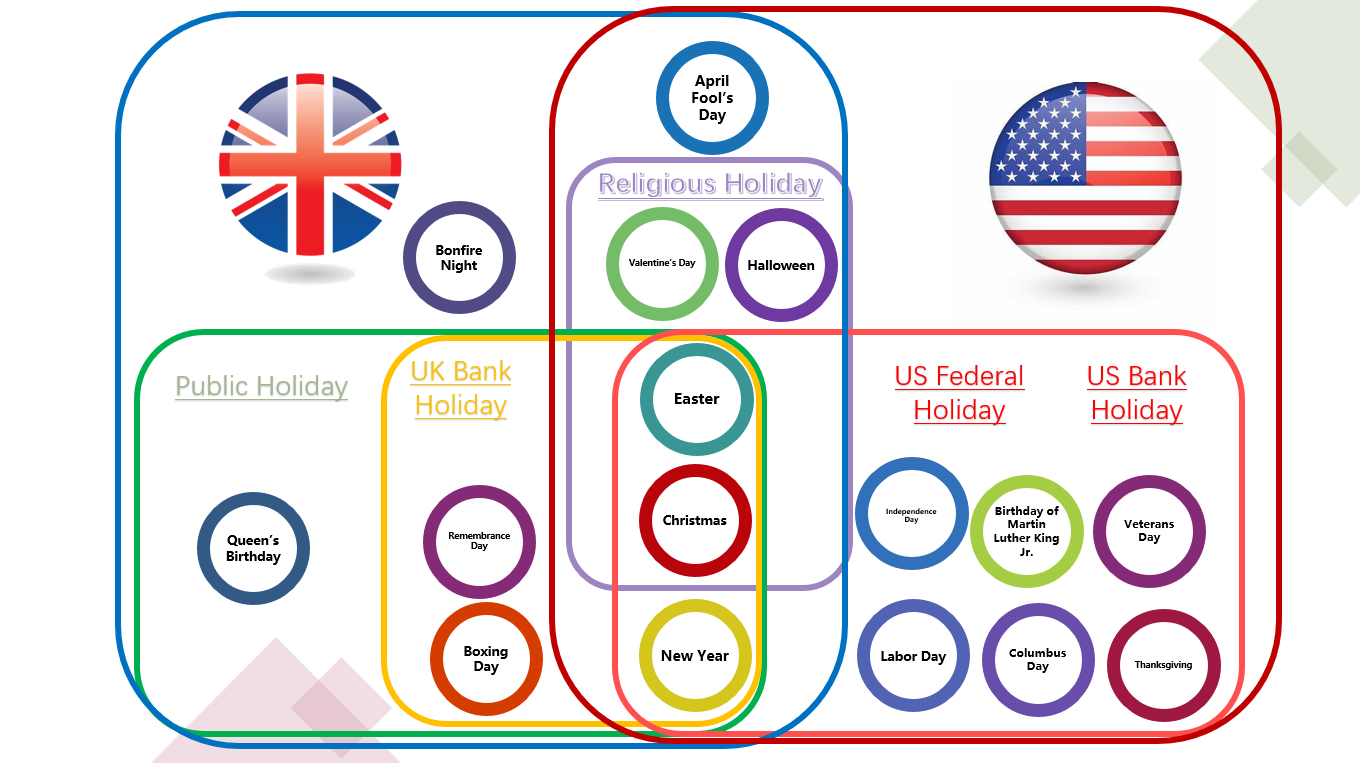
Holidays can be divided into several types. Some of the holidays wehave discussed are religious holidays, some are not. On some holidays, thelocals can have one day off, or even a longer vacation, but still have to workon some other holidays. Let’s go through the basic facts of these holiday typesfirst.

Most religious holidays have origins from Christianity. Someof them are public holidays, such as Easter and Christmas, while some of themare not, such as Lent (四旬斋,复活节前四十天,在此期间非星期日时需斋戒和忏悔).

The public holidays are the ones which are the holidays announced and acknowledged by the government and the constitution of the United Kingdom. Public holidays have the special place in the constitution of the United Kingdom and these holidays may or may not have the fixed dates. Generally,public holidays include bank holidays, which have been recognized since1871. The name comes from the time when banks were shut and so no trading couldtake place On Bank Holidays, generally on a Monday, some shops and banks areclosed. Shops that open may follow different trading hours than normal andtransport may run on a reduced schedule. There will be no postal service. In Britain,the bank holidays in the four regions are a little bit different from eachother. some of the bank holidays do not have a special name, just named as bankholiday, and the purpose of which is to give workers one day off.

US also have bank holidays, some of which overlap with the bank holidays in the UK. Anotherterm used in the United States is Federal holiday. Federal holidays in the US are authorized holidays which have been recognized by the US government,which are mainly created for federal institutions and employees. If employeesare required to work on that day, they will receive extra holiday pay. Generally,if a federal holiday falls on a Saturday, the preceding Friday is a holiday; if a holiday falls on a Sunday, the following Monday is a holiday. State holidays are holidays for the government and public sector in one orcertain specific states, but not all, private businesses will give employeesthe day off.