
目录

  • 1 UK-General Survey
    • 1.1 Introduction to the Course
    • 1.2 Official Name & Other Names
    • 1.3 Component Parts
    • 1.4 Capital City
    • 1.5 Language
    • 1.6 Currency
    • 1.7 Religion
    • 1.8 National Flag
    • 1.9 National Anthem
    • 1.10 National Emblem
    • 1.11 Quiz
    • 1.12 quiz
    • 1.13 checklist
  • 2 UK - Geography
    • 2.1 Position
    • 2.2 The Land
    • 2.3 Geographical Features of the Components
    • 2.4 Major Cites
    • 2.5 Climate
    • 2.6 checklist
  • 3 History
    • 3.1 The Founding of the Nation
    • 3.2 Transition to the Modern Age
    • 3.3 The Rise and Fall of the British Empire
    • 3.4 The History of the English Language
    • 3.5 checklist
  • 4 UK-Politics
    • 4.1 Political System
    • 4.2 Constitutional Monarchy
      • 4.2.1 The Constitution
      • 4.2.2 The Monarch
        • 4.2.2.1 Functions of the Monarch
        • 4.2.2.2 Present Monarch
      • 4.2.3 Quiz
    • 4.3 Separation of Powers
      • 4.3.1 Legislature – Parliament
        • 4.3.1.1 House of Lords
        • 4.3.1.2 House of Commons
          • 4.3.1.2.1 General Election
          • 4.3.1.2.2 Two-party System
      • 4.3.2 Executive – Government
        • 4.3.2.1 Prime Minister
        • 4.3.2.2 The Cabinet
      • 4.3.3 Judiciary - Court
      • 4.3.4 Quiz
    • 4.4 checklist
  • 5 UK-People and Their Lives
    • 5.1 Social Class
    • 5.2 General Characters of Britons
    • 5.3 Ways of Life
      • 5.3.1 Marriage and Family
      • 5.3.2 Housing
      • 5.3.3 Transportation
      • 5.3.4 Clothing
      • 5.3.5 Eating
      • 5.3.6 Working
      • 5.3.7 Sports
      • 5.3.8 Media
    • 5.4 Welfare System
    • 5.5 Social Problems
    • 5.6 checklist
    • 5.7 quiz 2A
    • 5.8 quiz 2B
  • 6 UK-Celebrities
    • 6.1 Who are they?
    • 6.2 Famous Britons
    • 6.3 Checklist
  • 7 UK & US -Major Holidays
    • 7.1 Intro
    • 7.2 New Year (UK&US)
    • 7.3 Birthday of Martin Luther King Jr. (US)
    • 7.4 Valentine's Day (UK&US)
    • 7.5 Easter (UK&US)
    • 7.6 April Fool's Day (UK&US)
    • 7.7 Queen's Birthday (UK)
    • 7.8 Independence Day (US)
    • 7.9 Labor Day (US)
    • 7.10 Columbus Day (US)
    • 7.11 Halloween (UK&US)
    • 7.12 Bonfire Night (UK)
    • 7.13 Rememberance Day (UK) / Veterans Day (US)
    • 7.14 Thanksgiving (US)
    • 7.15 Christmas (UK&US)
    • 7.16 Boxing Day (UK)
    • 7.17 Holiday Types
    • 7.18 Checklist
  • 8 Chapter 8 US-General Survey
    • 8.1 Country Name
    • 8.2 Capital City
    • 8.3 Language
    • 8.4 Religion
    • 8.5 Currency
    • 8.6 National Flag
    • 8.7 National Anthem
    • 8.8 National Bird
    • 8.9 Great Seal
    • 8.10 Population
    • 8.11 Checklist
    • 8.12 QUIZ
      • 8.12.1 QUIZ 3A
      • 8.12.2 QUIZ 3B
  • 9 Chapter 9 US-Geography
    • 9.1 Position
    • 9.2 Territory
    • 9.3 Time Zone
    • 9.4 State Region
    • 9.5 Geographical Features
    • 9.6 Waters
    • 9.7 Major Cities
    • 9.8 Climate
    • 9.9 Natural Disasters
    • 9.10 Quiz
    • 9.11 Checklist
  • 10 Chapter 10 US-History
    • 10.1 First Inhabitants
    • 10.2 Colonial Period
    • 10.3 War of Independence
    • 10.4 Westward Expansion
    • 10.5 American Civil War
    • 10.6 US in the 20th Century
    • 10.7 US in the 21st Century
    • 10.8 Resource for this chapter
      • 10.8.1 movie
    • 10.9 Quiz
    • 10.10 Checklist
  • 11 Chapter 11 US-Politics
    • 11.1 Government Principles
    • 11.2 Constitution
    • 11.3 Branches of Power
      • 11.3.1 Legislative
      • 11.3.2 Executive
      • 11.3.3 Judicial
      • 11.3.4 Checks and Balances
    • 11.4 Major Parties
    • 11.5 Election
    • 11.6 Quiz
    • 11.7 Checklist
  • 12 Chapter 12 US-People and Their Lives
    • 12.1 Basic Values
    • 12.2 Cultural Groups
      • 12.2.1 Caucasians
      • 12.2.2 Hispanics
      • 12.2.3 African Americans
      • 12.2.4 Native Americans
      • 12.2.5 Jewish Americans
      • 12.2.6 Asian Americans
    • 12.3 Social Welfare
    • 12.4 Tourism
    • 12.5 Life Style
      • 12.5.1 Family Structure
      • 12.5.2 Housing
      • 12.5.3 Commuting
      • 12.5.4 Food and Cuisine
      • 12.5.5 Fashion and Dress
      • 12.5.6 Transportation
      • 12.5.7 Media
      • 12.5.8 Sports
    • 12.6 Quiz 3
      • 12.6.1 Quiz 3A
      • 12.6.2 Quiz 3B
    • 12.7 Checklist
  • 13 Chapter 13 US-Celebrities
    • 13.1 Who are they?
    • 13.2 Influential Americans
  • 14 Chapter 14 UK & US-Education
    • 14.1 Education in the UK
      • 14.1.1 Education Policy
      • 14.1.2 Education System
        • 14.1.2.1 Primary Eduction
        • 14.1.2.2 Secondary Education
        • 14.1.2.3 Higher Education
    • 14.2 Education in the US
      • 14.2.1 Education Policy
      • 14.2.2 Education System
        • 14.2.2.1 Elementary & Secondary Education
        • 14.2.2.2 Higher Education
Geographical Features of the Components

Geographical Features of the Four Component Parts

England , with a total area of more than 130,000 square kilometers, may be divided into three landforms: the east and the southeast are made up of rolling downs and low-paying plains; middle England is a region of mountains formed by thePennines; the north and west of England are hilly, partly formed by the Cumbrian Mountain Range (坎伯兰山脉). England is the most populous and wealthiest part ofthe country, which is highly urbanized, with about 80% of the population living in cities. London, the capital of both England and the United Kingdom, is located in southeastern England.

The River Thames(泰晤士河) is the second longest and the most important river in Britain. It originates in southwestern England and flows through the midlands of England to London and empties into the North Sea.

Scotland has an area of 78,760 square kilometers. About two thirds of Scotland is covered by the Highlands. The chief rang in the Highlands is the Grampian Mountains(格兰扁山脉), which contain Ben Nevis (1334m)(本尼维斯山、尼维斯山), the highest mountain on the island of Great Britain.Scotland is the second largest of the four constituent parts of the United Kingdom,both in population and in area. Edinburgh is its capital. Tourism is one of Scotland’s most important industries.

The Clyde River(克莱德河) is the most important river in Scotland.

Another famous lake in Scotland is Loch Ness(尼斯湖), located in the northern Scottish Highlands, which is 37 kilometers long and 2.4 kilometers wide. Loch Ness is best known for sightings of the Loch Ness Monster, alsoknown as "Nessie". It was first brought to the world’s attention in1933, and many of the sightings suggest that Nessie is a creature with a long neck and flippers. However, evidence of its existence is supported by some indistinct photographs. Regardless of the truth, the suggestion of Nessie's existence makes Loch Ness one of Scotland's top tourist attractions.

Wales covers an area of about 20,700 square kilometers. Most of Wales is mountainous, mainly formedby the Cambrian Mountain Range. In Wales, only 12% of the land is arable (可耕作的), 6% is covered with forest. It is very close to the most densely populated parts of central England. The capital of Wales is Cardiff.

The Severn River(塞文河) is the longest river in Britain, which originatesin mid-Wales and flows through western England to the Bristol(布里斯托) Channel and the Atlantic Ocean.

       Northern Ireland is the smallest of the four parts, both in population and in area. It has an areaof 14, 135 square kilometers and occupies the northern one-sixth of the is land of Ireland. The central part of Northern Ireland is composed of plains surrounded by highlands and mountains. The capital of Northern Ireland is Belfast. On the central plain lies Lough Neagh(内伊湖), the largest lake in the whole country.
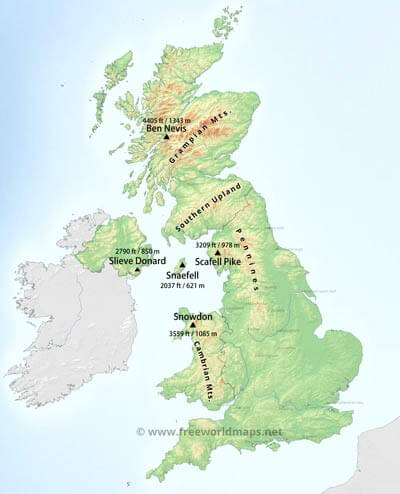
Major mountains in the UK
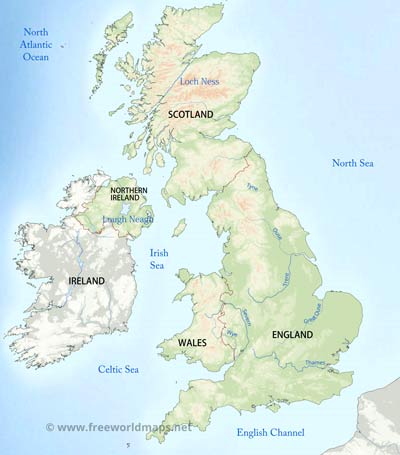
Major rivers in the UK