
After the death of William the Conqueror, England and Normandy were governed by William II, Henry I, and Henry II in succession. During the reign of Henry II, the power of the crown was further strengthened. The King limited the power of the nobles and carried out a series of reforms in administrative organs and judiciary system.
After the death of Henry II, John (1167-1216) was considered the worst of the English Kings and was notorious (声名狼藉)for his tyranny(暴政) and misgovernment(治国无方). King John, like William I, was one of the most controversial monarchs of Medieval (中世纪)England and was closely related to the Magna Carta or the Great Charter of 1215.
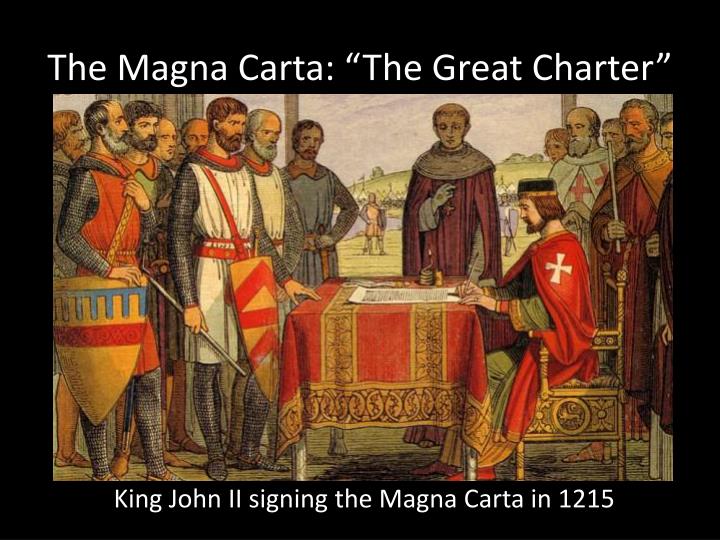
Great Charter (大宪章)(1215)

The Great Charter has been also known as Magna Carta, which King John was forced to sign in 1215. Its most important clauses were: no tax should be made without the approval of the Grand Council(大议会); no freeman should be arrested, imprisoned, or deprived of his property except by the law of the land; the Church should possess all its rights; London and other towns should retain their ancient rights. But the Great Charter said nothing about serfs(农奴).
The Great Charter established a legal relation between the King and the nobles(贵族), and granted some power to the Great Council,which has been regarded as the foundation of English liberties, a guarantee of the freedom of the Church and a limitation of the powers of the king.
NOTE: The Grand/Great Council is known to be the prototype (原型) of the current British Parliament.
The Hundred Year's War (英法百年战争)(1337-1453)
The Hundred Year's War referred to the intermittent (间歇性的) wars between France and England over the succession of the French throne that last from 1337 to 1453. The causes were partly territorial and partly economic. When Edward III claimed the French Crown but the French refused to recognize, the war broke out. At first the English were successful,but in the end, they were defeated and lost almost all their possessions in France.
After the war, neither of England or France obtained any real return for the vast expenditure of lives and treasure. However,it helped to accelerate the decline of feudalism in England and the English language finally took the place of French in all classes of society.

Wars of the Roses (玫瑰战争)(1455-1485)
Wars of the Roses was a series of civil wars for control of the throne of England, started between supporters of two rival braches of the House of Plantagenet(金雀花王朝): the House of York (symbolized by the white rose) and the House of Lancaster (symbolized by the red rose). With the support of the new noble and bourgeoisie(资产阶级), Henry Tudor from Lancaster came to the throne as Henry VII and started the Tudor Monarchy.
During the wars, feudal nobles killed each other and were in decline, which marked the end of Middle-aged England and paved the way for the development of the bourgeoisie.
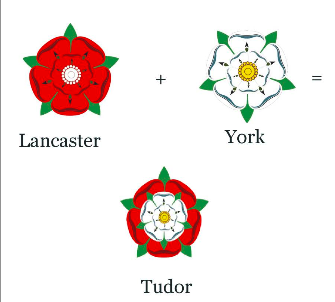
House of Tudor (都铎王朝)(1485-1603)
After Henry Tudor (who is also known as Henry VII) ascended the throne(继位) in England, the Tudor family ruled the country from 1485 to 1603, which could be regarded as a turning point in English history. Under the Tudors, England became a national state with an efficient centralized government and was in the transitional stage from feudalism to capitalism(资本主义). It was during the Tudor Monarchy that church was reformed and the Renaissance(文艺复兴) spread into the country. It also stimulated commercial and maritime(海事) enterprise, which helped the country rise to one of its highest points of the power.
Henry VIII reign(亨利八世统治时期)(1509-1547)
Henry VIII, the most famous king in England, was remembered not only for his six wives, but also for bringing about the Reformation of Church(宗教改革). He established the Church of England (英国国教)and separated it from the Pope in Rome(罗马教皇), appointing himself the supreme head of the Church of England. At home, Henry is known for his radical changes to the English Constitution(宪法), which greatly expanded royal power during his reign. Additionally, he created the Royal Navy(皇家海军), which became the basis of further British sea power.
Henry VIII and Reformation
Through the Middle Ages(中世纪), the Church in Europe had not been only a religious body, but also a political and legal power. At first, the kings of England did nothing to weaken the Pope’s (罗马教皇)role for their own political purposes. But in the 16thcentury, the wealth and power gathered by the Church attracted the jealousy of kings, and the English people realized the Church, under the foreign influence, hindered the social and political progress of England. Thus Henry VIII’s religious reformation was supported by parliament(议会) and people, even some leaders of the Church itself.
The direct cause of the Reformation was the issue over Henry VIII’s divorce(离婚). The Pope refused to annul(宣告…无效) Henry’s marriage with Catherine, a Spanish princess, who could not give him a male heir (继承人)to the throne. In the next few years, Henry VIII required Parliament to pass a series of acts which destroyed the power of the Church and established the English King as the head of the Church of England. As a result, Henry stressed the power of the monarch and strengthen his own position; England became a Protestant (新教) country, rather than a Catholic (天主教)one.
Elizabeth I Reign (伊丽莎白一世统治时期)(1558-1603)
Elizabeth’s reign brought in one of the most glorious eras of British history. Among the events of the Elizabethan Age were the defeat of the Spanish Armada (西班牙无敌舰队) in 1588, Sir Walter Raleigh’s discovery of tobacco in Virginia, and Sir Francis Drake’s circumnavigation of the world(环球航行). The Elizabethan age saw the flourishing (繁荣) of English poetry, music and literature and produced the world’s greatest playwright(剧作家) William Shakespeare.
The Elizabethan Age is viewed so highly because of the contrasts with the periods before and after. It was a brief period of largely internal peace. The Protestant/Catholic divide was settled,for a time, by the Elizabethan Religious Settlement, and parliament was not yet strong enough to challenge royal absolutism (王权专制). England was also well-off compared to the other nations of Europe and the century’s long conflict between France and England was also largely suspended for most of Elizabeth’s reign.
Elizabeth I had never been married and died in 1603 without leaving an heir to succeed her. The Scottish King, James I, was welcomed to the English throne as a descendent of Henry VII. Therefore, England and Scoland were brought together under the reign of James I, and the two kingdoms gave birth to the name "Great Britain". The period between 1603 and 1714 is usually referred to as the House of Stuart (斯图尔特王朝).
Civil War (英国内战) (1642-1649)
After the death of James, his son Charles I came into conflict with Parliament. He tried to rule without summoning (召唤)parliament for 11 years, but eventually ran out of money to suppress the Scottish uprising, and forced to recall Parliament in 1640. Parliament was outraged by his neglect of their rights. They refused Charles I’s request, so the country split between supporters of the king and supporter of Parliament. The former was called “Cavaliers” (骑士党) and the latter “Roundheads” (圆颅党) under the command of Oliver Cromwell(奥利弗·克伦威尔). The Civil War ended with the Parliamentary victory. Charles I was executed(处死) in London in 1649, and his son Charles II was exiled(放逐). Meanwhile,Parliament proclaimed England to be a commonwealth(共和国,现在Commonwealth也指英联邦) without the monarch and the Upper House(贵族阶层).
The Civil War overthrew (推翻)feudal system in England and led to the replacement of English monarchy first with the Commonwealth of English (1649-1653). Cromwell became the real ruler of the nation and rule under the name of Lord Protector (护国公), who was in charge of military leadership and possessed power superior to Parliament.
NOTE: civil war直译为内战,针对具体战争可能有不同翻译,如American Civil War为美国南北战争

Restoration (王政复辟)
After the death of Cromwell in 1658, his son Richard Cromwell succeeded the Protector. However, due to his incapability, Parliament decided to restore Charles II to the throne of England in 1660. This put an end to the Commonweath. Charles II was crowned in 1661, and tried to restore the old social order during his reign. Upon his death in 1685, he was succeeded by his brother, James II.
Glorious Revolution (光荣革命)(1688)
In 1685, James II succeeded the throne and backed up Catholic in public, regardless of people’s opposition of suspending (暂停) the anti-Catholic laws. Main parties of the bourgeoisie united and turned to James II’s daughter Mary and her husband William of Orange (奥兰治) and offered them the throne in 1688 on condition that they would respect the rights of Parliament. The peaceful crown of them was called “the Glorious Revolution”by British. In 1689, the Bill of Rights (《人权法案》)was passed to limit the power of kings and being regarded as the second Magna Carta.
The Glorious Revolution is the greatest landmark in the history of England. It achieved its objective without any blood shed. The struggle between the King and the Parliament ended in victory of the latter, which marks the end of absolutism (专制政体),and the beginning of modern English parliamentary democracy. The Bill of Rights has become one of the most important documents in the political history of Britain.
King William III and Queen Mary II
NOTE:
Orange is the surname of Holland's royal family. The orange color is also the representative color of the royal family in Holland.
William III and Mary II reigned the country together, so Queen Mary II should not be understood as the king's wife, but as the ruler of the country. For this period, there were two mornachs on the throne.

