
最大功率传输定理
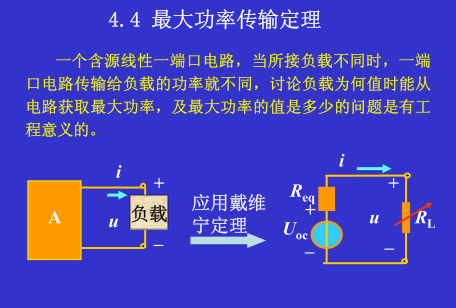
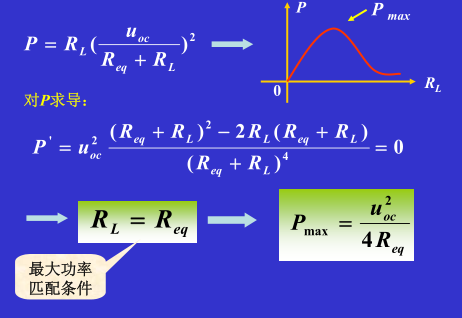
最大功率传输定理(maximum power transfer,theorem on)是关于使含源线性阻抗单口网络向可变电阻负载传输最大功率的条件。定理满足时,称为最大功率匹配,此时负载电阻(分量)RL获得的最大功率为:Pmax=Uoc^2/4R0。最大功率传输定理是关于负载与电源相匹配时,负载能获得最大功率的定理。
定理内容
最大功率传输定理是关于负载与电源相匹配时,负载能获得最大功率的定理。定理分为直流电路和交流电路两部分,内容如下所示。
直流电路
含源线性电阻单口网络( )向可变电阻负载
 传输最大功率的条件是:负载电阻 与单口网络的输出电阻
 相等。满足
相等。满足 条件时,称为最大功率匹配,此时负载电阻RL获得的最大功率为:
 。[1]
。[1]
交流电路
工作于正弦稳态的单口网络向一个负载

供电,如果该单口网络可用戴维宁(也叫戴维南)等效电路(其中 )代替,则在负载阻抗等于含源单口网络输出阻抗的共轭复数(即电阻成份相等,电抗成份只数值相等而符号相反)时,负载可以获得最大平均功率 。这种匹配称为共轭匹配,在通信和电子设备的设计中,常常要求满足共轭匹配,以便使负载得到最大功率。[2]
计算步骤
计算可变二端电阻负载从含源线性电阻电路获得最大功率的步骤是:
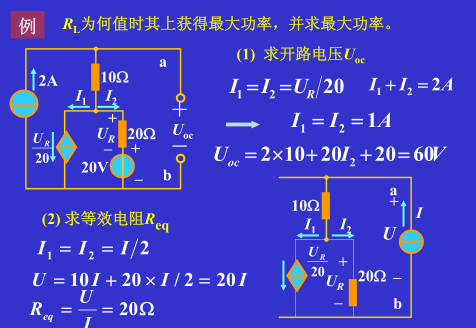
1.计算连接二端电阻的含源线性电阻单口网络的戴维宁(也叫戴维南)等效电路。
2.利用最大功率传输定理,确定获得最大功率的负载电阻值 。
。
3.计算负载电阻
时获得的最大功率值。[1]
使用范围
满足最大功率匹配条件()时,Ro吸收功率与RL吸收功率相等,对电压源uoc而言,功率传输效率为 。对单口网络N中的独立源而言,效率可能更低。电力系统要求尽可能提高效率,以便更充分地利用能源,不能采用功率匹配条件。但是在测量、电子与信息工程中,常常着眼于从微弱信号中获得最大功率,而不看重效率的高低。[1]
注意事项
使用最大功率传输定理的注意事项:
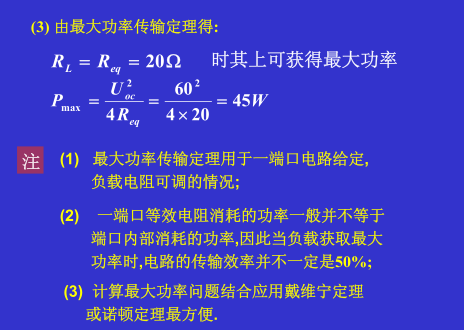
1、最大功率传输定理用于一端口网络的功率给定,负载电阻可调的情况;
2、一端口网络等效电阻消耗的功率一般不等于端口网络内部消耗的功率,因此当负载获取最大功率时,电路的传输效率并不一定等于50%;
3、计算最大功率问题结合应用戴维宁(也叫戴维南)定理或诺顿定理最方便。[3]
参考资料
英文的最大功率传输定理:
来源于:https://www.allaboutcircuits.com/textbook/direct-current/chpt-10/maximum-power-transfer-theorem/
Maximum Power Transfer Theorem
Chapter 10 - DC Network Analysis
The Maximum Power Transfer Theorem is not so much a means of analysis as it is an aid to system design. Simply stated, the maximum amount of power will be dissipated by a load resistance when that load resistance is equal to the Thevenin/Norton resistance of the network supplying the power. If the load resistance is lower or higher than the Thevenin/Norton resistance of the source network, its dissipated power will be less than the maximum.
This is essentially what is aimed for in radio transmitter design, where the antenna or transmission line “impedance” is matched to final power amplifier “impedance” for maximum radio frequency power output. Impedance, the overall opposition to AC and DC current, is very similar to resistance and must be equal between source and load for the greatest amount of power to be transferred to the load. A load impedance that is too high will result in low power output. A load impedance that is too low will not only result in low power output but possibly overheating of the amplifier due to the power dissipated in its internal (Thevenin or Norton) impedance.
Maximum Power Transfer Example
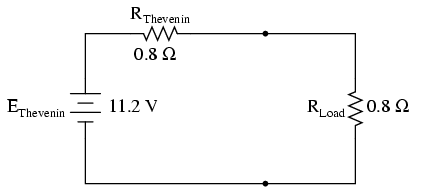
Taking our Thevenin equivalent example circuit, the Maximum Power Transfer Theorem tells us that the load resistance resulting in greatest power dissipation is equal in value to the Thevenin resistance (in this case, 0.8 Ω):
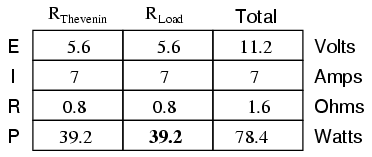
With this value of load resistance, the dissipated power will be 39.2 watts:
If we were to try a lower value for the load resistance (0.5 Ω instead of 0.8 Ω, for example), our power dissipated by the load resistance would decrease:

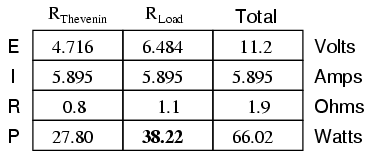
Power dissipation increased for both the Thevenin resistance and the total circuit, but it decreased for the load resistor. Likewise, if we increase the load resistance (1.1 Ω instead of 0.8 Ω, for example), power dissipation will also be less than it was at 0.8 Ω exactly:
If you were designing a circuit for maximum power dissipation at the load resistance, this theorem would be very useful. Having reduced a network down to a Thevenin voltage and resistance (or Norton current and resistance), you simply set the load resistance equal to that Thevenin or Norton equivalent (or vice versa) to ensure maximum power dissipation at the load. Practical applications of this might include radio transmitter final amplifier stage design (seeking to maximize power delivered to the antenna or transmission line), a grid-tied inverter loading a solar array, or electric vehicle design (seeking to maximize power delivered to drive motor).
Maximum Power Doesn’t Mean Maximum Efficiency
Maximum power transfer does not coincide with maximum efficiency. Application of The Maximum Power Transfer theorem to AC power distribution will not result in maximum or even high efficiency. The goal of high efficiency is more important for AC power distribution, which dictates a relatively low generator impedance compared to the load impedance.
Similar to AC power distribution, high fidelity audio amplifiers are designed for a relatively low output impedance and a relatively high speaker load impedance. As a ratio, “output impedance” : “load impedance” is known as damping factor, typically in the range of 100 to 1000. [rar] [dfd]
Maximum power transfer does not coincide with the goal of lowest noise. For example, the low-level radio frequency amplifier between the antenna and a radio receiver is often designed for lowest possible noise. This often requires a mismatch of the amplifier input impedance to the antenna as compared with that dictated by the maximum power transfer theorem.
REVIEW:
The Maximum Power Transfer Theorem states that the maximum amount of power will be dissipated by a load resistance if it is equal to the Thevenin or Norton resistance of the network supplying power.
The Maximum Power Transfer Theorem does not satisfy the goal of maximum efficiency.

