You are here
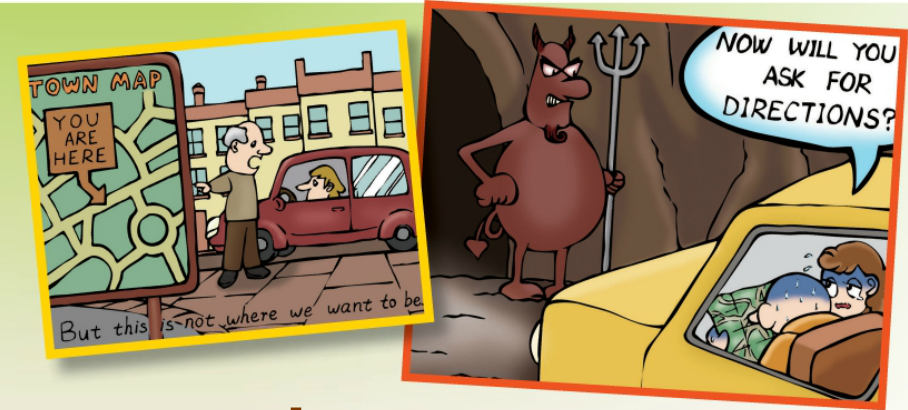

Read the text and find out why Max went the wrong way.
It was easy for Max to get to Liverpool Station. He enjoyed the 300-mile train journey through the countryside, but now came the difficult bit. How could he find the youth hostel? The guidebook said it was in an old warehouse down by the docks. The address was Tabley Street with the postcode L18EE.
He asked at the tourist information office opposite the station. The woman behind the counter gave him a map of the city and said it was only a 10-minute walk. He could see the station on the map and River Mersey with the docks. It looked easy enough to find. He started to walk, but then it began to rain.
After half an hour he decided to ask somebody for directions. He stopped a man in the street.
“Excuse me, can you tell me the way to the youth hostel?”
But the man answered, “Sorry, I’m a stranger here myself.”
He then asked a policeman, “Excuse me, do you know where the youth hostel is?”
“Well, the easiest way is if you go to the station. It is only a 10-minute walk from there. Ah, you have a map. Let’s see. We are here. The railway station is there on the corner of Station Road and Main Street. Go straight down Station Road past the cinema. Then you will come to a crossing with traffic lights. Turn left at the traffic lights and straight on at the roundabout. The youth hostel is in front of you. You really can’t miss it.”
“Thanks a lot for your help.”
“Don’t mention it,” said the policeman.
Max looked at the map and realised that he had looked at it upside down. He hadn’t turned left at the traffic lights; he had turned right! And instead of going straight on at the roundabout, he had turned left.
A very wet Max went back to the station and this time he was very careful not to take a wrong way. Five minutes later he was standing in front of the youth hostel.
重难点解析
1. But now came the difficult bit.
这是一个倒装句。当句子以now,then,soon以及thus开头且其后动词是be或者不及物动词begin,come以及follow等时,这些动词一般放在主语之前。如:
(1) Now comes your turn. 现在轮到你了。
(2) Then followed a great noise. 接着一声巨响。
2. The address was Tabley Street with the postcode L18EE.
在英国,邮政编码由三部分组成:一是代表城镇或伦敦某个区域的一个或两个字母,然后是代表这些地区内某一片区的一个或两个数字,最后是任意的一个数字或两个字母。所以这里的L就代表Liverpool。
3.It was only a 10-minute walk.
表示距离或路程时,英语可以使用“It is a +时间+walk/ride等”,表示“步行/乘车要花多长时间的路程”。如:
(1)It is a 40-minute taxi ride from the airport. 距离机场大约乘出租车40分钟的距离。
(2)The metro station is a 10-minute walk from the youth hostel. 地铁站离青年旅馆就步行10分钟的距离。
4.Excuse me, can you tell me the way to the youth hostel?
[1]“Excuse me”是英语口语中常用的礼貌用语,通常用于询问时以引起对方注意或者打搅他人时表示一种歉意。如:
(1)Excuse me, what time is it? 对不起,请问几点了?
(2)Excuse me, but there is a phone call for you. 打搅一下,有电话找您。
[2]“Can you tell me the way to…?”是一个问路的常用句型,表示“去……怎么走?”。如:
Excuse me, can you tell me the way to the warehouse? 对不起,请问去仓库怎么走?
5. Sorry, I’m a stranger here myself.
“I’m a stranger here myself.”是别人问路而自己无法指路时常用到的一句话,表示“我对这儿也不熟”。如:
“Can you tell me the way to the football stadium?”
“Sorry, I’m a stranger here myself.”
“对不起,请问足球场在哪儿?”
“对不起,我对这儿也不熟。”
6. Go straight down Station Road past the cinema.
“straight”这里的意思是“径直地,直接地” 。“go straight”也是一个指路常用语,表示“径直往前走”。如:
We decided to go straight home after the dinner.我们决定吃饭后直接回家。
Go straight down the street and then turn right at the second crossing. 先沿街径直往前走,然后在第二个十字路口向右转。
7.You really can’t miss it.
“You can’t miss it.”是一句指路日常用语,表示“你不会找不到的”。如:
The police station is just opposite the library. You can’t miss it.警察局就在图书馆对面,很容易找到的。
Assignment

