
New Words
Text A
Barbecue party
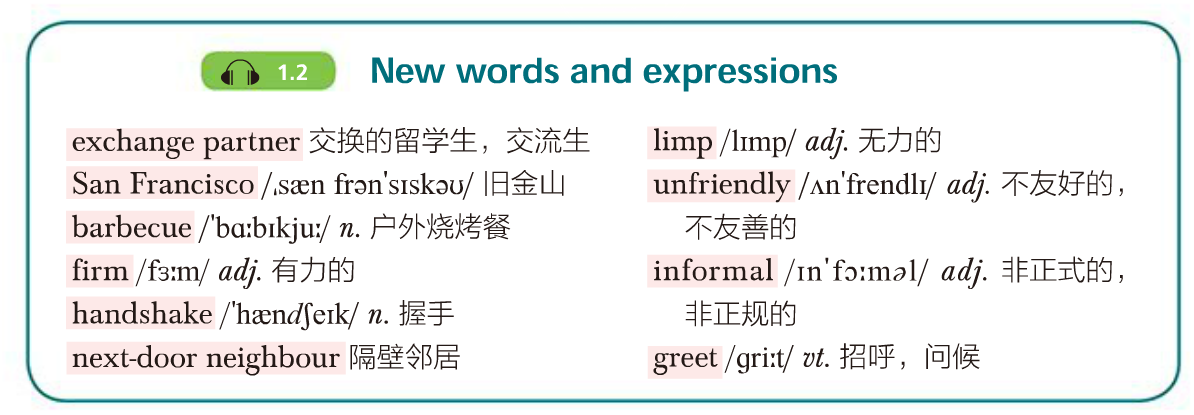
Sung Ling from Shanghai is staying with her exchange partner, Kate Miller, in San Francisco.
On Ling’s first Saturday, the Millers have a barbecue in their garden. They want to introduce Ling to some of their neighbours. Kate also invites some of her friends from school.
Before the barbecue, Ling is a little nervous. “What do I say when you introduce me to somebody?” she asks Kate.
“Don’t worry, Ling,” Kate says. “It’s very easy. When I introduce you to an older person, for example Grant Summers, our next-door neighbour, I say, ‘Grant, this is Sung Ling from Shanghai. She’s my exchange partner.’ And then I say to you, ‘Ling, this is Grant Summers. He’s our next-door neighbour.’ And you just say, ‘How do you do, Mr Summers? It’s nice to meet you.’”
“Yes, but do I shake hands or just smile?”
“Well, with an older person you can shake hands and smile. But remember that in America, we like a firm handshake.”
“Okay, Kate,” Ling says, “but what about when I want to introduce myself? Maybe you won’t be there.”
“Well, if it’s an older person – Grant’s wife, Susan, for example – you just offer your hand and say, ‘How do you do? I’m Sung Ling from Shanghai. I’m Kate’s exchange partner.’”
“And what will the other person say?” Ling asks.
“Well, the other person will also say ‘How do you do?’ and tell you his or her name.”
“Okay. I’ve got that. But what about younger people? You know, your friends from school.”
“Well, just say, ‘Hi, I’m Ling, Kate’s exchange partner.’ It’s very informal.”
“And what about people I already know?”
“Well, if you see somebody you know after a short time, just say ‘Hello.’ But if you see them after a longer time, then you say, ‘How are you?’ or maybe ‘How are things?’”
“And what do I answer if somebody greets me with ‘How are you, Ling?’”
“Just say ‘Fine, thanks. And you?’ Then the other person says, ‘I’m fine, too. Thanks.’”
“Okay. But I thought you said it’s very easy.”
重难点讲解
1.What about when I want to introduce myself?
“What about …”常常用在口语中,提醒某人考虑某人或某事,表示“……呢?”。如:
(1)What about Allen?Should I ask him to come? 那艾伦呢?要我叫他来吗?
(2) “What about taxi?” “Carpooling.” “叫出租车了吗?” “拼车。”
2. If you see somebody you know after a short time, just say “Hello.”
[1]该句中“you know”是修饰somebody的定语从句。当关系代词在定语从句中充当宾语时,关系代词可以省略。如:
(1) The book (that) I bought yesterday is rather interesting. 我昨天买的那本书很有意思。
(2) I have no idea about the report (that) he mentioned.我对他提到的报告一无所知。
[2]if引导的条件状语从句若涉及将来的情况,if从句的动词要用一般现在时。如:
(1) If it rains, we’ll have to stay at home. 如果下雨,我们就得待在家里了。
(2) If he offers you a job, just accept it. 如果他给你一份工作,你就接受得了。
Learn More —— Parties

