-
1 IGS
-
2 Workshop 2018
-
3 Workshop 2017
-
4 ION GNSS&nbs...
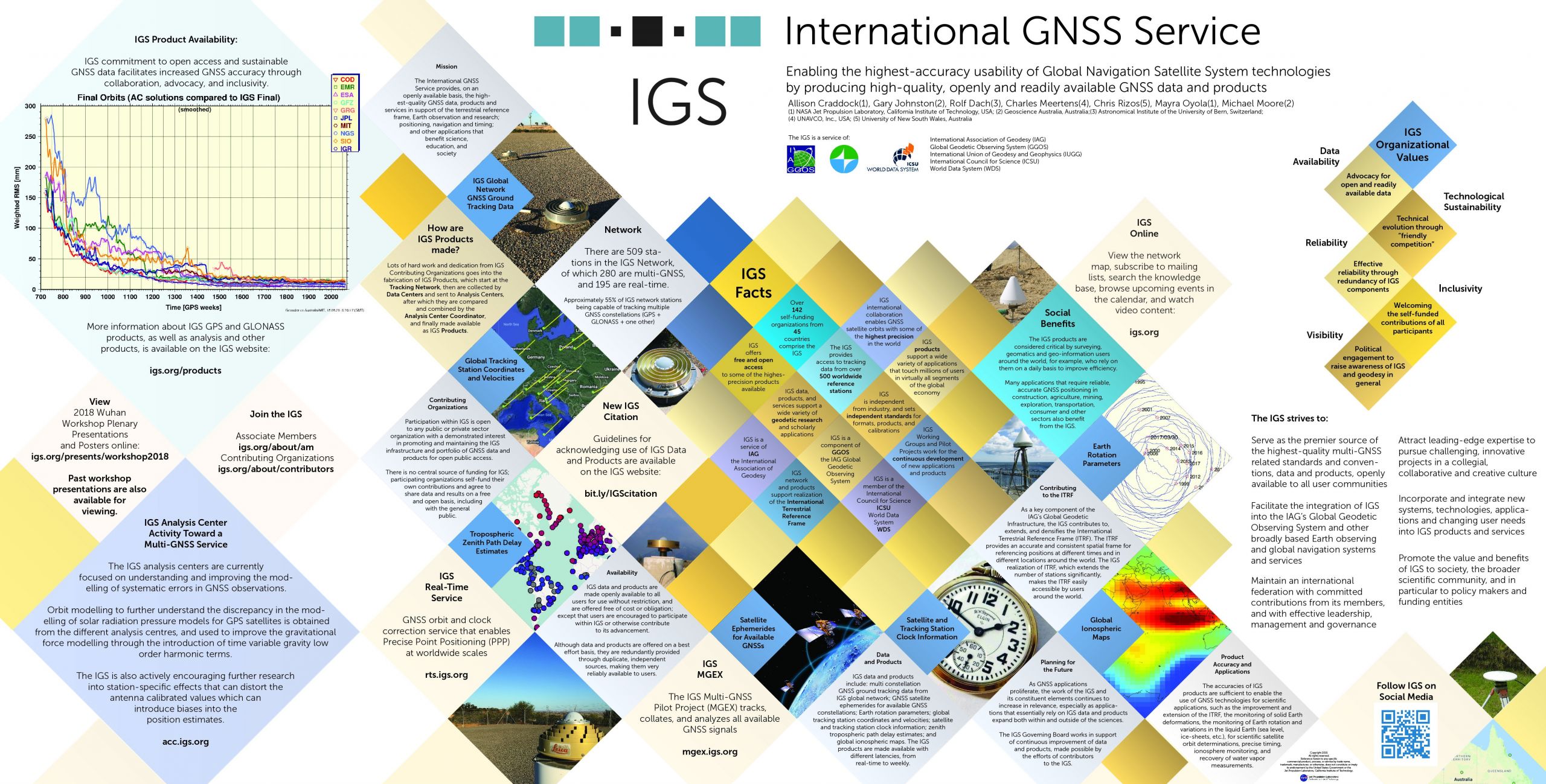
IGS地址:
中国: ntrip.gnsslab.cn
IGS :ftp.igs.org
UNAVCO : http://www.unavco.org/
================================================================
https://www.blackdotgnss.com/2018/11/07/igs-workshop-2018/
IGS Workshop 2018
The IGS Workshop 2018 was held from 29 October to 2 November in Wuhan, China. One of the focus of the workshop was to align efforts towards incorporating multi-GNSS products into the standard line of IGS products. As a bonus, we might even see products enabling PPP with ambiguity resolution (PPP-AR) in a not-so-distant future!
Towards multi-GNSS
While several analysis centers are contributing products to the MGEX working group, ingesting these multi-GNSS products into the standard IGS product line is taking a long time. Since it is known that multi-GNSS data processing leads to improved geometry and faster PPP convergence, why is there such a delay? The main reason seems to be related to issues with antenna calibrations. First, for ground antennas, the standard procedure is to use robot calibrations, typically provided by Geo++. However, with Geo++ only providing GPS and GLONASS L1/L2 calibrations, a bottleneck has been created in the calibration process. Anechoic chamber calibrations, although accepted within the IGS, can have discrepancies of a few millimeters with respect to robot calibrations. As a consequence, agencies such as ETF Zurich, Wuhan University and NGS have acquired robots and have started calibrating antennas for multi-GNSS and multi-frequency antennas. Without such calibrations, a multi-GNSS solution will be corrupted by phase-center errors and will never reach the level of accuracy as GPS+GLONASS solutions. So, even though a multi-GNSS solution might converge faster to cm-level accuracies, it is not acceptable for the IGS to adopt a multi-GNSS solution with such outstanding issues.
Another antenna issue originates from the Galileo satellite phase-center offset/variation values provided by GSA last year. Obtaining such metadata directly from the satellite manufacturer was extremely valuable, but using these values leads to scale incompatibilities with the ITRF scale adopted for GPS. Various approaches for dealing with this issue were discussed and a solution would need to be adopted before the next repro3 campaign planned for 2019.
Biases
Yoaz Bar-Sever from JPL made a very interesting presentation on FlexPower, a sporadic technique used by GPS operators consisting of increasing signal power to prevent jamming. When FlexPower is activated, code-bias variations can be observed, reaching up to about 30 centimeters. A bimodal mode (i.e., either on or off) for FlexPower could be detected by JPL, leading to sudden jumps in the satellite DCBs. This effect can have potential consequences for PPP-AR, when the assumption is made that code biases (either DCBs or widelane biases) are constant over a day. These events are a reminder that the decoupled-clock model used by NRCan, modelling code biases as clock-like white-noise parameters, is a robust approach to this kind of unpredictable fluctuations.
Jean-Marie Sleewaegen of Septentrio analyzed satellite biases between the data (I) and pilot (Q) signals, finding centimeter to decimeter-level biases for most systems, except Galileo which had negligible biases. Quantifying the biases for receivers providing the mixed (‘X’) signals is more complex since it is dependent on the tracking algorithm implemented within the receiver and could differ among manufacturers. Fortunately, no carrier-phase biases could be detected between the data and pilot signals.
PPP-AR
A lot happened with respect to PPP-AR during this workshop. First, CNES announced that Galileo integer clocks and widelane biases (from the E1/E5a signals) are available in their MGEX products (grm) since GPS week 2022.
CODE has also implemented undifferenced ambiguity resolution in their Bernese software. As a result, their satellite clock estimates have been significantly improved since GPS week 2004. While the satellite phase biases computed by CODE are still not being made available to the general public, it is CODE’s plan to release these biases in the near future.
Similarly, the GNSS Research Center of Wuhan University computed a repro campaign from 2006-2016, thereby generating uncalibrated phase delays (UPDs) for GPS. They also aligned their biases from day to day, leading to a long time series of continuous phase biases, which should be made available before 2019.
While I usually restrain from blowing my own horn during conference summaries, I think it is well deserved this time: NRCan proposed the creation of a new IGS working group on PPP-AR which has been accepted at the governing board meeting on Friday. With at least four analysis centers now generating PPP-AR products (CNES, NRCan, CODE and Wuhan), the timing is right for the IGS to analyze the inter-operability of these products and, if possible, to consider combining them. It is then my job as the working group chair to coordinate the work of the analysis centers involved and enable PPP-AR using combined IGS clock/bias products.
The Future of GNSS Positioning
With the workshop being held in China, we had two very interesting keynote presentations on the performance and future of the BeiDou system. An interesting characteristic of the current BeiDou-3 constellation is the inter-satellite links, allowing not only communication between MEO satellites, but also accurate ranging capabilities. This feature allows for an accurate real-time orbit determination using only ground stations located in China!
But the most fascinating part is the future of BeiDou: the existing GEO, MEO and IGSO satellites could be complemented with hundreds of LEO satellites. These satellites would have GNSS-like ranging signals and, with the rapid change in geometry, would allow for centimeter-level positioning within seconds. With a first test satellite launched on September 29th 2018, we can only believe the seriousness of this idea. One presenter also went as far as to suggest that BeiDou-4 would also include underwater positioning capabilities… that is an ambitious proposal, but I would be glad to see it happen. The future of positioning is bright indeed!
PY01 - Analysis Centers and Reference Frames - Thomas Herring, Paul Rebischung, Michael Moore
PY02 - Orbit Modeling - Rolf Dach, Tim Springer
PY03 - Troposphere - Rosa Pacione, Sharyl Byram
PY04 - Infrastructure Committee, RINEX, Data Centers - Nacho Romero, Ken Macleod, Carey Noll
PY05 - Timing and Biases - Stefan Schaer, Michael Coleman
| B. Duan | |
| J. Geng | |
| L. Pan | |
| Y. Bar-Sever | |
Quantifying the pilot-data bias on all current GNSS signals and satellites | J. Sleewaegen |
PY06 - MGEX and IGMA - Oliver Montenbruck, Urs Hugentobler
PY07 - Antennas - Arturo Villiger, Florian Dilssner
PY08 - Ionosphere - Andrzej Krankowski
PY09 - Real-Time - Axel Ruelke, Qile Zhao
PY10 - Science Applications - Jianghui Geng, Fred Blume
GS Workshop 2017
PY00 - Opening - Zuheir Altamimi
| Z. Altamimi | |
Welcome by IAG & Local Organizing Committee | Z. Altamimi |
| D. Bursaux | |
| M. Falcone | |
| G. Johnston | |
| J. Lambin | |
| R. Neilan | |
| S. Rousset |
PY01 - Multi-GNSS & Constellation Monitoring - Oliver Montenbruck, Qile Zhao
PY02 - Scientific applications - Geoffrey Blewitt, Tilo Schöne
Earthscope’s Plate Boundary Observatory (PBO) use of IGS products. | T. Herring |
| C. Kreemer | |
GNSS Augmentation to Tsunami Early Warning Systems | J. Lauterjung |
EPN-Repro2: A reference tropospheric dataset over Europe | R. Pacione |
A review of recent advances in GNSS-MR | S. Tabibi |
| N. Teferle |
PY03 - Antennas & Biases - Florian Dilssner, Stefan Schaer
PY04 - Troposphere & Ionosphere - Sharyl Byram, Andrzej Krankowski
PY05 - Infrastructure, Data Centers & Formats - Nacho Romero, Carey Noll, Ken MacLeod
Progress since Sydney IGS Workshop Geoscience Australia | F. Boler |
GeodesyML 0.4 Recently Released | C. Bruyninx |
Some information from CNAV not in proposed message | K. Macleod |
| I. Romero |
PY06 - Real-time - Axel Rülke, Loukis Agrotis
PY07 - Analysis Centers - Tom Herring, Michael Moore
| F. Boler | |
Impact of modern Earth orientation models on GPS precise orbit determination | A. Sibois |
The ESA/ESOC Analysis Centre progress and improvements | T. Springer |
CODE’s Update of the Clock Products | A. Villiger |
| Q. Zhao |
PY08 - Orbit modelling - Marek Ziebart, Flavien Mercier
PY09 - Reference Frame - Paul Rebischung, Zuheir Altamimi
PY10 - Timing - Gérard Petit, Michael Coleman
Data Quality: from Tracking to Archiving with no Gaps | F. Clemente |
Improving the Resilience to Interference of a GNSS Reference Station | Y. Tawk |
Proceedings of IONGNSS+ 2019
September 16–20, 2019
Miami, Florida
Acknowledgements
About ION
ISSN: 2331-5954
© 2019, Institute of Navigation
Copyright andDisclaimer © 2019 The Instituteof Navigation, Inc. (ION®). All rights reserved.This publication,"Proceedings of the 32nd International Technical
Meeting of theSatellite Division of the Institute of Navigation (ION GNSS+ 2019)," iscopyrighted by The Institute of Navigation, Inc. (ION) unless otherwiseindicated. All rights are reserved and content may not be reproduced,downloaded, disseminated, or transferred, in any form or by any means, exceptwith the prior written agreement of the ION or as indicated below. Individualusers of these proceedings may download content for their own personal use on asingle computer, but no part of such content may be otherwise or subsequentlyreproduced, downloaded, disseminated, or transferred, in any form or by anymeans, except with the prior written agreement of, and with the expressattribution to the ION.
While ION makes everyeffort to present accurate and reliable information on these proceedings, theION does not endorse, approve or certify such information, nor does it guaranteethe accuracy, completeness, efficacy, or timeliness of such information. Use ofsuch information is voluntary, and reliance on it should only be undertakenafter an independent review by qualified experts. Reference herein to anyspecific commercial product, process or service does not constitute or implyendorsement, recommendation or favoring by the ION. The ION assumes noresponsibility for consequences resulting from use of the information containedherein or in any respect for the content of such information. The ION is notresponsible for, and expressly disclaims all liability for, damages of any kindarising out of use, reference to, reliance on, or performance of suchinformation.

