1-2 legendary Wanhu‘s spaceship
3-5 Howard Hughes' flying boat
6-7 Leonard da Vinci's flying machine sketches
Pioneers of Flight
The legend of Wan Hu
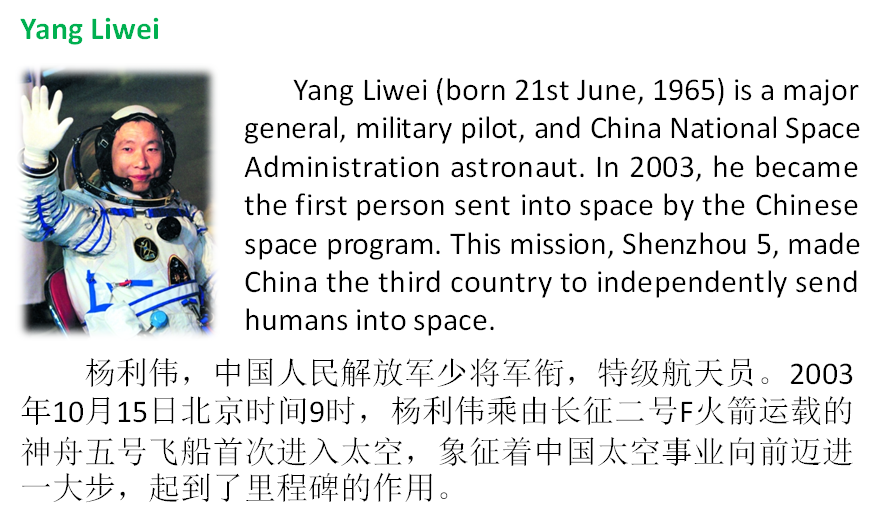
1 China launchedits first rocket with human beings aboard on October 15, 2003. Astronaut YangLiwei brought to its fulfillment a dream that probably had its roots in a much earlier time. Although the veracity of the story cannot be confirmed, legend has it that in A.D. 1500 a man named Wan Hu prepared his own mission to the stars. At that time, the Chinese invention of gunpowder was widely used in rockets for military purposes as well as in fireworks. Wan Hu devised a risky plan to harness the power of such rockets to take him to the stars.
2 The story goes that Wan Hu built the first spaceship: a chair with 47 powerful gunpowder rockets and two kites attached to it. On the day of the launch, each rocket was lit by a different servant carrying a torch. The servants then moved back and waited. An earth-shattering explosion followed: Wan Hu and his primitive spaceship had disappeared completely. Although the story may seem a littlefar-fetched, the principles of rocket-powered space flight are contained in WanHu’s crazy dream.
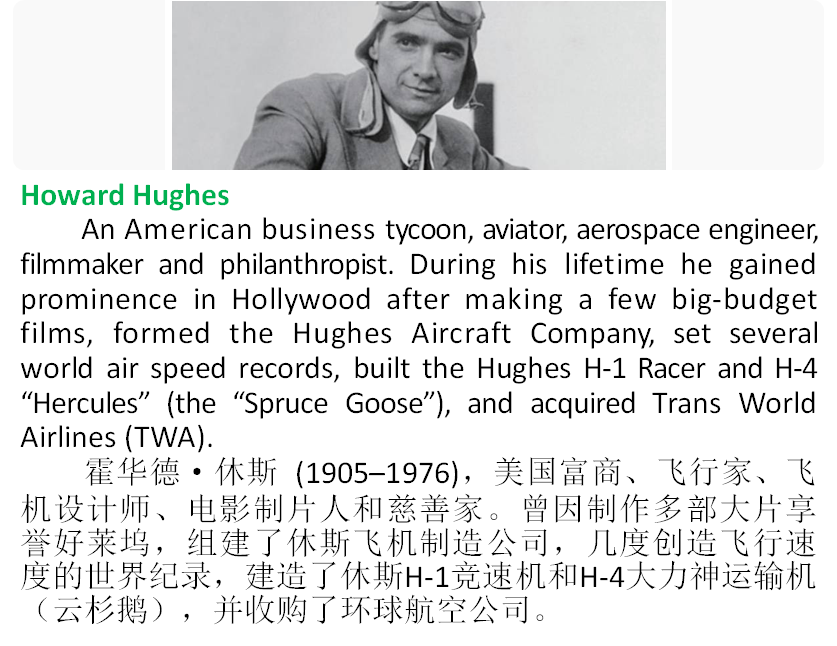
Howard Hughes’s Spruce Goose
3 On November 2,1947, a crowd of onlookers at San Pedro harbor in Los Angeles witnessed aviation history. An enormous flying boat, nicknamed the Spruce Goose, sped across the bay and rose 70 feet above the water. After just under a minute, it landed perfectly one mile down the bay. It was the first and last time the boatever flew.
4 The concept for construction of the Spruce Goose came from the need for more effective ways of transporting troops and materials in World War II. The idea came from a mancalled Henry Kaiser, but it was Howard Hughes, the legendary multi-millionaire,who actually developed the flying boat.
5 The Spruce Goosewas the biggest airplane ever built and still holds the record for the greatest wingspan, and it was made entirely of wood. Though it had promise, in the endthe project failed for three main reasons: the cost of building the enormous machine; the complexity of working with wood; and Hughes’s perfectionist approach, which caused the entire project to finish behind schedule. The Goose was put into storage and remained hidden from view until 1976, when it was put on display for the public. In 1992, the plane was dismantled and transported tothe state of Oregon, where it remains today. Many of the design features of the Spruce Goose have been incorporated into modern cargo planes. Like other pioneers in the field of transportation, Hughes was simply ahead of his time.
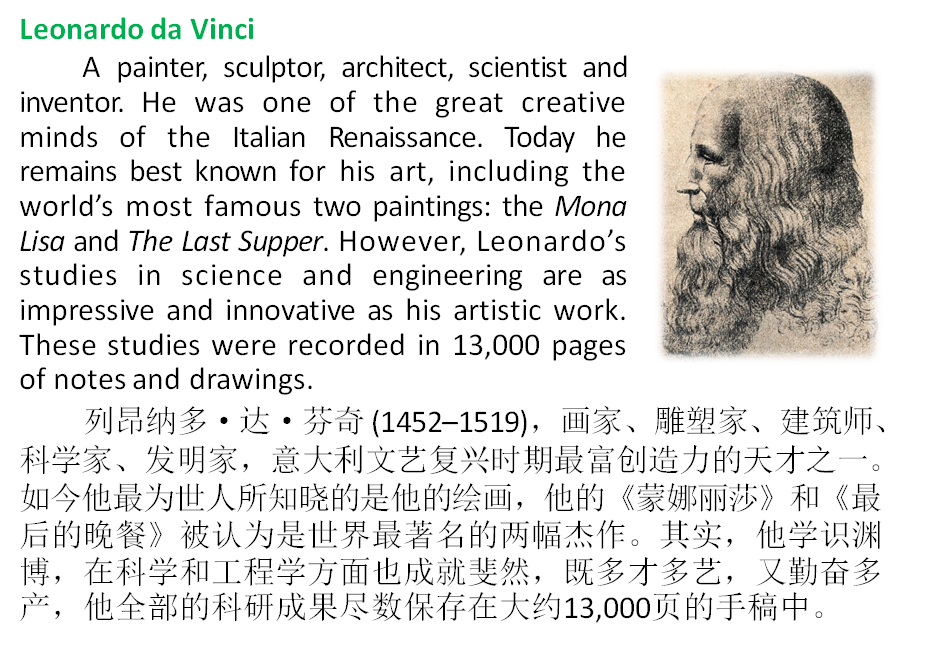
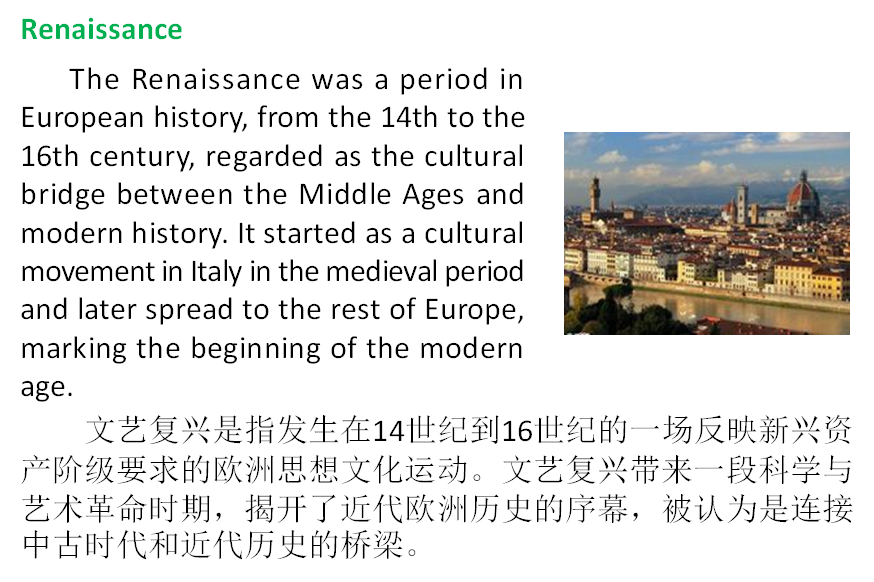
The futuristic ideas of Leonardo da Vinci
6 Centuries before Hughes was designing the Spruce Goose, another pioneer in transportation design was sketching plans for different kinds of flying machines. Leonardo da Vinci,perhaps the most famous artist of the Renaissance period, planned flying devices with flapping wings controlled and steered by human pilots. His research focused on the complex anatomy of birds in flight, and he based his flying machines on this analogy. It took almost 500 years for da Vinci’s sketches to become real. In June 2000, a professional parachutist named Adrian Nicholas jumped out of a hot-air balloon over the South African countryside using aparachute made of wood and canvas based on one of da Vinci’s designs. Nicholas landed safely, and Leonardo’s dream became reality.
7 These three enigmatic individuals, Wan Hu, Howard Hughes, and Leonardo da Vinci, came from places and cultures that are about as different as we can imagine. What they shared was a fascination with flying, a spirit of innovation, and the courageto try and make their dreams of flight come true.

Astronaut Yang Liweirealized a dream that had probably originated long before.

Although the story doesn’t sound believable, Wan Hu’s crazy dream
has in it the principles of rocket-powered spaceflight.

The idea of building the Spruce Goose grew out of the need for more effective movement of troops and materials during World War II.

He carefully studied the shape and structure of birds and appliedthe principles of their flight to the design of his flying machines.

The three enigmatic individuals, Wan Hu, Howard Hughes, and Leonardo da Vinci, cannot be more different in terms of their living places and cultures.