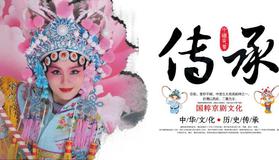
PekingOpera
Among all traditional Chinese operas, Peking Opera is a relativelynewcomer. However, it has become one of the most important and influentialopera forms for Chinese audience and is now regarded as a nationally acceptedform.
Like any other traditional opera, Peking Opera tells stories throughmovement, singing and elaborate dancing. Thus it is a graceful art whichcombines the best elements of literature, music and dance. First conceived anddeveloped in Beijing (Peking), Peking Opera has only been performed for about 200.But, by maintaining the heritage of traditional opera and absorbing so muchfrom other local arts, it came to dominate the theaters of the imperial capitaland enjoyed rapid growth. As it developed, Peking Opera has experienced periodsof full bloom, diminishing popularity and near extinction. But in the end, ithas still been passed down from generation to generation because of its immensevitality.
During the Qing Dynasty, opera became very popular with Beijingaudience. In the 55th year of Qianlong’s reign (1790), the Sanqing Hui Operatroupe(三庆徽班) wassummoned to Beijing to celebrate the emperor’s 80th birthday. After thecelebration, the troupe stayed on in Beijing and gave performances for thepublic. As Qianlong entered his 56th year on the dragon throne (1791) variousHui Opera troupes came to Beijing. By the reign of the Emperor Jiaqing, manyother Hui opera troupes had come to perform in Beijing, including the Sanqing(三庆), Sixi(四喜), Hechun(和春)and Chuntai(春台), known as the “Four Great HuiOpera Troupes①”. At that time, Hui opera troupes mainly performed Erhuang(二黄) melody, Xipi(西皮) melody and other local folktunes. They attracted a diverse audience and occupied an obviously dominantposition among all the troupes performing in Beijing. During the reigns ofJiaqing and Daoguang, a group of Handiao(汉调) actors came to Beijing to perform together with the Hui troupes.Because Handiao actors concentrated on both Xipi and Erhuang melody, thisencouraged the merging of Hui, Han and Qin and enabled Hui troupes to performplays using pi huang melody(皮簧腔), laying the foundation for Peking Opera.
After another half century of development and experimentation,Peking Opera began to use the Beijing dialect for its songs and dialogue.Singing pi huang melody in Beijing dialect became the dominant feature ofPeking Opera, which also marked its birth in the mid-19th century. 1917 to 1937was a period of full bloom for the newborn opera form. The next decade saw amarked decline because of the Japanese invasion. In 1949, with the founding ofthe People’s Republic of China, Peking Opera was reborn. From 1964 to 1976,Peking Opera performers were directed to explore the possibilities ofreflecting revolutionary themes using traditional artistic forms, so they producedthe eight revolutionary model operas②.Notable among these operas was The Legendof the Red Lantern(红灯记). But due to the upheaval(动乱) of the “Cultural Revolution”, any further growth and developmentwas seriously disrupted. In the 1980’s, Peking Opera managed to resurrectitself once again and become even more vigorous.
Main roles in Peking Opera fall into four categories: Sheng, Dan,Jing and Chou. The roles have the features of age and sex, as well as socialstatus, and are exaggerated by make-up, costume and gestures.
The Sheng (生) is the main male role in Peking opera. This role has numeroussubtypes. The laosheng(老生) is a dignified older role. These characters have a gentle andcultivated disposition and wear sensible costumes. Young male characters areknown as xiaosheng(小生). These characters sing in a high, shrill voice with occasionalbreaks to represent the voice changing period of adolescence. The wusheng(武生)is a martial character for rolesinvolving combat. They are highly trained in acrobatics, and have a naturalvoice when singing.
The Dan (旦) refers to any female role inPeking opera. Dan roles were originally divided into five subtypes. Old womenwere played by laodan(老旦), martial women were wudan(武旦), young female warriors were daomadan(刀马旦), virtuous and elite women were qingyi(青衣), and vivacious(活泼的) and unmarried women were huadan(花旦). One of Mei Lanfang’s mostimportant contributions to Peking opera was in pioneering a new type of role,the huashan(花衫). Thisrole type combines the status of the qingyi with the sensuality of the huadan. Four Examples of Famous Dans③are Mei Lanfang, Cheng Yanqiu, Shang Xiaoyun, and Xun Huisheng.
The Jing (净) is a painted face(花脸) male role. This type of role is a forceful character, so a Jingmust have a strong voice and be able to exaggerate gestures. Three main typesof Jing roles are often seen. These include tongchui(铜锤花脸), roles that heavily involvesinging, jiazi(架子花脸), roleswith less emphasis on singing and more on physical performance, and wujing(武净), martial and acrobatic roles.
The Chou (丑) is a male clown role. Chou roles can be divided into Wen Chou(文丑), civilian roles such asmerchants and jailers, and Wu Chou(武丑), minor military roles. Chou characters are generally amusing andlikable. The defining characteristic of this type of face paint is a smallpatch of white chalk around the nose.
Sheng, Dan, Jing and Chou represent people from all walks of life.When an actor or actress comes onto a stage, the audience can immediatelyrecognize whether the character is good or bad from his or her movements,speech, singing, make-up and costume.
Abridgedand revised from
http://np.china-embassy.org/eng/Culture/wh/t167626.htm
Notes:
① Four Great Hui OperaTroupes: 四大徽班,中国清代乾隆年间北京剧坛四个戏班。即三庆班、四喜班、和春班、春台班。多以安徽籍艺人为主,故名。
② eight revolutionarymodel operas:八部样板戏,是革命现代京剧《红灯记》、《沙家浜》、《智取威虎山》、《奇袭白虎团》、《海港》、《龙江颂》,革命现代芭蕾舞剧《红色娘子军》和《白毛女》。
③ Four Examples of FamousDans:京剧四大名旦,一般而言是指民国十六年(1927年)由北京《顺天时报》评选出的梅兰芳、程砚秋、尚小云、荀慧生四位著名的京剧旦角。

