儿童口腔医学(全英文)

儿童口腔医学教研室

目录

  • 1 Examination of the mouth and other relevant structures; Behavior management in pediatric dental clinic
    • 1.1 Introduction
    • 1.2 Examination and behavior guidance
    • 1.3 Summary
  • 2 Dental caries in the child and adolescence (1)
    • 2.1 The overall introduction
    • 2.2 Classification and Prevalence
    • 2.3 Impact Factors and Hazard
    • 2.4 Strategy for dental caries control and prevention
  • 3 Dental caries in the child and adolescence (2)
    • 3.1 Caries management strategies
    • 3.2 Treatment for caries of primary teeth
    • 3.3 Treatment for caries of immature permanent teeth
    • 3.4 Caries control and prevention
    • 3.5 Cases study
    • 3.6 Summary
  • 4 Pulp therapy for primary and immature permanent tooth 
    • 4.1 Introduction
    • 4.2 Diagnosis of the pulp status
    • 4.3 Treatment plan for primary teeth
    • 4.4 Treatment plan for immature permanent teeth
  • 5 Management of dental trauma for primary and immature permanent tooth 
    • 5.1 Introduction
    • 5.2 Introduction to Dental Trauma
    • 5.3 Fractures of Permanent Teeth
    • 5.4 Luxations and Avulsion of Permanent Teeth
    • 5.5 Dental Trauma of Primary Teeth
    • 5.6 In-class Review and Case Discussion
  • 6 Periodontal and mucosal diseases in children
    • 6.1 Introduction
    • 6.2 Periodontal diseases in children
      • 6.2.1 Gingival diseases in children
      • 6.2.2 Periodontitis in children
    • 6.3 Mucosal diseases in children
  • 7 Prevention and treatment for early orthodontic problems
    • 7.1 What is early-age orthodontic treatment
    • 7.2 Why is early-age orthodontic treatment needed
    • 7.3 When and How to imply early-age orthodontic treatment
    • 7.4 Conclusion
  • 8 Early interceptive orthodontic treatments
    • 8.1 Introduction
    • 8.2 Introduction to management of occlusal development
    • 8.3 Occlusive guidance and anomalies of the development of teeth
    • 8.4 Oral habits
  • 9 Lab 1. Morphology of the primary and immature permanent teeth. Radiographic Techniques
    • 9.1 Morphology of the primary and immature permanent teeth.Radiographic techniques
  • 10 Lab 2. Preventive resin restoration 
    • 10.1 Preventive Resin Restoration
  • 11 Lab 3. Strip crown and composite resin restoration for primary incisors
    • 11.1 Composite-Resin and Strip Crown Restoration for Primary Incisors
  • 12 Lab 4. Stainless Steel Crown restoration for primary molars
    • 12.1 Stainless Steel Crown Restoration For Primary Molars
  • 13 Lab 5. Design and manufacture for space maintenance of early loss of deciduous molar
    • 13.1 Design and manufacture for space maintenance of early loss of deciduous molar
  • 14 Lab 6. #ONLINE ONLY# Orofacial muscle training for oral habits
    • 14.1 Orofacial muscle training for oral habits
Mucosal diseases in children

PART II: Mucosal diseases in children
-----------------------------------------------------------------------------------------------------

1)Acute pseudomembranous candidiasis/thrush

Key point:

Clinical features:
1)Commonly seen in neonate, infants younger than 6 months, and immunosuppressed patients.
2)The lesions of oral candidiasis is appear as raised, furry white patches, which can be removed easily to produce a bleeding underlying surface.
3)Lesions can be found on lips, tongue, buccal mucosa, soft and hard palate.

------------------------------------------------------------------------------------------------

2)Primary herpetic gingivostomatitis


Key point:

Clinical features:
1)Age: commonly seen in children younger than 6 years old,  especially 6 months to 3 years.
2)Incubation period : about 1 week.
3)Prodrome:
Febrile illness;
Headache;
Malaise;
Oral pain;
Cervical lymphadenopathy.
4)Gingivitis:
Gingivitis is the most striking feature;
With markedly swollen, erythematous, friable gums.
5)Vesicular lesions:
Vesicular lesions develop on oral mucosa, lip and tongue;
Can occur anywhere in the oral cavity, on the perioral skin, on the pharynx.
------------------------------------------------------------------------------------------------

3)Traumatic ulcer


Key point:

1.Riga–Fede disease:
1)An oral condition that manifests as an ulceration on the ventral surface of the tongue.
2)Caused by trauma to the soft tissue from erupted baby teeth
3)Although it begins as an ulceration, it may progress to a large fibrous mass with repeated trauma.

2.Bednar ulcer:
1)Suction ulcers on the posterior lateral parts of the hard palate.
2)It has been associated with the traumatic effect of the bottle‘s nipple, pacifier and/or finger sucking.
------------------------------------------------------------------------------------------------


Question for review
1.
Please give the definitions for the following terms:
1)Eruptive gingivitis
2)Localized aggressive periodontitis
3)Riga–Fede disease 
2.What is the common pathogen of primary herpetic gingivostomatitis?
A. HSV-2                B.HSV-1
               C. Candida albicans
D. Coxsackie virus A4                         E.Enterovirus

----------------------------------------------------------------------------------

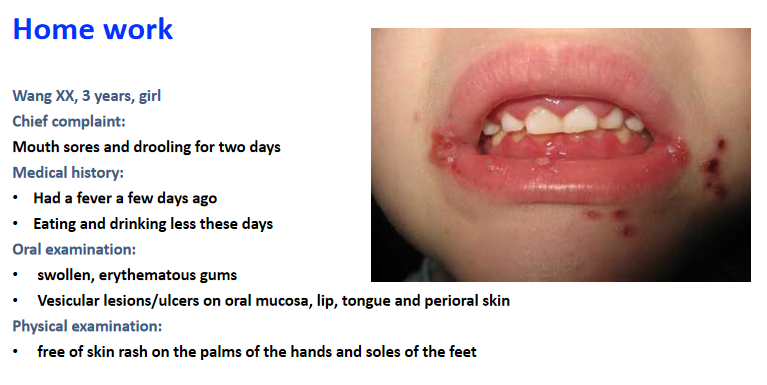
Homework(please send your answers to email)

Questions: 
1)Please give the diagnosis. 
2)Please give the common pathogen of the disease.
3)Please give your treatment plan.
4)Please give the purposes of treatment for this type of disease.