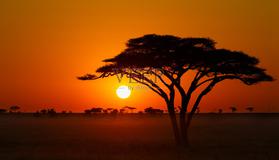
A Sunrise on the Veld
By Doris Lessing
I. About the Author
Doris Lessing (1919-): a Zimbabwean-British novelist, poet, playwright, biographer and short story writer.
* Born in Iran, then known as Persia, to a British family ;
* The family moving to then British colony of Southern Rhodesia (now Zimbabwe) in 1925;
* Leaving school at 14;
* Two marriage failures (in 1943 & 1949);Moving to London in 1949;
* Nobel Prize in 2007;
* Major writings: The Grass is Singing (1950), The Golden Notebook (1962), Love, Again (1996), Alfred and Emily (2008)
II. A Sunrise on the Veld
1. The story
A young boy, very sure of his own power, goes hunting early one morning. He watches a young buck being eaten by a swarm of black ants and is overwhelmed by a feeling of rage, misery and protest and reaches a new understanding of life .
* Theme: In the form of an initiation story, the story tries to show that there are many things in life that one could not control, and one must learn to accept the reality.
2. Structure of the story
* A distressing journey from innocence to knowledge and experience;
* The boy's pride in his own power --- his morning hunting excitement --- the scene of death --- the boy's new understanding of life and of himself.
3. Characterization
* The growth of a fifteen-year-old boy from innocence to knowledge and experience;
* Specific details for the characterization: the boy's innocent pride in his ability to control himself (or even the world), his excitement in the morning hunting, his rage and protest at the scene of death, his further understanding of life.
4. Point of view
* Third-person narrator: keeping a distance from the protagonist to create an objective and seemingly indifferent attitude about the matter;
* First person (direct speech) in revealing the protagonist's thought: vividness and directness
5. Setting
* A veld (as the title indicates, in Southern Africa);
* Typical features: grass, trees, rocks and river; extreme cold and heat; duiker, bucks, birds and ants
6. Language and Style
* Specific and concrete details in expressive language --- to make the scene realistic and vivid:
E.g. Light: glow, glitter, sparkle, glistening, shine ;
Movement: hurry, scurry, jerk, frisk, crush, flow, trickle;
* Use of symbols: e.g. the death of the buck --- reality of life;
* Effective sentences: concise and vivid descriptions;
* Figures of speech: exaggeration, simile, parallelism, comparison

