专业外语

李法云

目录

  • 1 PART I:INTRODUCTION
    • 1.1 Importance
    • 1.2 The Logic of Science
    • 1.3 Further Reading
  • 2 PART II: CRASH COURSE IN ENGLISH FOR ECOLOGY MAJORS
    • 2.1 History of Earth
    • 2.2 Population Ecology
    • 2.3 The Population Growth
    • 2.4 Community Ecology (1)
    • 2.5 Community Ecology (2)
    • 2.6 Ecological Succession
    • 2.7 Ecosystem Ecology
    • 2.8 Hydrological Cycle and Carbon Cycle
    • 2.9 Nitrogen and Phosphorus Ecology
    • 2.10 Human's Impact on Environment
    • 2.11 Pollution
    • 2.12 Conservation  Ecology and Restoration Ecology
  • 3 PART III: PRINCIPLES OF ECOLOGY
    • 3.1 Climate and the Distribution of  Life on Earth
    • 3.2 Physiological Ecology
    • 3.3 Population Growth
    • 3.4 Interspecific Competition
    • 3.5 Ecological Communities
    • 3.6 Energy and Matter in Ecosystems
    • 3.7 The Factors Affecting Biodiversity
  • 4 PART IV: PAPER WRITING
    • 4.1 How to Write a “Good” Paper
    • 4.2 The Writing Process
    • 4.3 Format and Other Technical Details
    • 4.4 General Considerations
    • 4.5 Title
    • 4.6 Abstract
    • 4.7 Introduction
      • 4.7.1 Establishing the Field and Its importance
      • 4.7.2 Citing other research in the field
      • 4.7.3 Pointing out a gap in the field knowledge
      • 4.7.4 Giving a preview of what you did in the present study
      • 4.7.5 Alternate form
    • 4.8 Research journal article--Experimental Section/Model Description
    • 4.9 Research journal article--Results
    • 4.10 Research journal article-Discussion
    • 4.11 Research journal article--Acknowledgments and References
    • 4.12 Research journal article--Legends for tables and illustrations
    • 4.13 Oral Presentation
    • 4.14 Writing to the Editor
    • 4.15 Lecture
    • 4.16 AI helps academic
Lecture

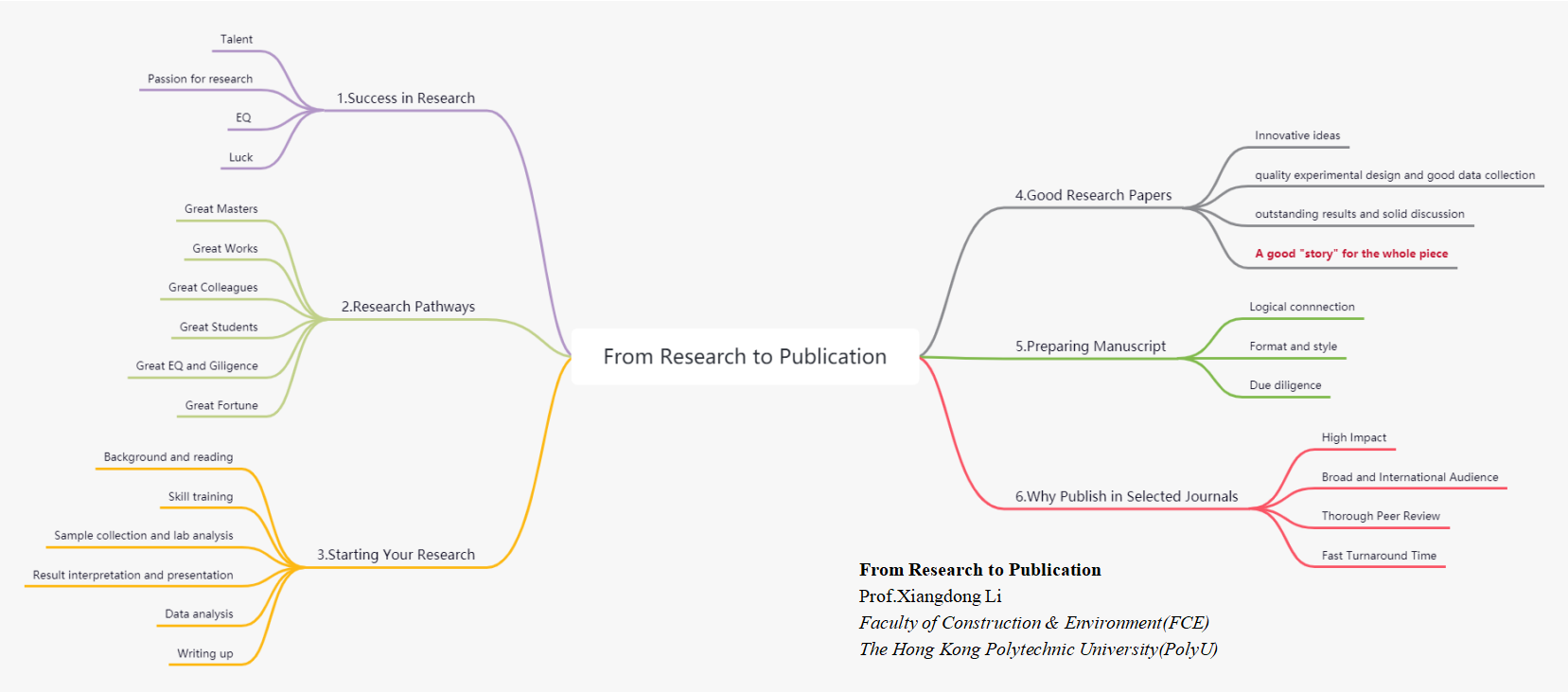
从研究到论文-以环境领域为例(香港理工大学 李向东)

报告概要:

1、Research pathways 研究途径:容许自由探索,支持及鼓励的文化。

2、Starting research 开始研究:

背景阅读

技能培训

样品采集和实验室分析

结果陈述和解释

数据分析

写作(期刊论文papers和毕业论文thesis)。

3、Good research papers 好的研究论文:

       (1)出色的实验结果还需要扎实的讨论,要有清晰的思路逻辑,如何从123

       (2)读到好的文章就像读好的小说,从开头到中间到结尾,对自己的思路会有好的影响。

4、Preparing manuscript准备稿件:

(1)摘要是论文的亮点,是编辑阅读最多的部分,也是送审的判断依据。

(2)追求完美,注意细节。

(3)两个“3”

                    给导师前自己阅读3遍。if you don’t care, whocares?

                    提交给期刊前作3-5次修订。

5、Determing Appropriate Fit 确定稿件是否适合:

(1)稿件是否适合期刊规定的范围和质量;

(2)研究主题是否合适?核心主题(core topics)、边缘主题(edge topics);

(3)高质量的图文,图表质量常被忽视!

(4)增强分析。预想审稿人会提出的问题,在文章中体现支撑材料。

思维导图: