Types of Hybrid Electric Vehicles (I)
New energy vehicles refer to using electricity and natural gas as the source of power instead of conventional fuel such as gasoline and diesel. New energy vehicles include electric vehicles (EV) and natural gas vehicles (NGV). Just as its name implies, EV uses electricity as major power source and NGV uses natural gas as power source. Both of these kind vehicles belong to new energy vehicles (NEV).
EV is divided into three categories: hybrid electric vehicle (HEV), battery electric vehicle (BEV) and fuel cell electric vehicle (FCEV).
Hybrid electric vehicle (HEV)
Generally, HEV of this kind has two power drive devices: one is an internal combustion engine (ICE) and the other is an electric motor.They can provide maximum power and fuel economy with minimume missions. Nowadays, the electric motor, generator and battery pack all work together in a car on behalf of the hybrid concept.
According to the structures, HEV is divided into three types: series hybrid, parallel hybridand series-parallel hybrid.
Series hybrid
In a series hybrid car, the engine and the electric motor are connected together in a series. It works in the following manner: the engine converts the fuel from the fuel tank into the mechanical energy to drive the generator, generating electric power. Then the generator delivers the electric power through the inverter to the electric motor which moves the car. There is no mechanical connection between the engine and the drive wheels, so the engine never directly drives cars (see Fig.8-1).
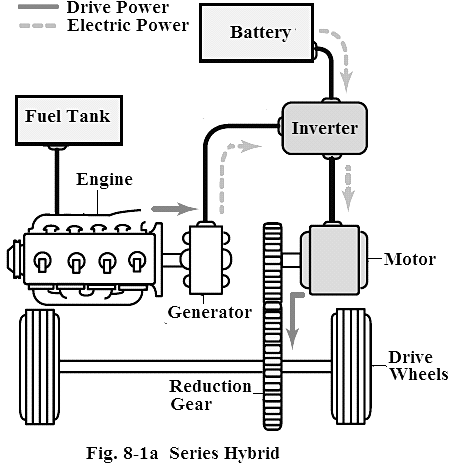
When the series hybrid car is in the condition of starting, accelerating, or climbing, the engine, the generator and the battery together supply electric power to the electric motor. When the car is at low speed, coasting or idling, only the battery offers the electric power to the motor. If the battery is short of electricity, the engine and generator recharge the battery.
Parallel hybrid
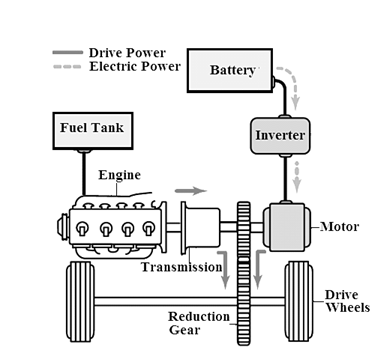
In a parallel hybrid car, the fuel tanks upplies the fuel to the engine and the battery supplies the electric power to the electric motor. Both of the engine and the electric motor connect to the transmission in parallel ( see Fig.8-2).The engine drives the car when cruising, and accelerating or climbing, the motor assists the engine to provide the driving force for the transmission which turns the drive wheels. In a parallel hybrid car, the electric motor works not only as a driving motor but also as a generator which charges the battery to store the electricity for later use.
Series-parallel hybrid
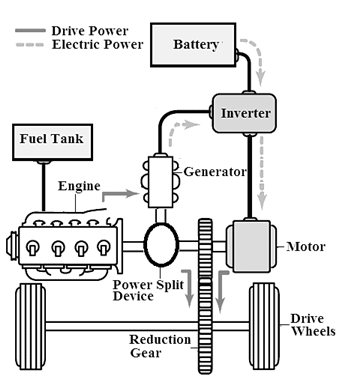
Series-parallel hybrid, also called power-split hybrid, combines the series hybrid system with the parallel hybrid system in order to make full use of the benefits of both systems. The electric motor is used to drive the car at low loads and low speeds. The engine is used when the loads and speeds increase. Both of the engine and the electric motor can work individually, or together to drive the car depending on the power required. In addition, the engine can drive the generator at the same time to produce electricity to charge the battery when necessary (see Fig.8-3).
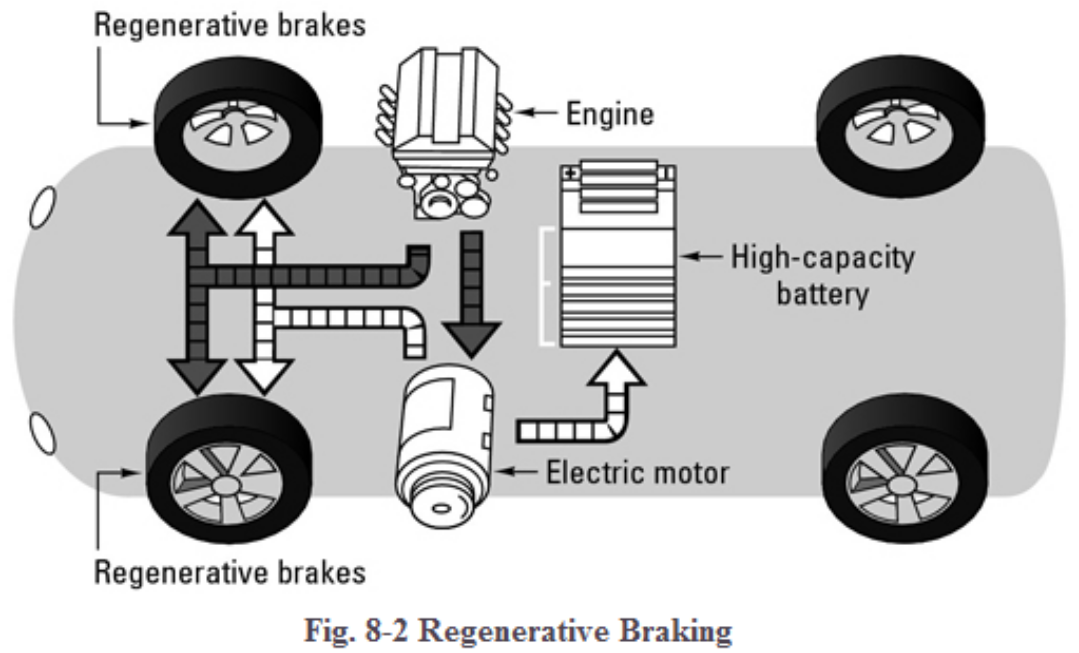
The three types of HEV above all include the regenerative braking feature. The regenerative braking is an energy recovery mechanism which converts wasted energy from braking into electricity and stores it in the battery. In the regenerative braking, the electric motor reverses direction so that the rotating car wheels can turn it, producing electricity to store in the battery just like a generator (see Fig.8-4).
译文:
课文A电动混合动力汽车类型 (I)
新能源汽车是指利用电和天然气作为动力源而不是传统的燃油(如汽油和柴油)。新能源汽车包括电动汽车(EV)和天然气汽车(NGV)。顾名思义,EV用电作为主要动力源,NGV用天然气作为动力源。这两种都属于新能源汽车(NEV)。
EV分为三种类型:油电混合动力汽车,纯电动汽车和燃料电池汽车。油电混合动力汽车(HEV)
一般来说,HEV这种车有两个动力驱动装置:一个是内燃机(ICE),另一个是电动机。它们都能提供最大的动力和燃油经济性,且排放最小。当今,一辆汽车上有电动机、发电机和蓄电池组相互配合工作就代表了混合概念。
HEV按结构分,有三种形式:串联式、并联式和混联式。
串联式混合动力汽车
在串联式混合动力汽车上,发动机和电动机是以串联形式连接的。其工作方式是:发动机将燃油箱的燃油转变成机械能,驱动发电机产生电能。然后发动机将电能通过逆变器输送给电动机来使汽车行驶。在发动机和驱动轮之间没有机械连接,因此,发动机不能直接驱动汽车(见图8-1)。
串联式混合动力汽车在起动、加速或爬坡时,发电机和蓄电池共同给电动机供电。当汽车在低速行驶或滑行或怠速时,只有蓄电池给电动机供电.如果蓄电池电量不足时,发动机和发电机都会给蓄电池充电。
并联式混合动力汽车
在并联式混合动力汽车.上,燃油箱给发动机提供燃油,蓄电池给电动机提供电能。发动机和电动机是以并联形式连接到变速器上的(见图8-2)。在巡航加速或爬坡时,由发动机驱动汽车,电动机辅助发动机给变速器提供驱动力以使驱动轮转动。在并联式混合动力汽车上,电动机不仅起驱动电机的作用,还起发电机的作用给蓄电池充电并储存电能以备后用。
混联式混合动力汽车
混联式混合动力汽车也称为动力分配式混合动力汽车。它将串联混合系统和并联混合系统相结合,充分发挥两个系统的优势。电动机在汽车低负荷和低速时驱动汽车。发动机在汽车负荷增大和提速时驱动汽车。发动机和电动机可以根据所需的动力单独驱动汽车或共同驱动汽车。此外,发动机在必要时还可以同时使发电机发电,给蓄电池充电(见图8-3)。
以上三种类型的混合动力汽车都具有再生制动的特点。再生制动是能量回收装置,是将制动时产生的废能量转变成电能,并储存在蓄电池中。再生制动工作时,电动机反方向转动,旋转的车轮使电动机转动,如同发电机一样发电并储存在蓄电池中(见图8-4)。

